
European defense cooperation has a familiar shape: a summit, a joint statement, a target date somewhere past everyone’s retirement. The hardware part usually stays on paper. Which is why the thing standing in a shipyard on the Estonian island of Saaremaa deserves a closer look than it’s getting.
It’s the hull of a 45-meter (148-foot) warship, presented to officials on May 21 at the Baltic Workboats yard in the village of Nasva. The program behind it is called EUROGUARD, it runs on a €95 million budget funded mostly by the European Defence Fund, and the ship is designed to sail with ten people aboard, six, or none at all.
The design review is done, the hull is standing, and the full technical picture, sensors and weapons included, surfaced in early July via Naval News. Sea trials in the Baltic are expected this fall. So while the argument over whether Europe can actually build common defense hardware keeps running in Brussels, ten countries went ahead and welded some.
One hull, ten countries, 27 organizations
The May 21 event at Nasva packed three milestones into one day: the program’s Critical Design Review, the physical presentation of the prototype hull, and a virtual demonstration of the ship’s systems. Consortium partners and government representatives from the participating countries showed up to see it.
“The Critical Design Review confirms that the EUROGUARD system is moving from design to operational reality,” said Project Coordinator Martin Laur in the Baltic Workboats statement. In defense-program language, that’s the moment a project stops being drawings and starts being a boat.
The consortium behind it is genuinely sprawling. Baltic Workboats coordinates 27 organizations from ten European countries, per the company, and the roster reads like a European naval industry directory: Damen, Fincantieri, Naval Group, Navantia, Kongsberg, Leonardo, Thales, Safran, plus research outfits like TNO and TU Delft. Getting that crowd to agree on a single hull form might be the most impressive engineering achievement in the whole program.
The money is European too. The European Commission’s factsheet puts the estimated total cost at €95,021,353.98, because Brussels does not round. The EU covers up to €65 million through the European Defence Fund, with participating countries and industry putting in the remaining €30 million. Baltic Workboats calls it one of the largest projects the fund has ever backed.
So what exactly did they build?
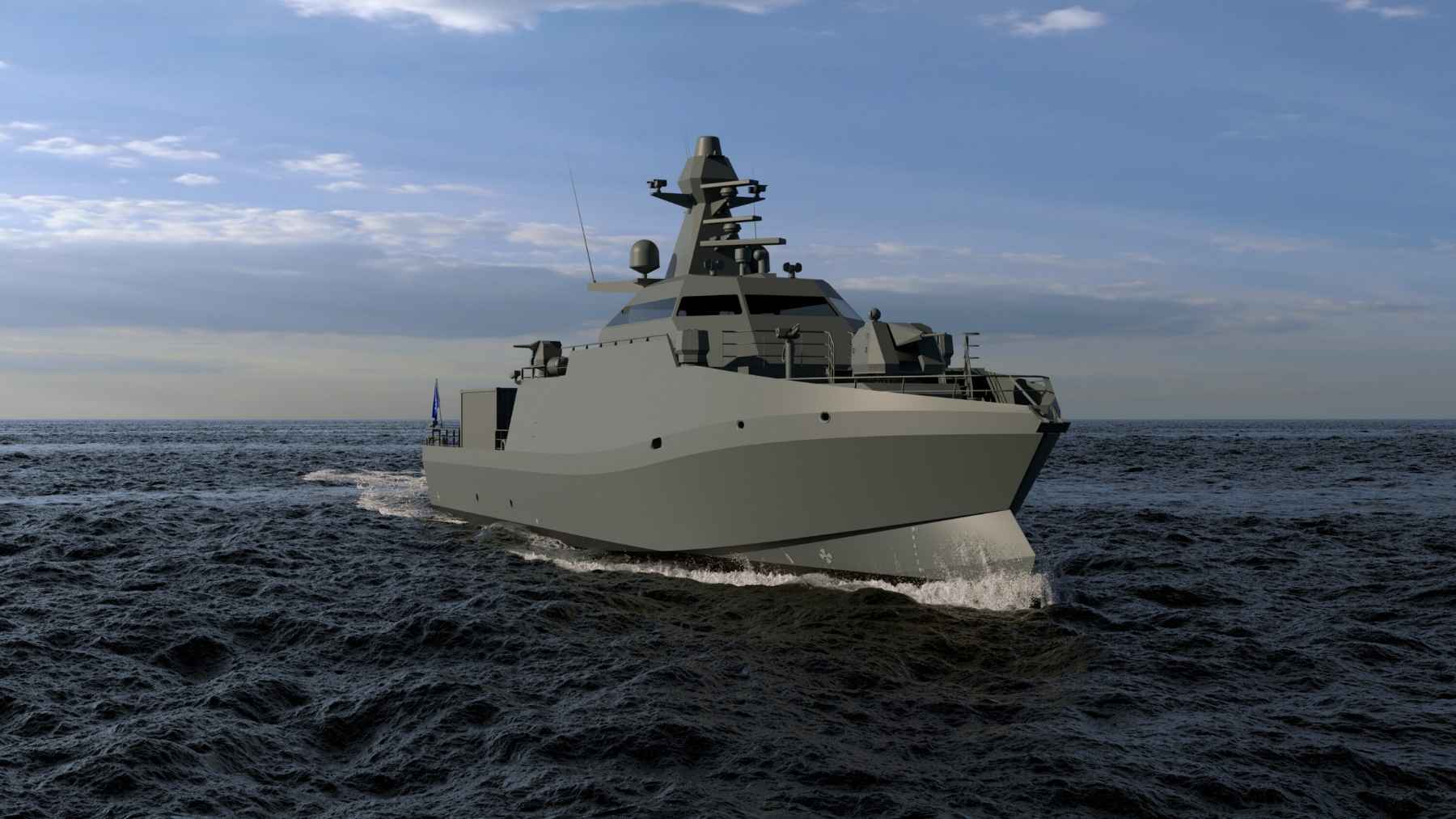
The M-SASV, short for Medium Size Semi-Autonomous Surface Vehicle, measures 45 meters long with a 9.4-meter (31-foot) beam and a 3-meter (10-foot) draft, according to the specifications published by Naval News. Top speed is around 25 knots, and maximum range sits at 2,000 nautical miles, roughly 2,300 land miles.
Empty, it displaces about 335 metric tons. Fully loaded, 500. Up to 100 metric tons of that is payload capacity, which is the number that matters most here, and I’ll get to why in a second.
The hull is aluminum, and it’s a heavy one for its size. Jüri Saska, the former commander of the Estonian Navy who now works at the shipyard as the project’s manager, told Estonian public broadcaster ERR that the ship can carry up to five 20-foot containers for testing different capabilities.
Then there’s the crew math, which is the part that makes this ship interesting. It can accommodate up to 20 people. The standard crew is 10. The lean-manning configuration is six. And the whole architecture is built for remote control and unmanned operation, so the correct answer to “how many sailors does it need” is somewhere between ten and zero, depending on the mission and how much you trust the software that day.
It changes jobs by swapping containers
A conventional warship is built around its mission. This one is built around a payload bay, and the mission arrives in boxes.
The planned module list covers minehunting, intelligence and surveillance, anti-submarine warfare, anti-surface warfare, seabed monitoring and critical infrastructure protection, search and rescue, environmental monitoring, and deploying and controlling other drones. Same hull, different container, different job. One week it’s combing the bottom for mines, the next it’s a mothership for smaller unmanned craft.
The fixed equipment is not an afterthought either. Per Naval News, the sensor suite includes a Leonardo SSR X400/6 surveillance radar, a Leonardo TMMR 3D radar, a GEM Elettronica electro-optical system, an electronic warfare suite from ELT Group, a hull-mounted sonar, and a drone detection system called Shark from Estonia’s own Marduk Technologies. Communications run from HF radio all the way to 5G, plus a Kongsberg HiPAP 502 acoustic link for talking to things underwater.
For self-defense, the standard fit is one Leonardo LIONFISH 30 remote weapon station with a 30mm gun, two 12.7mm remote stations, and two SNAPDRAGON decoy launchers. This is not a missile boat. It’s armed to survive, not to start anything.
The Baltic seabed is the reason this exists
None of this came out of nowhere. For two and a half years, the Baltic has produced a steady rhythm of damaged infrastructure, and there always seems to be a commercial ship with a dragging anchor somewhere nearby. The Balticconnector gas pipeline was torn open in October 2023, the C-Lion1 and BCS East-West data cables were severed in November 2024, and NATO ended up standing a permanent patrol over its own seabed.
That’s the same stretch of water where a US Navy underwater drone spent two weeks mapping the seabed off Latvia during this year’s BALTOPS exercise, and where Germany now operates a submarine-sized underwater drone built to hunt subs and find mines for weeks at a stretch. The seabed-protection module on EUROGUARD’s list is not a hypothetical. It’s the neighborhood.
Estonia driving the program makes sense in that light. It’s a small country with a long coastline, a front-row seat to the cable problem, and now a shipyard leading a pan-European naval project. Baltic Workboats has been building vessels in Nasva for 25 years, close to 300 of them, with more than 200 employees and about €70 million in annual revenue, per ERR. This is the first full warship the company has ever built and outfitted itself. Roughly a third of the program’s budget stays in Estonia.
Nobody has ordered one, and that’s sort of the point
One detail separates EUROGUARD from every normal naval program. “This ship does not have a client,” Saska told ERR, apart from the framework document it’s being built under. No navy has signed for it. No admiral is waiting on a delivery date.
That sounds like a flaw and is actually the design. EUROGUARD is a demonstrator, a €95 million answer to the question of whether European navies could share a common semi-autonomous platform instead of each country designing its own. The EU funds the prototype, the consortium proves the technology, and member states decide later whether they want production versions. The keel went down on May 27, 2025. The program launched at the end of 2023 and runs through the end of 2027.
The American approach to the same problem looks very different. DARPA’s USX-1 Defiant deleted the crew from the blueprints entirely, a 240-ton ship with no bunks and no doors sized for people. Europe went the other way: build a ship that can carry ten sailors, six, or nobody, and let each navy pick its own comfort level with the empty bridge.
Whether that flexibility is wisdom or committee-driven hedging is the question the next 18 months will answer. Sea trials are expected this fall in Estonian waters with the Estonian Navy, and Saska says the autonomous navigation gets its real test in 2027. Until then, the score is simple: Brussels has held a lot of meetings about European defense. Saaremaa has a hull.