
Nuclear control rooms are one of the last corners of America where analog never died. Dials, knobs, chart recorders, switch panels that look lifted from a 1960s film set. And there’s a logic to it: you can’t reach a dial through a network, so there’s nothing for a hacker to grab.
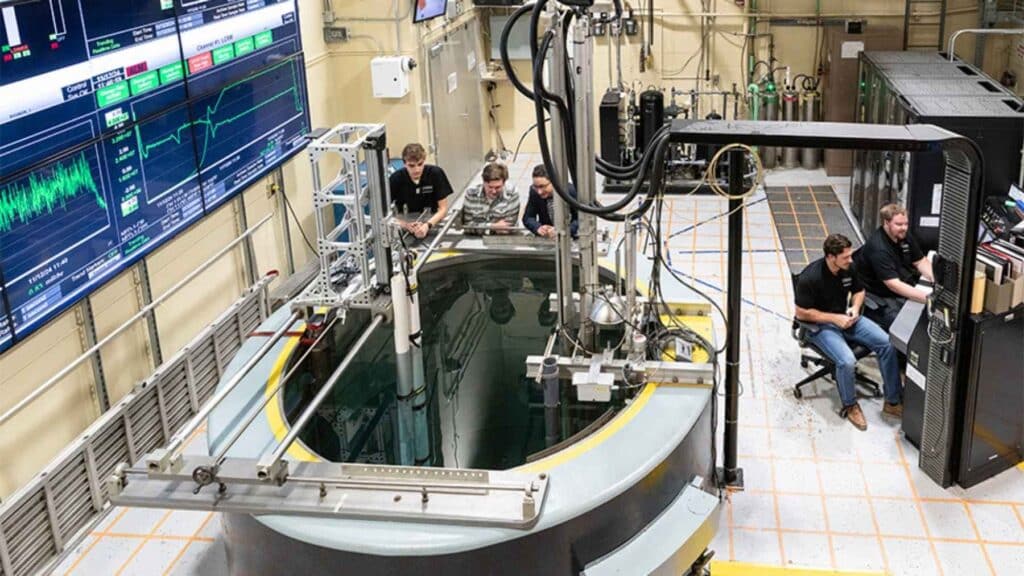
But in a basement at Purdue University in West Lafayette, Indiana, sits a reactor that threw all of that out. PUR-1 runs on computer screens, keyboards and ethernet cables, and it’s the only reactor the US Nuclear Regulatory Commission has ever licensed with fully digital instrumentation and controls.
On July 10, Purdue went public with the reactor’s new job. PUR-1 has started serving as the nation’s first reactor test bed for working out how digital communication, AI tools and cybersecurity methods would hold up at scale in advanced reactors. Which makes this small machine the place where America finds out whether a reactor and a keyboard can be trusted together.
The only reactor in America you operate from a keyboard
PUR-1 stands for Purdue University Reactor Number One, and it has been sitting under campus since 1962. It’s a pool-type research reactor, the only operating reactor in the state of Indiana, and it tops out at 10 kilowatts of thermal power. Purdue’s own comparison: enough to run about 10 microwaves.
For scale, a single commercial unit like the Slovak reactor that just swallowed eight million uranium pellets powers hundreds of thousands of homes. PUR-1 powers experiments. Data is the entire product.
In 2019, Purdue ripped out the reactor’s analog nervous system and replaced it with fully digital instrumentation and controls, with backing from the Department of Energy’s Office of Nuclear Energy. Seungjin Kim, who heads Purdue’s School of Nuclear Engineering and directs the facility, has said the point of the switch was to show the American nuclear industry that digital could actually be done here.
Other countries already run reactors with digital controls, so the technology itself isn’t exotic. What’s exotic is an NRC license for it. Across the rest of the US fleet, digital capability mostly stops at sensors. The controls stay analog.
The payoff shows up in the readings. In the analog days, operators could pin the reactor’s power level to within about 5%. “Now we can tell what the power is down to a fraction of a watt,” says True Miller, PUR-1’s reactor supervisor and a nuclear engineering PhD student at Purdue.
Its digital twin predicted the core’s behavior with 99% accuracy
Since 2023, PUR-1 has had a double. The lab of Stylianos Chatzidakis, an assistant professor and the facility’s associate director, built a digital twin of the reactor: a physics-and-data simulation that ingests live readings from PUR-1’s sensors and runs AI-driven predictions on them. His students work with it from a lab right next to the reactor facility.
The twin lets researchers experiment on a copy of the reactor without touching the operation of the real one. There’s plenty to copy, too. PUR-1’s control system exposes more than 2,000 monitorable parameters, and Purdue’s researchers found that 67 of those signals do most of the work of describing how the system behaves.
Kim calls Purdue the only university anywhere with a digital twin of a true nuclear reactor fed by actual reactor-generated signals. The headline number backs him up. In a study published in Scientific Reports, Chatzidakis and collaborators from Purdue and Argonne National Laboratory used the twin to test a machine-learning algorithm built to improve the performance of small modular reactors.
The algorithm learned the physics behind a measure of how steadily the reactor produces power. Then it predicted changes in that measure over time with 99% accuracy.
That precision matters because of where the industry wants to go. Small modular reactors and microreactors are designed to be parked in remote places and, in many designs, run from a shared control center a long way off. Chatzidakis has described the target scenario as staff in a control room hundreds or thousands of miles away, watching a whole fleet at once, and says PUR-1 can put an actual number on how much that setup would cut operating and maintenance costs.
Nuclear already trusts machines with its worst rooms. Japan’s 4.6-ton robotic arm at Fukushima exists because no human can ever enter that space. The remote-reactor version of the idea is friendlier: nobody has to live next to a microreactor in the middle of nowhere just to watch it.
So could somebody actually hack it?
This is the question the whole test bed exists to answer, and it’s the honest tension in the story. Analog controls survived this long partly because a dial has no attack surface. The moment a reactor speaks ethernet, it does, and remote operation multiplies it.
Purdue’s answer is to study the problem on a 10-kilowatt teaching reactor instead of discovering it on a full-size power plant. In a technical letter report published by the NRC, Chatzidakis and other Purdue researchers used real-time PUR-1 data to test whether AI and machine-learning models could tell normal cybersecurity states from abnormal ones inside a nuclear system.
The models caught the abnormal events. The point, per Chatzidakis, is that the industry can lean on that document as a reference while it builds machine learning into its own cyber defenses, with the regulator’s name already on the cover.
None of this hands anyone a certificate that says unhackable. What it produces is real data from a live core, which is the one thing this class of question has never had. Until now, the answers came from computer simulations and lab demonstrations. PUR-1 is the first US reactor where the software meets an actual operating core.
Quantum encryption is next on the bench
The lab’s other project reads like science fiction with a docket number. Chatzidakis’s group has been studying whether quantum encryption could protect the communications flowing in and out of a reactor. His case for it is blunt: no computer can break encryption built on quantum principles, and he includes supercomputers and quantum computers in that.
So far the work has run on real PUR-1 data feeding simulations of how quantum-secured channels would behave, published in the journal Nuclear Technology, plus a paper the group posted to arXiv on demonstrating quantum-secure communications in a reactor environment. The next step is hardware: actual quantum equipment encrypting signals coming off PUR-1, accessed through the digital twin.
If it works, remote reactor operation gets a channel that stays sealed even in a future where quantum computers chew through today’s encryption. If it doesn’t, better to find out on 10 kilowatts.
A second twin, a full-scale control room and a reactor named PUMA
Purdue isn’t stopping at one copy. The School of Nuclear Engineering is building a second digital twin of PUR-1 inside a new full-scale reactor control room, and the same room will house a digital twin of PUMA, the Purdue University Multidimensional Integral Test Assembly.
PUMA is a scaled-down model of an advanced light-water reactor, and it’s due for its own digital instrumentation and controls upgrade to support small modular reactor research. The money comes from the DOE’s Office of Nuclear Energy through a $6 million award to a consortium led by Purdue.
The reactor keeps its day job too. Purdue students can sit an NRC exam and walk away licensed to operate PUR-1, and the facility pulls in about 1,500 visitors a year, from school tours to nuclear-sector reps and policymakers.
None of this flips a switch for the rest of the fleet. No US commercial plant is about to trade its panels for keyboards, and licensing digital controls on a gigawatt-scale reactor is a far heavier regulatory lift than doing it on a machine with the output of 10 microwaves.
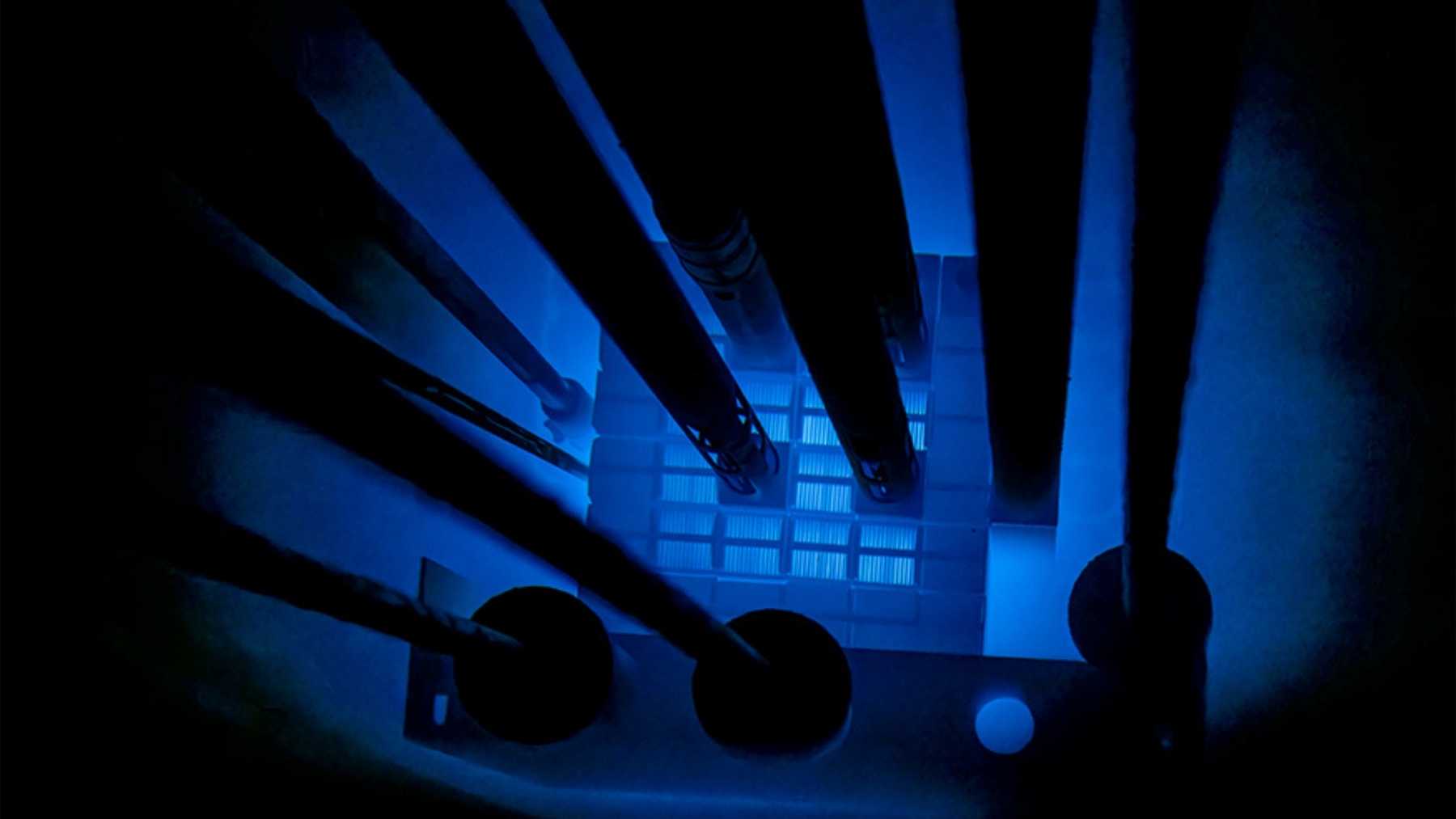
But the features being tested here are the ones the next generation of American reactors is being designed around: digital controls, remote links, software watching the core. It’s the same wave that has a fusion company selling a fission reactor while it waits for fusion. Somebody had to plug the first reactor into ethernet and see what breaks. Turns out it lives in a basement in Indiana, and it glows blue in the dark.