
- 5 MONTHS AGO · INDUSTRYRussia just started building its ninth 13,800-ton Yasen-M nuclear attack submarine, a hypersonic missile carrier crewed by just 64 sailors and designed to hit land from so far out it never has to swim through the chokepoint NATO spent decades guarding
- 5 MONTHS AGO · INDUSTRYChina just craned 319 tons of nuclear containment into place in a single pick, a steel ring with its ventilation ducts already strapped on, skipping a step nobody skips — on a site running four reactors through four different stages of life at once, with two more waiting behind them
- 4 MONTHS AGO · INDUSTRYThe exploding drone boats that rattled Russia’s Black Sea fleet just landed an American factory, 26 feet of hull hauling 1,430 pounds of payload 800 nautical miles on a single tank of fuel, set to be built by the hundred in Oregon
- 1 MONTH AGO · INDUSTRYA million pounds of explosives shook 1.3 million tons of iron ore loose in a Minnesota pit, six times the mine’s first production blast, at a plant that sat half built for a decade, and its pellets are headed for a planned 10-million-ton steel mill in Iowa
- TODAY · THIS ARTICLEA 400,000-square-foot nuclear building left unfinished in South Carolina has been stripped of its ducts, piping, tanks and gloveboxes to be rebuilt as a factory for at least 50 plutonium cores a year, and a structure first due a decade ago now won’t be done for another 12 years
What do you do with a nuclear fuel factory that never made any fuel? If you’re the Department of Energy, it turns out you start pulling its insides out and rebuild it as a completely different kind of plant.
That’s what’s going on at the Savannah River Site (SRS), near Aiken, South Carolina. If the name rings a bell, it’s probably because we recently covered a 375-foot-wide concrete tank there that got filled to the brim with nuclear-waste grout. This time the star is a building.
On October 15, the Department of Energy (DOE) approved the performance baseline for the Main Process Building of the Savannah River Plutonium Processing Facility and authorized full-scale construction. In agency-speak, that’s Critical Decision 2/3. Basically, it’s the moment the design gets locked in and the project commits to a price and a finish date it’ll be judged against, and the Savannah River Site’s own release says it formally ends the design phase.
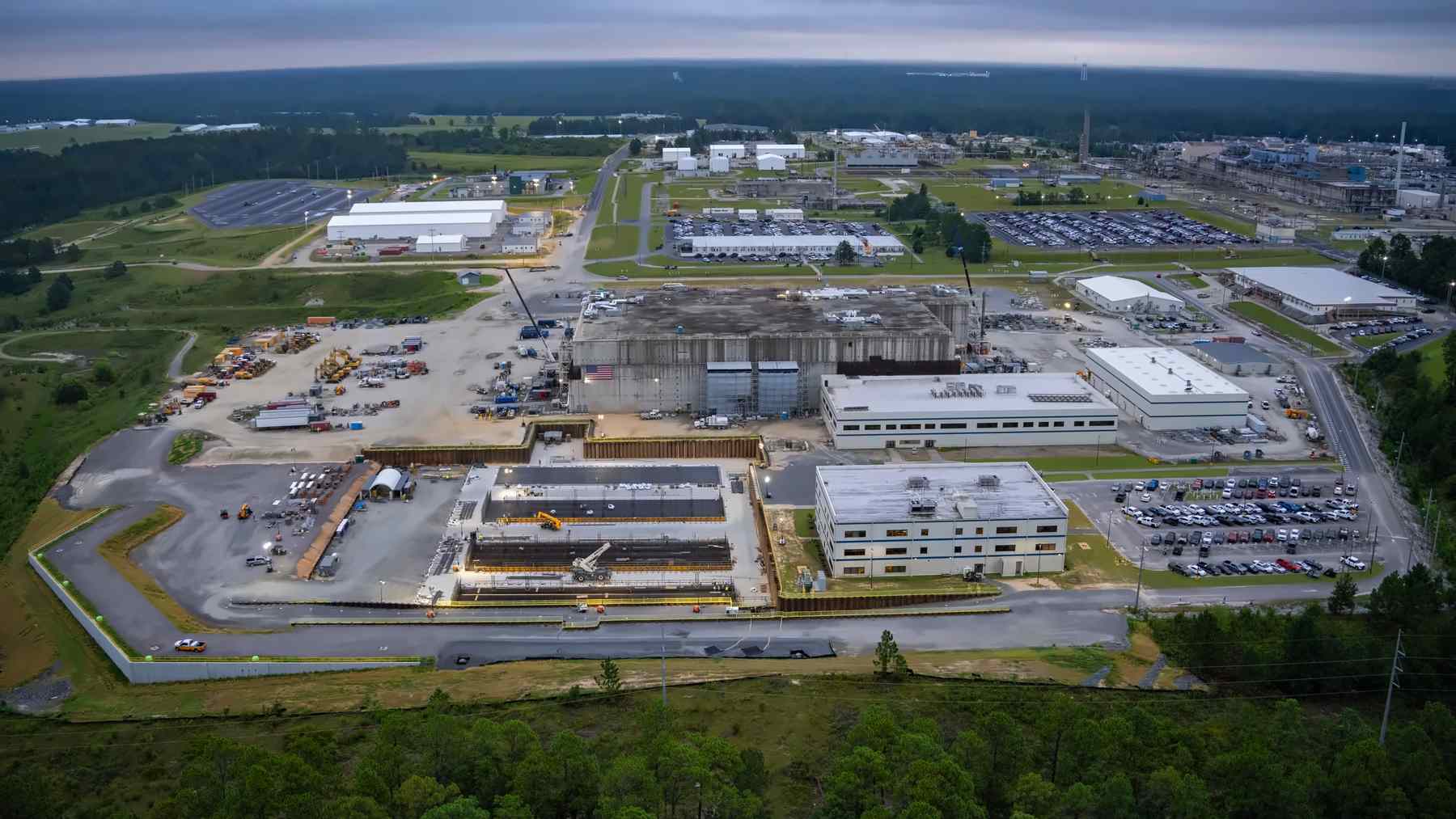
The building in question is Building 226-F. It’s the unfinished shell of the old Mixed Oxide Fuel Fabrication Facility, which most people just call MOX.
NNSA’s October 16 announcement and the site’s October 19 release both left the price tag and the finish date out. Those came later. The National Nuclear Security Administration, the DOE agency that runs the project, confirmed to ENR on November 9 that the Main Process Building’s baseline is $23.5 billion, with completion set for December 2038.
So what’s a plutonium pit?
A pit is the official name for the plutonium core of a nuclear weapon. The name works a lot like the pit in a peach: it’s the hard bit at the center that everything else gets built around.
This plant’s job is to make at least 50 of them a year, according to ENR. I’m going to leave the weapons side of it there, because honestly I find the building a lot more interesting.
The MOX plant never got finished
MOX stands for mixed oxide, a reactor fuel that blends plutonium and uranium. The plan was to take surplus weapons-grade plutonium and turn it into fuel that commercial power plants could burn, which is a pretty tidy way to get rid of something nobody wants lying around. We touched on the building’s second life briefly back in August, in a piece about a lead-cooled reactor whose developer wants plutonium fuel made in America.
Construction started in 2007, according to the Government Accountability Office (GAO). Here’s where the dates get a little messy, though. ENR and World Nuclear News both put the original start-up target at 2016, while the DOE inspector general’s audit of the project lists a projected start of operations in fiscal 2017.
Either way, it didn’t happen. By fiscal 2016, DOE’s own estimate had the plant costing about $17.2 billion to finish, with operations starting as late as 2048. NNSA terminated the contract in October 2018, after spending nearly $6 billion, according to GAO.
Why keep the shell?
You might be wondering why nobody just knocked the thing down and started fresh. It mostly comes down to concrete.
The site’s fact sheet calls Building 226-F “an existing seismically-qualified structure,” which basically means it’s already been designed and built to ride out an earthquake. Getting a nuclear building to that point is arguably the slowest and priciest part of the whole job, so a shell that’s already standing is a pretty big head start.
And it’s a big shell. SRS fact sheets put it at more than 400,000 square feet of Hazard Category-2 space. That’s DOE’s label for a facility holding enough nuclear material that an accident could have serious consequences on the site itself. An earlier SRS fact sheet adds that the structure is about 73 feet tall, with three floors and a 50-year design life, and its interior walls are reinforced concrete to shield the people working inside.
What doesn’t carry over is the stuff inside. NNSA says the leftover equipment can’t be used for the new mission, and it’s safe to assume a fuel line and a pit line don’t move plutonium around the building the same way.
What’s already been ripped out?
Quite a lot, from the looks of things. An NNSA spokesperson told ENR that early site work has already pulled out the pumps, tanks, piping and gloveboxes, along with HVAC ductwork, electrical conduit and the coatings on the walls. ENR adds that the early work packages included tearing out wall sections and old equipment.
If you’ve never seen a glovebox, it’s a sealed steel cabinet with thick rubber gloves built into the side. Workers put their hands into the gloves and handle radioactive material inside without touching it or breathing the same air.
Funnily enough, the new plant needs a lot of them. GAO reported that as of June 2025, Fluor had issued 243 of the 320 planned glovebox contracts for the Main Process Building. So the old gloveboxes came out, and a whole new set is being ordered to go back in. I’d guess the MOX-era boxes just weren’t built for what this plant is going to do. That glovebox count is also from mid-2025, and I couldn’t find a newer one.
Fluor is designing the building itself, while Merrick & Co. is designing the gloveboxes and process equipment, according to ENR.
So why does it take until 2038?
Part of it is the sheer size of the job. The October 15 approval covers more repurposing work inside the old MOX structure, plus underground utilities and supporting infrastructure, according to ENR. NNSA says the whole complex covers 160 acres of the site, with auxiliary buildings around the main plant.
SRS expects to bring on more than 3,000 new workers when construction peaks, and to need over 2,000 people to run the place once it’s operating.
The price has moved a lot, too. DOE approved a preliminary range of $6.9 billion to $11.1 billion in 2021, with completion somewhere between October 2031 and September 2035, according to GAO. The baseline NNSA confirmed to ENR on November 9 is $23.5 billion and December 2038. That’s a bit more than double the top of the old range and a little over three years past its latest finish date, which is, frankly, pretty on-brand for big nuclear construction.
Which means a structure that was supposed to start up around 2016 is now looking at a finish date about 12 years from now. One thing I can’t tell you is when the first pit actually comes out. December 2038 is the completion date for the Main Process Building, and I couldn’t find a separate official date for when production starts.
The next milestone on the site’s calendar is smaller. SRS expects to finish its High-Fidelity Training and Operations Center, essentially a practice facility where future pit workers learn the job, in 2028, a decade ahead of the Main Process Building’s December 2038 target.
Credit: U.S. Department of Energy / Savannah River Site
 A 591-foot bulk carrier that can load about 40,000 tons struck a 97-year-old drawbridge on the Delaware River while its span stood open for ships, and the bridge then stayed stuck in the air, backing up cars on both banks between Philadelphia and New Jersey, with no one hurtIndustry · 3 hours ago
 An Idaho silver mine flooded to about its 3,400 level traded the hoist it had used for 110 years for one that lifts 3,500 tons a day, and the shaft it hangs in is the only way down to a deposit that gave up about 365 million ounces of silver and that its owner wants back in productionIndustry · 21 hours ago
 An 89-year-old lock gate on the upper Mississippi was lifted out by a 500-ton floating crane and replaced in a 12-hour closure, one of eight steel leaves up to 33 feet tall swapped in four closures at a lock that passes close to 5,000 barges a yearIndustry · 1 day ago