
Lake Michigan quietly steals an hour from anyone who crosses it heading east. Wisconsin runs on Central time and most of Michigan runs on Eastern, so if you’ve ever taken the Lake Express ferry from Milwaukee to Muskegon, you’ve probably watched your phone jump forward somewhere out on the water.
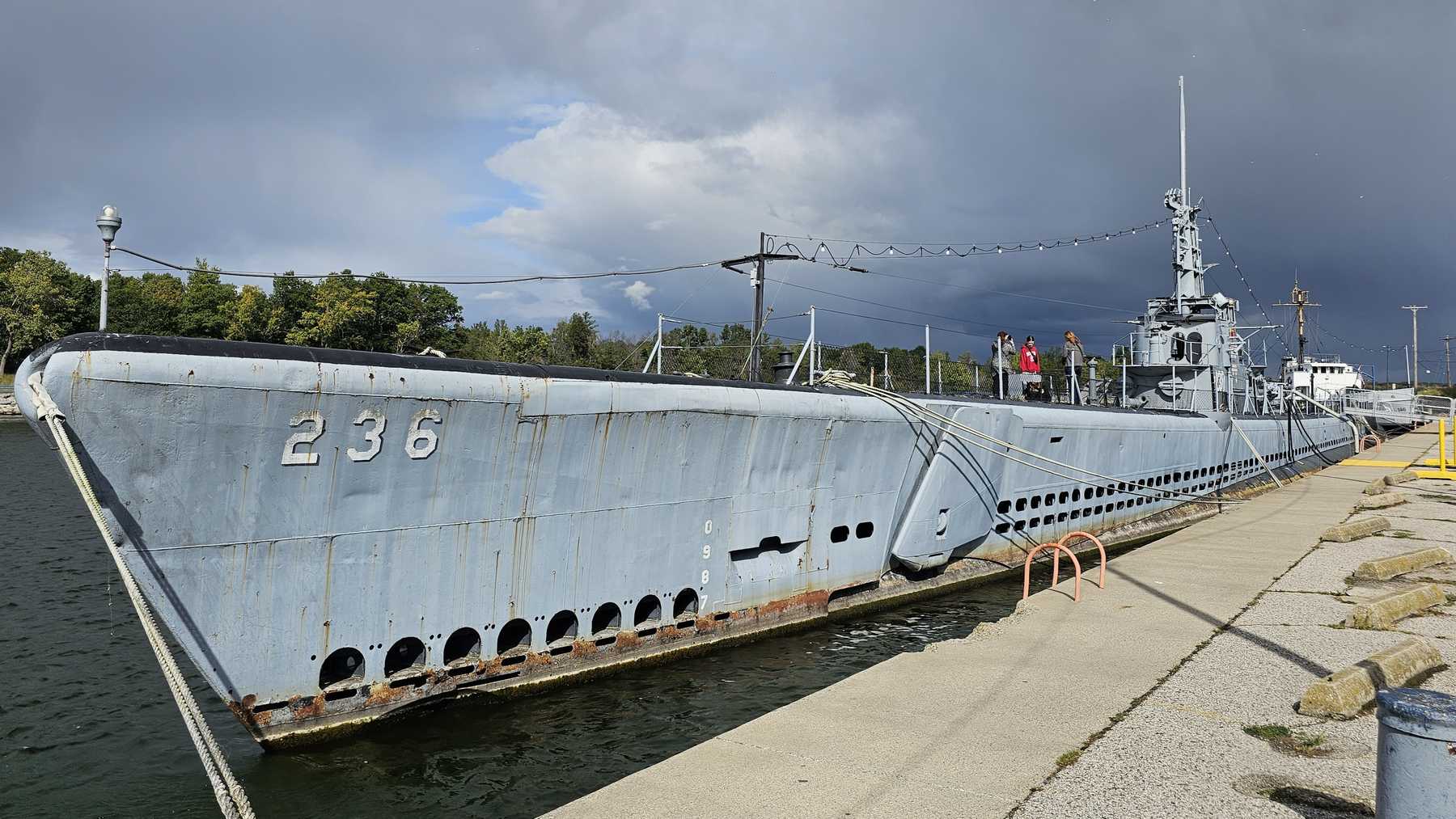
That little time zone trick made USS Silversides look a bit slower than she really was. The World War II submarine left a shipyard in Sturgeon Bay, Wisconsin, around 4:30 p.m. local time on Friday, October 30, and entered the Muskegon Channel at 8:30 a.m. Eastern on Saturday. That’s 16 hours if you just read the clocks. MLive, which was at the channel when she showed up, puts the actual tow at 15.
Either way, she’s home. Two tugboats brought the 312-foot sub into Muskegon Lake, swung her around and nudged her back into her berth at the USS Silversides Submarine Museum by 10 a.m., with a flotilla of boats following her in and people lined up along the channel to watch.
If you read our piece on what turned up while she sat on blocks all summer, you’ll know this was her first visit to a dry dock in 72 years. The ride home was the last box to check. And as it turns out, the news from the bottom of her hull was a lot better than the museum had been bracing for.
The Coast Guard had to sign off first
You can’t just hook a line to an 85-year-old submarine and head out onto one of the Great Lakes at the end of October. Silversides lost her propellers decades ago, so she can’t do anything to help herself if a tow goes sideways. She’s also not small. She’s 312 feet long and displaces 1,526 tons on the surface, which is a lot of steel to have drifting around a lake with no way to steer.
So the U.S. Coast Guard wanted proof she’d stay upright and watertight before it let her leave Wisconsin. According to MLive, its checklist had five items on it: a float test, an incline and stability test, setting her ballast, a last round of touch-ups and getting her rigged for the tow. She passed all five that week.
The incline test is the one that sounds strangest if you’ve never seen it done. Basically, the shipyard moves a known amount of weight from one side of the deck to the other and measures how far the boat leans. From that, a naval architect can work out where her center of gravity sits. And that tells you how likely she is to roll over when the lake gets choppy. That’s a pretty important thing to know about a boat that can’t steer herself.
The Coast Guard hasn’t published the results of any of those tests, and I wouldn’t really expect it to. All we know is that she passed, and that the trip home took an hour less than the trip over in July, when she needed 16 hours to cover 113 miles going the other way.
Basic Towing, an outfit from Escanaba, Michigan, handled both crossings with a pair of 100-foot-plus tugboats. On the July run, the Nickelena and the Erika Kobasic worked as a team, one pulling from the front and the other pushing from behind. If you’ve ever helped a buddy carry a couch down a flight of stairs, it’s the same idea. One of you leads, and the other keeps the thing from going where it wants to go. One of those two tugs, it turns out, is actually older than the submarine.
So what does 10% wastage actually mean?
This is the number the museum’s been happiest to talk about. Fincantieri Bay Shipbuilding found only about 10% wastage in Silversides’ steel hull. Veronica Campbell, the museum’s executive director, told MLive that’s “incredible for a vessel of her age,” and she gives most of the credit to fresh water.
Wastage is just shipyard-speak for metal that’s rusted away. Say a hull plate started out half an inch thick and now measures a little thinner than that. The steel that’s gone is wastage. As I read it, the yard found Silversides has lost roughly a tenth of her hull steel to corrosion, which is frankly a pretty great result for a boat that went to war in the Pacific and has spent the decades since sitting in a lake.
So why does fresh water matter so much?
Rust is basically a slow electrical reaction between steel and the water touching it. Salt dissolved in seawater makes that water carry current far better than lake water does, so the reaction speeds up. Take most of the salt away and it crawls along instead. That’s also why a car that spends its winters on salted roads up north tends to rust out years before one that’s never seen a salt truck.
The ballast tanks had their own surprise. Campbell said they’d filled up over the decades with silt, debris and worms, so crews had to clean them out before anyone could even judge what shape they were in. Once they did, the tanks turned out to be in good enough condition that some of the protective coatings the museum had planned for them weren’t needed after all.
I’m not sure what kind of worms move into a submarine’s ballast tank in the Muskegon Channel, and MLive didn’t say. I’d also rather not find out personally.
She’s good for another 20 to 30 years
The project cost $3.5 million, and Campbell told MLive the museum hit a fork in the road partway through as prices climbed. It could have stopped early and been covered for eight to 10 years, or finished the remaining work and bought itself 20 to 30 years before the next trip to dry dock. The museum went with the second option, on the logic that coming back later to finish the job would’ve cost about twice as much.
That strikes me as the right call. Hauling a submarine across Lake Michigan isn’t something you want to do every decade if you can help it. Before she left in July, the museum was saying her new hull coating should protect her for 15 to 20 years, so walking out of the shipyard with a 20-to-30-year estimate is a pretty nice upgrade.
The money isn’t all in yet, either. The museum told WLUK in Green Bay on Friday that it was about $215,000 short of its dry dock fundraising goal. And according to MLive, anything raised beyond the $3.5 million goes into an endowment for the next dry dock. Which is a pretty sensible way for a small nonprofit to think, considering the last time Silversides came out of the water, Eisenhower was in the White House.
Figures: USS Silversides Submarine Museum, MLive.
Not every museum ship gets home this easily. When we checked in on the USS Kidd in October, the destroyer was waiting for the Mississippi to hit 32 feet on the Baton Rouge gauge so she could float back into her cradle. Silversides needed a Coast Guard sign-off and two tugboats.
So when can you go aboard?
Not quite yet. The museum had been teasing Saturday’s return on Facebook as “All treats, no tricks,” which is a pretty good use of Halloween morning. The party itself had food trucks, a pop-up store, a water cannon salute from the sheriff’s office and several flyovers by the Hooligans Flight Team, according to MLive’s report from the channel.
But you can’t walk through the sub just yet. Crews are cleaning her interior after the crossing, and the museum hasn’t said exactly what that involves. I’d guess a submarine that’s spent three months in a shipyard and a night on the lake has picked up its share of grit.
The museum building itself stayed open the whole time she was away, and it’s now on winter hours, Thursday through Monday from 10 a.m. to 4 p.m., according to the USS Silversides Submarine Museum. Silversides herself reopens for tours on Saturday, Nov. 7.