
Scrapping a car is a pretty straightforward process. You tow it to a yard, somebody pulls whatever parts are worth selling, and the rest gets crushed and trucked off to be melted down. It’s the car that makes the trip. Emotionally, it can be a bit complex, but let’s stick to the process.
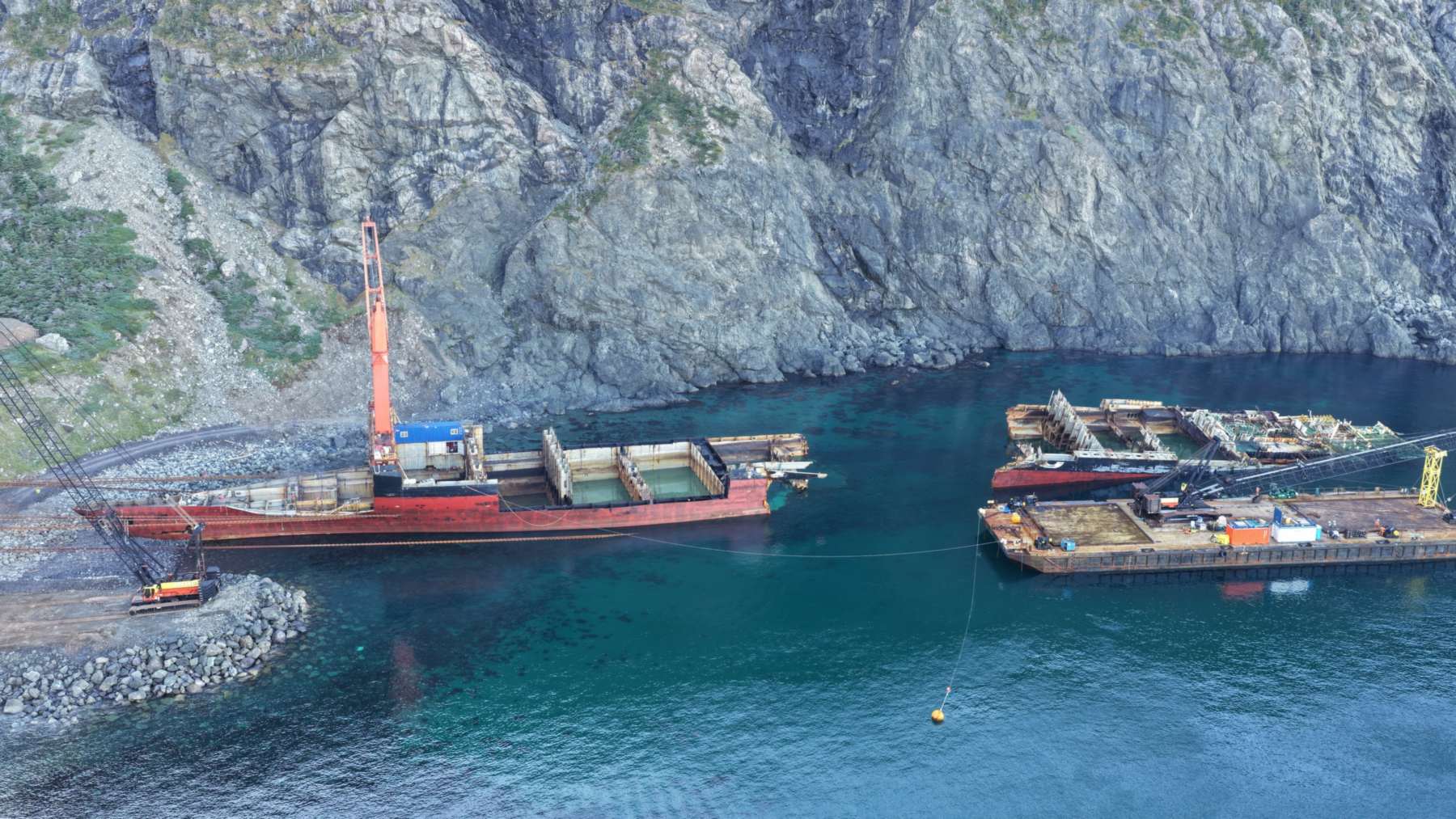
The MSC Baltic III never got that option. The 679-foot container ship has been stuck on the rocks in Cedar Cove, on the west coast of Newfoundland, for more than 20 months, and since it can’t float, the scrapyard pretty much had to be built on the beach next to it. According to the Canadian Coast Guard’s latest update, more than two-thirds of the ship is now gone.
We checked in on the wreck in September, when it had been dragged 174 feet toward shore, and a big piece of the bow had just come off. Since then, Resolve Marine has kept pulling. That’s the Fort Lauderdale salvage company MSC hired to take the ship apart, and the same outfit that spent part of September sawing the masts off a Liberty ship full of munitions in the Thames, so it’s had a busy fall.
The Coast Guard’s October 16 update says the bow and midship sections have now moved a total of 557 feet toward the beach. The stern, which Resolve only started pulling on its own in early October, has moved 256 feet.
That same update puts the total removed at 7,445 tonnes, about 68% of the vessel’s total tonnage. Those are metric tonnes, by the way, since this is Canada. In the tons we use here, it works out to 8,207 tons of ship that’s been cut loose, lifted out and sent off to be recycled.
So how much ship is actually left? I’m trying to picture this.
Unfortunately, that’s a trickier question than it sounds. The Coast Guard only gives percentages, not a total, but you can work backward from them. If 7,445 tonnes is 68 percent, the whole job it’s measuring comes out somewhere around 12,000 of our tons, and the earlier updates land in the same neighborhood. If my math’s right, that leaves a little under 4,000 tons still sitting in the cove.
You might be wondering why that’s so much smaller than the numbers you’ll find for this ship online. Ship-tracking databases list the Baltic III at 25,407 gross tons, with a deadweight of roughly 37,000 tons. But gross tonnage isn’t a weight. It measures how much enclosed space a ship has, which ports and regulators use to calculate fees and rules, and the “ton” in the name is basically a leftover from the days when ships were rated by how many big casks of wine they could hold.
Deadweight is a real weight, but it’s what the ship can carry (cargo, fuel, water, crew, and so on), not what the ship itself weighs. The number that actually matters here is the empty steel, which naval architects call lightship weight. As far as I can find, neither MSC nor the Coast Guard has published it, so the Coast Guard’s percentages are the closest thing we’ve got.
The stern finally got on the chains
If you missed the first story, here’s how it works. Resolve runs heavy anchor chain from the wreck to hydraulic chain pullers on shore and hauls around high tide, when the water takes a little of the hull’s weight. In theory, every chunk of steel that comes off makes that extra lift count for more. Judging by the numbers, that’s exactly what’s happening.
On September 27, the bow and midship sections were pulled another 138 feet, which the Coast Guard says put them within reach of the scrap pad. That’s basically a flat, reinforced work area built on the shoreline so a land crane has something solid to sit on while it lifts pieces of hull. By October 2, about 55 percent of the ship’s tonnage was gone, and the stern was still in the water waiting its turn. A week later, Resolve had the stern on the chains, and it had moved 82 feet. Then the October 16 update added another 108 feet for the front sections and 174 feet for the stern.
Frankly, that last stretch is a pretty quick pace for something that has to be winched over rocks. The stern covered as much ground in that one week as the entire wreck did in its first six weeks of pulling.
Back in September, our first story said it’d be a little surprising if the stern went anywhere before spring.
Consider us a little surprised.
There’s still oil in Cedar Cove
The cutting isn’t happening without a mess. The Coast Guard says it’s seen sheening in Cedar Cove, which is a thin film of oil on the water (think of the rainbow on a puddle in a gas station parking lot), along with oiled plants and debris on the shoreline and fresh tar stains, tar balls, and smears. Three dead birds have also been recovered from the area, and the Coast Guard says the cause of death hasn’t been confirmed.
The bulk of the fuel was pumped out long before anyone started cutting, but some residual fuel is still inside the wreck, and the Coast Guard says sheening usually shows up after rough seas. Tank cleaning is continuing wherever crews can safely get in, and crews are cleaning up tar as they find it. The Coast Guard and Environment and Climate Change Canada are also watching from the water and the air when the weather lets them.
The Coast Guard also says more sheening may show up as the weather gets worse. In western Newfoundland in late October, that seems like a fairly safe prediction.
None of that’s surprising for a wreck that’s being torn apart in open water with fuel still in its pipes, and the Coast Guard has been saying for months that it expected some of this. Still, three dead birds is a pretty grim line to read in an update. Under Canadian law, a ship’s owner is responsible for pollution from its vessel, which is why MSC Mediterranean Shipping Company is paying for the removal rather than Canadian taxpayers.
So will the Baltic III be gone before winter?
Probably not all of it. Resolve has said it’ll keep working until winter weather shuts the cove down, and it hasn’t said whether it will remove the whole hull this year. The plan also includes restoring the cove once the wreck is cleared, and Resolve expects that part of the job to run into next year.
One loose end remains in the latest numbers. On October 27, the Newfoundland TV station NTV ran a report saying the Coast Guard now puts the removal at roughly three-quarters of the ship. I haven’t been able to find that figure in writing, though, and the Coast Guard’s own live operations page still shows October 16 as its most recent update. So I’m sticking with 68 percent until the paperwork catches up.
Given how quickly the stern has been moving, I wouldn’t bet against Resolve getting most of what’s left onto the beach before the weather turns. I’d also bet someone’s still out there next summer picking tar balls off the rocks.
The Coast Guard’s October 16 update, its most recent written update, says 8,207 tons are off the wreck, the bow and midship sections are 557 feet closer to shore, and the stern is 256 feet closer than when Resolve started pulling it.