
Clearing sea mines has always come down to one grim piece of geometry. Somebody has to get close enough to a stretch of water to find the things built to sink ships, without setting one off on the way in. For as long as navies have taken the job seriously, that somebody has been a crewed minehunter, a team of divers, or a ship dragging a sonar on a cable through water nobody wanted to be sitting in.
A Canadian company just showed a way to take the ship, and the sailors, out of that equation. Kraken Robotics ran a demonstration in which an uncrewed boat launched a towed sonar, ran a full seabed scan, and pulled the sonar back aboard, with no human on deck touching the tow at any point. The whole thing happened off the coast of Istanbul, and the imagery came back sharp enough to tell a mine from a rock.
That last part is the sonar’s job, and it’s worth understanding before the robot-boat trick makes any sense.
A robot boat that launches and retrieves its own sonar
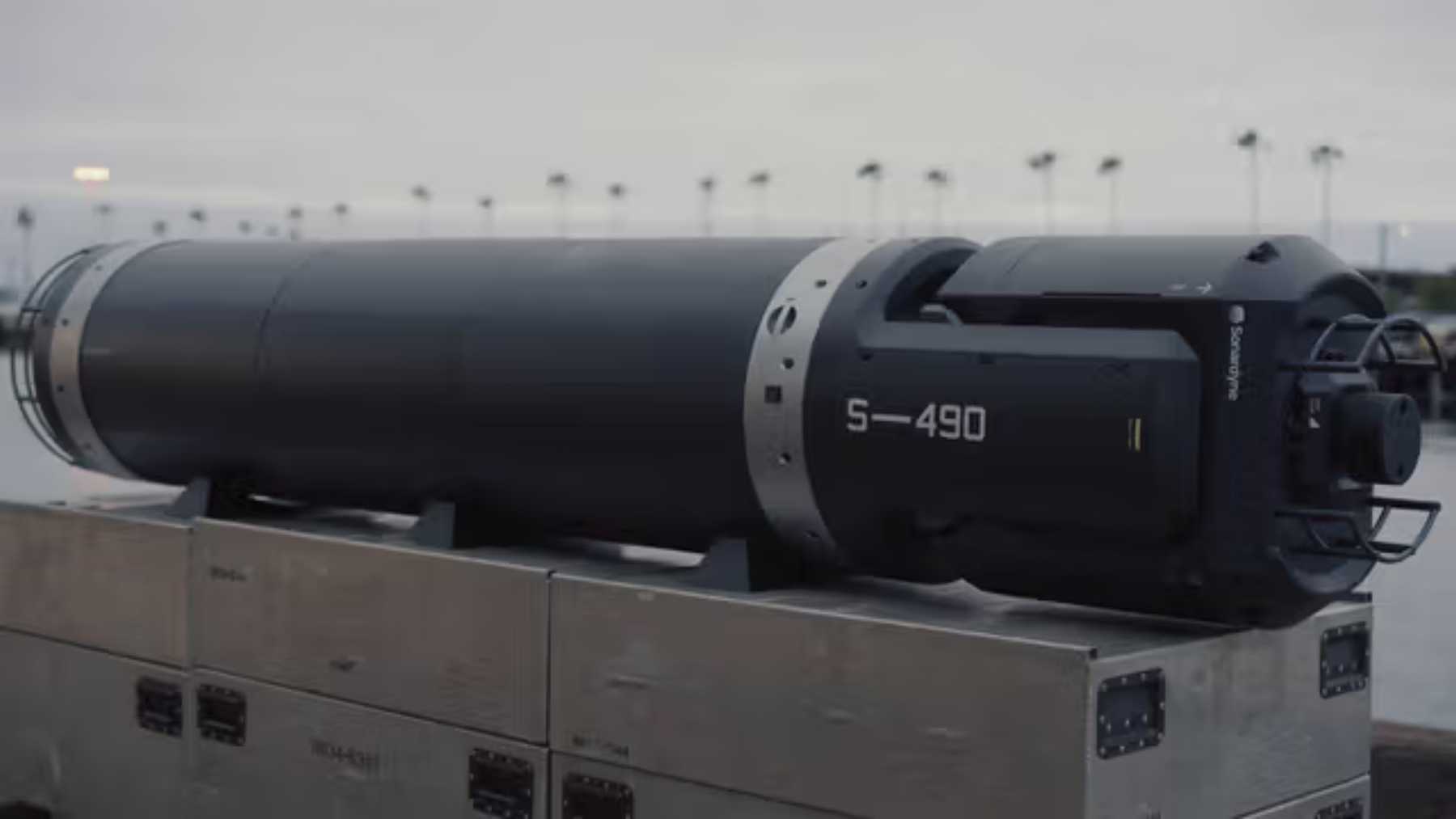
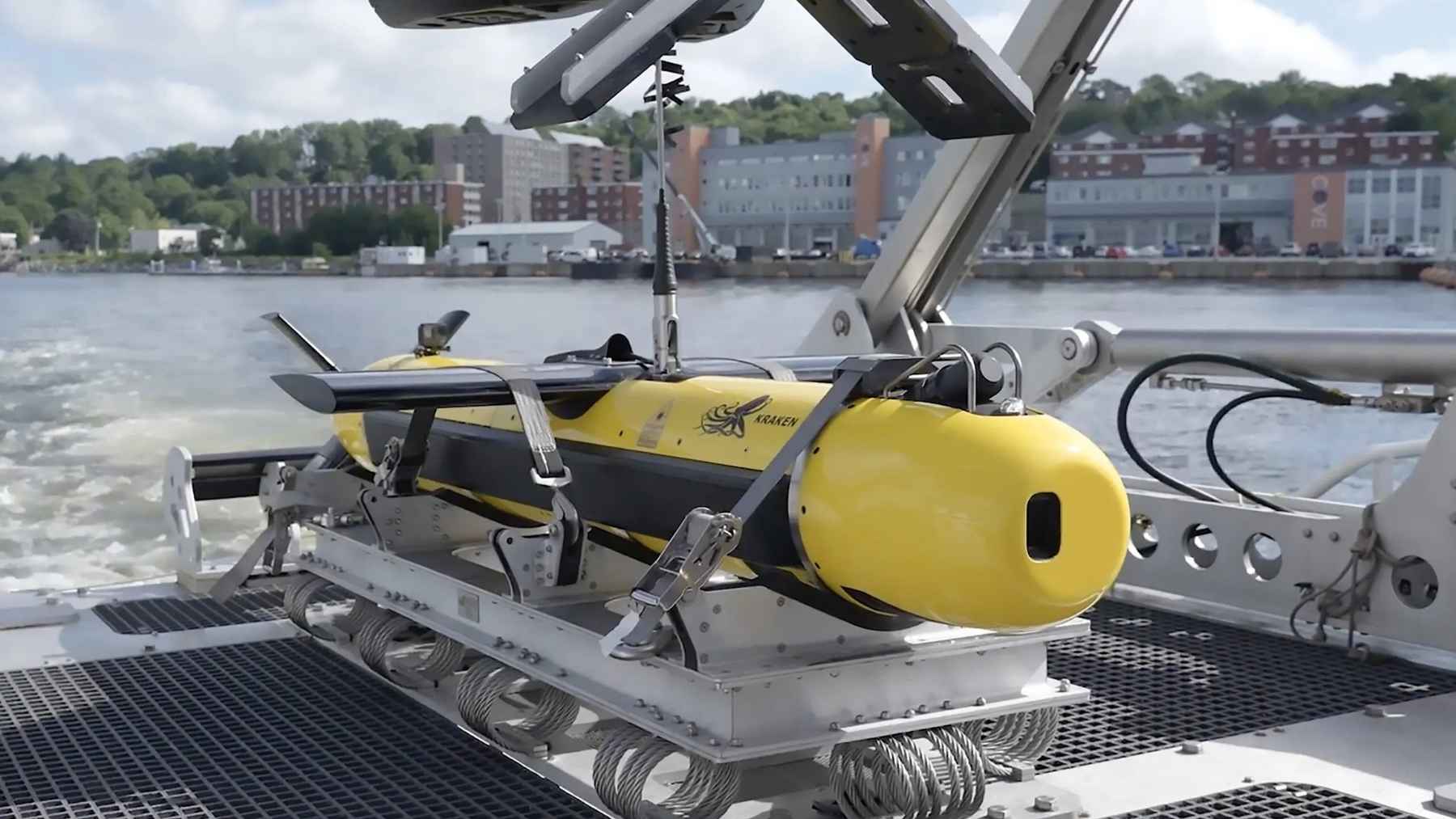
KATFISH is a towfish: a sonar body that a vessel drags behind it on a cable while the sonar images the seabed below and out to the sides. Towing a heavy body off a small boat in any kind of sea has always been a hands-on, mildly dangerous job. People on deck, a crane, wires under load, a hull pitching in the swell. Get it wrong and you lose the sonar or hurt somebody.
Kraken’s pitch is that it made that whole launch-and-recovery routine run itself. The system measures the motion of both the surface boat and the towfish and works a winch accordingly, so a small uncrewed vessel can put the sonar in the water and bring it back on its own.
In the Istanbul run, according to Naval News, the host was SEFINE’s RD-22 unmanned surface vessel. The data streamed live to a command center onshore, where operators classified contacts in real time using mission-planning software from SEFINE’s SISAM unit. The demonstration was built around rapid detection and classification of mine-like objects and underwater infrastructure, and Kraken says several navies and government organizations showed up to watch.
What that autonomy removes is the whole point. If the boat can deploy and recover the sensor with nobody aboard, you no longer need a crewed ship loitering over the danger area to babysit the tow.
The sonar reads the seabed at 3 centimeters
The sonar itself is a synthetic aperture sonar, or SAS, and the “synthetic aperture” part is the clever bit. A normal sonar’s sharpness is limited by how big its transducer physically is, and the picture blurs the farther out you look. SAS gets around that by stitching together a long string of pings as the fish is towed along, so it behaves like a much bigger sonar than it really is. The resolution stays constant no matter how far to the side you’re imaging.
The number Kraken quotes on its KATFISH product page is 3 centimeters by 3 centimeters of resolution out to 200 meters on each side, which works out to a 400-meter-wide strip of seabed imaged in a single pass. The company says the towfish does it at speeds up to 10 knots.
Three centimeters is what changes the calculus. At that resolution you’re not squinting at a fuzzy blob that might be a mine and might be somebody’s discarded washing machine. You can see the shape well enough to make the call.
SAS also covers wider, faster, and sharper than the older towed sidescan sonar it’s meant to replace, which matters a lot when the water you have to check is measured in square miles rather than square yards.
The whole idea is to keep sailors off the minefield
None of this is about a nicer gadget for its own sake. Mine countermeasures, MCM in the trade, is one of the jobs navies most want to hand to a machine, because the traditional version means steering a crewed ship, or lowering divers, into exactly the water you suspect is mined.
The fix everyone is converging on is the same one. Send an uncrewed boat or an underwater drone to do the finding, and keep the people and the expensive crewed hull well back. It’s the same logic behind the sail-and-solar drone Ocean Aero has been running mine-hunting patrols with, the seabed-guarding drone stack Italy is now building, and the US Navy’s own crewless vehicles that combed the Baltic floor this summer. Taking the human out of the launch-and-recovery step is the specific piece Kraken is selling, because that was the last thing still tying the sensor to a crewed deck.
The package is built to travel light, too. Kraken says the system is air-deployable and rated to 300 meters of depth. In an earlier trial it worked in sea state 3, meaning real weather rather than a flat calm.
Navies are already writing checks for it
This isn’t a concept video. Back in November, Kraken and TKMS ATLAS UK ran the same launch-and-recovery system off an in-service 11-meter ARCIMS uncrewed boat, the type already used by the UK Royal Navy, and Kraken says the two companies integrated and demonstrated the whole setup in roughly two weeks.
In March, Kraken announced it had sold a new KATFISH to the Polish Navy for its minehunting program. Greg Reid, the company’s President and CEO, said Kraken had “sold a new KATFISH to the Polish Navy for their minehunting program” as part of about $24 million in defence orders. Poland is not a new customer here. It first picked the sonar back in 2020 for its Kormoran II-class minehunters, and the latest order ran through Thesta, Kraken’s reseller in the country.
Turkey, for its part, has been quietly assembling its own catalog of undersea hardware, from synthetic aperture sonar to containerized armed drone submarines. A Canadian sonar plugging into a Turkish uncrewed boat and Turkish mission software fits that pattern neatly. In May, Kraken signed a memorandum of understanding with SEFINE’s SISAM to fold KATFISH into that mission-planning software and to build automatic target recognition, software that flags likely mines in the sonar picture instead of leaving every contact to a human eye.
Kraken is also scaling up around all of this. On July 2 it closed a roughly $615 million acquisition of the Covelya Group and raised its 2026 revenue guidance to a range of $290 to $320 million. Whatever else you make of the technology, this is not a garage outfit betting the company on one sea trial.
What the sonar still can’t do for you
There’s a hard limit here. KATFISH finds and classifies mines. It doesn’t blow them up. Something else, a disposal team or a separate one-shot drone, still has to go in and deal with whatever the sonar flags, and that step hasn’t been automated away here.
But the finding was always the part that put a crewed ship over the minefield in the first place. If an uncrewed boat can drop the sonar, run the 400-meter scan, and haul it back aboard on its own, the sailors get to do the risky part from a screen a long way off. For a job that’s been about proximity since the very beginning, that’s a real change in who has to be standing where.