
- 3 MONTHS AGO · ENERGYA Belgian ship crosses the North Sea at 11.5 knots, drives four 426-foot steel legs into the seabed, then climbs its own legs until the hull is clear of the water and stops being a ship, because no crane on a rolling deck can thread a 351-foot blade onto a hub 500 feet up
- 2 WEEKS AGO · ENERGYHundreds of offshore wind turbines with 318-foot blades slowed to under two turns a minute off the Dutch coast for six hours one night so migrating birds could cross the North Sea, on a forecast that had to be locked in two days before the birds took off
- 6 DAYS AGO · ENERGYAn 11,000-volt ship connector packed into its own container just passed factory tests with outside inspectors watching, and it’s built to reel in a high-voltage cable from an offshore wind turbine, lock it in and let a service vessel charge its batteries without heading back to port
- 2 HOURS AGO · ENERGYA Dutch crew took a 402-foot cable-laying ship 33 miles out to sea and lowered six hubs of live oysters onto the seabed inside a 52-turbine wind farm, about 3,600 European flat oysters and thousands of young ones meant to breed in water where fishing boats can’t drag the bottom
- TODAY · THIS ARTICLEA 426-foot ship built to lay internet cable across oceans can now carry about 4,400 tons of power cable on two giant turntables, and it has started unspooling 311 miles of it across the seabed of a British wind farm to plug 197 turbines into two converter stations out at sea
Offshore wind turbines get all the photo ops. They’re the tall white towers on every brochure, and they’re probably what you picture when someone says “wind farm.” But a turbine standing in the North Sea with nothing plugged into it is pretty much the world’s most expensive weather vane.
So someone has to do the wiring. At Hornsea 3, the wind farm Ørsted is building off England’s east coast, that job is now underway, and it’s a big one.
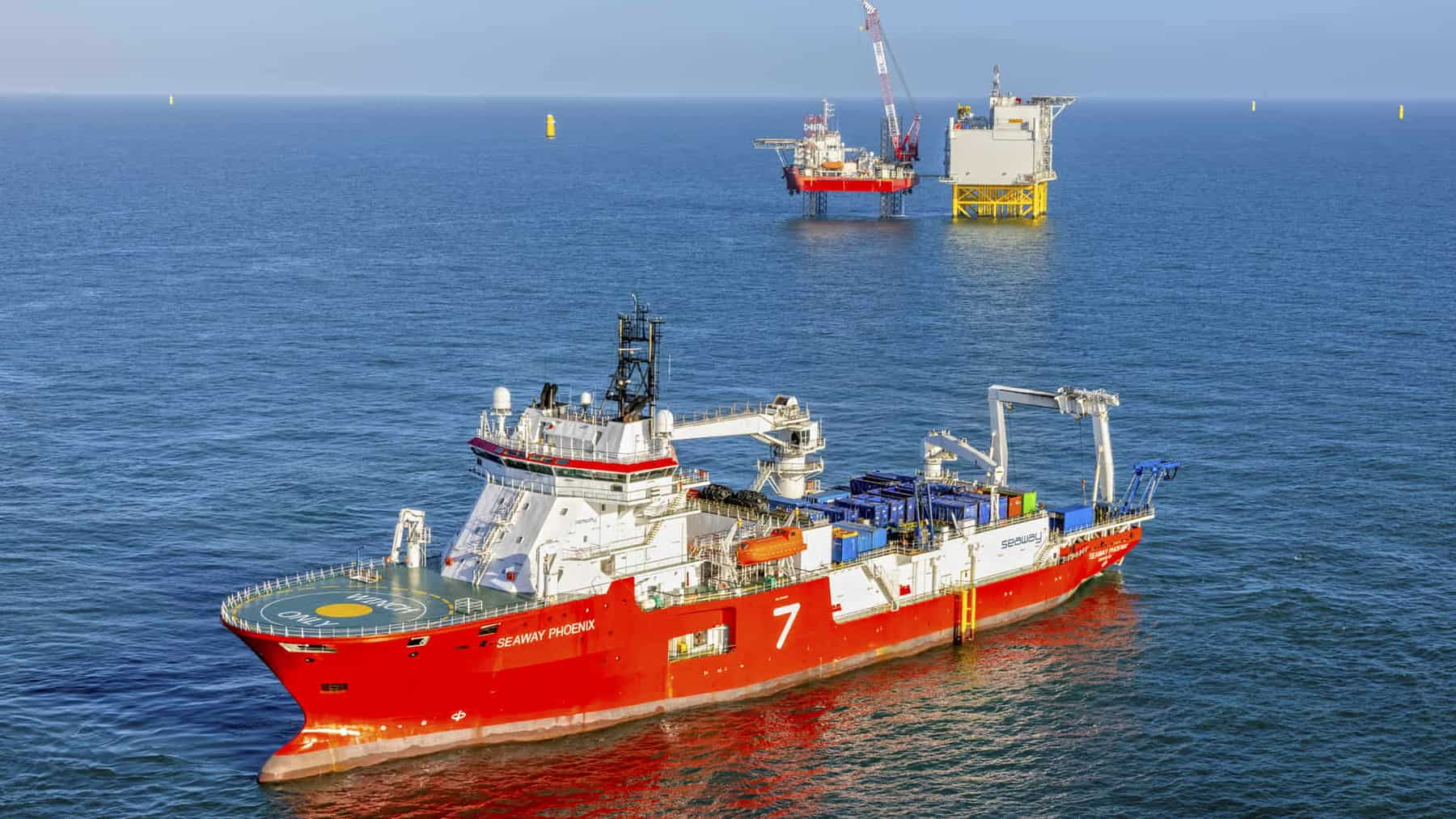
Seaway7, the offshore wind arm of the Subsea7 group, has started laying the farm’s inter-array cables, Offshore Wind reported on November 12. The job covers about 311 miles of cable, enough to hook 197 turbines up to a pair of converter stations out at sea. The ship doing the laying is the Seaway Phoenix.
So what kind of ship gets handed a job like that?
The Seaway Phoenix is basically a floating cable spool
The Phoenix is 426 feet long and 91 feet wide, according to Seaway7’s vessel page. That’s not giant by cargo ship standards, but pretty much everything on board is there to handle cable. The heart of it is a pair of turntables, which are huge flat spools built into the ship. Each one holds about 2,200 tons, so the Phoenix can carry roughly 4,400 tons of cable at a time. That’s a lot of copper and insulation to have sitting in one hull, and it’s why a ship like this doesn’t have to run back to port every few miles.
Then there’s the working gear. Seaway7 lists about 9,500 square feet of deck space, a crane rated for about 37 tons and a hinged steel A-frame rated for about 66 tons. You use the A-frame to swing heavy equipment over the side and lower it into the water.
The crane uses what the industry calls active heave compensation. In plain English, the hook stays more or less still while the ship rises and falls on the swell. Try threading a needle on a city bus and you’ll see why that’s handy when you’re lowering expensive hardware toward the seabed.
The Phoenix also carries two work-class ROVs, which are remote-controlled underwater vehicles with cameras and arms, plus a dedicated trenching ROV. That last one digs a trench in the seabed and buries the cable, so anchors and fishing gear are less likely to snag it later.
Funnily enough, the Phoenix didn’t start out as a wind farm ship. Seaway7 has said it was originally built to lay fiber-optic cable across oceans, and the company converted it for wind farm work. So it went from carrying internet traffic between continents to carrying electricity between turbines, which is arguably a step down in distance and a big step up in cable weight.
And no, I didn’t borrow the 426 feet from another story. That’s also the length of the steel legs on the Belgian jack-up ship we covered at Dogger Bank. It’s a completely different ship at a different wind farm, and the matching number is a total coincidence.
Why does a wind farm need 311 miles of cable?
Every turbine has to be wired into something. At Hornsea 3, that something is a pair of offshore converter stations, which are essentially giant electrical substations parked out at sea. The array cables carry power from the turbines to those stations, and Ørsted says they run at 66 kV, or 66,000 volts.
The converter stations then switch that power from alternating current to direct current before it heads to shore through separate export cables. DC loses less energy over long distances, which is why you tend to see it on big projects a long way from the coast. Offshore Wind says this is the first project in Europe where Ørsted is using high-voltage direct current.
Hornsea 3 is also just enormous. It’s rated at 2.9 GW, according to Offshore Wind, which is more than Hornsea 1 (1.2 GW) and Hornsea 2 (1.4 GW) combined. Ørsted says that’ll be enough electricity for more than 3.3 million homes in the UK once it’s finished.
The site has already seen plenty of heavy steel. We’ve covered the 1,840-ton steel tubes going under its turbines, and the second converter station went in back in September, according to Offshore Wind. The cables are what turn all that steel into something that actually produces power.
Hellenic Cables and Prysmian are making the cable itself, and JDR Cable Systems is handling testing and termination. Termination is the fiddly job of connecting each cable end to the equipment and checking it works before anyone switches it on.
Luke Bridgman, managing director of Hornsea 3 at Ørsted, says the array cable team has spent almost five years getting to this point. “We’ve reached the key moment for our array cables,” he said, according to Offshore Wind. Frankly, that doesn’t sound like much of an exaggeration. Without the array cables, 197 turbines aren’t connected to anything.
Then there’s the walk-to-work ship
The Phoenix isn’t working alone. Seaway7 has also brought in the Seaway Moxie, a walk-to-work vessel, to support the campaign. Walk-to-work ships carry technicians and typically use a motion-compensated gangway, so workers can basically stroll from the ship onto a turbine or platform instead of hopping across from a small boat. It’s about as close as offshore construction gets to a normal commute.
Both ships got ready in Eemshaven, in the Netherlands. An Ørsted operations notice, reported by Offshore Wind in October, had the Phoenix loading cable there and due on site October 19, with the Moxie sailing on October 15.
What I can’t tell you is the exact day the first cable hit the seabed. I couldn’t find a date from Ørsted or Seaway7, and Offshore Wind’s November 12 report only says the work has begun. The Phoenix had been due on site for a few weeks by then, so it’s safe to assume the crew wasn’t sitting around waiting for a press release.
Seaway7 now has about 311 miles of cable to work through at Hornsea 3, and as of Offshore Wind’s November 12 report, the Phoenix is on the job.
 A 79-foot steam generator weighing about 694 tons, nearly 20 feet across, was hoisted into a Guangdong reactor building on Wednesday, the first of two for a 1,250-megawatt unit whose steel vessel went in this summer, a lift its builder said was kept stable and precisely controlledEnergy · 5 hours ago
 A 100-watt nuclear reactor sitting in a 35-foot concrete pit under Texas ranch land has been cleared by the Energy Department for unrestricted operations three months after its first chain reaction, and its maker will use it to train operators and check its math for an isotope reactorEnergy · 8 hours ago
 An 882-ton boiler, one of eight at a closed nuclear plant on the English coast, is slated to be jacked and slid out of its bay under a contract announced late last month, a job meant to take away about a third of the buildings still standing on the siteEnergy · 23 hours ago