
- 2 MONTHS AGO · MILITARYA 39-pound tube shaped the way American sonobuoys have been shaped since 1942 pinged at underwater drones this summer, gave away its own position doing it, and sank, while a 21-inch reel unspooled nearby into a listening array and never made a sound
- 2 MONTHS AGO · MILITARYWhile the US Navy cuts the reactor block out of its old nuclear submarines and buries it whole in a desert trench, Britain has cut 2,695 tons off a 272-foot Cold War attack submarine in a Scottish dry dock, taking one fully apart for the first time anywhere
- 2 WEEKS AGO · MILITARYA drone submarine built for the Australian navy surfaced, slid its top doors open and raised a rack of 12 angled tubes that fired an American aerial drone with a 275-mile range, a second rack sat folded beside it, and the whole hull ships inside a standard container
- 2 WEEKS AGO · MILITARYA 6,900-ton nuclear attack submarine lost permission to dive while she waited for an overhaul, was towed three times between Norfolk and a private shipyard and sat in dry dock with less than a quarter of the work done, and the Navy is now sending her shipyard workers to new submarines
- TODAY · THIS ARTICLEA 6,900-ton nuclear attack submarine at Norfolk pushed a 19-pound underwater drone out of a flooded 21-inch torpedo tube so sailors could run underwater inspections from inside the boat, using a 3D-printed resin housing instead of a temporary alteration that costs 200 times as much
The best submarine story I’ve read in a while comes down to a chunk of 3D-printed resin and some ordinary low-voltage wiring. Together they cost the Navy less than $1,000, counting both parts and labor. And on August 24, they let sailors aboard USS Pasadena send a small underwater drone out of one of the boat’s torpedo tubes and stay in contact with it the whole time.
The first fix the Navy looked at would’ve cost about $200,000 per submarine.
So how does a part that cheap stand in for one that expensive?
Pasadena’s torpedo tubes usually carry something much heavier
Pasadena is a Los Angeles-class nuclear attack submarine out of Norfolk, Virginia, and it’s been in commission for more than 37 years. The Navy’s fact file lists the class at about 6,900 tons submerged and 360 feet long.
Up front, it has four torpedo tubes built for the Mk 48 heavyweight torpedo, which the Navy says weighs 3,744 pounds. The thing that went out of one of them on August 24 weighed 19 pounds.
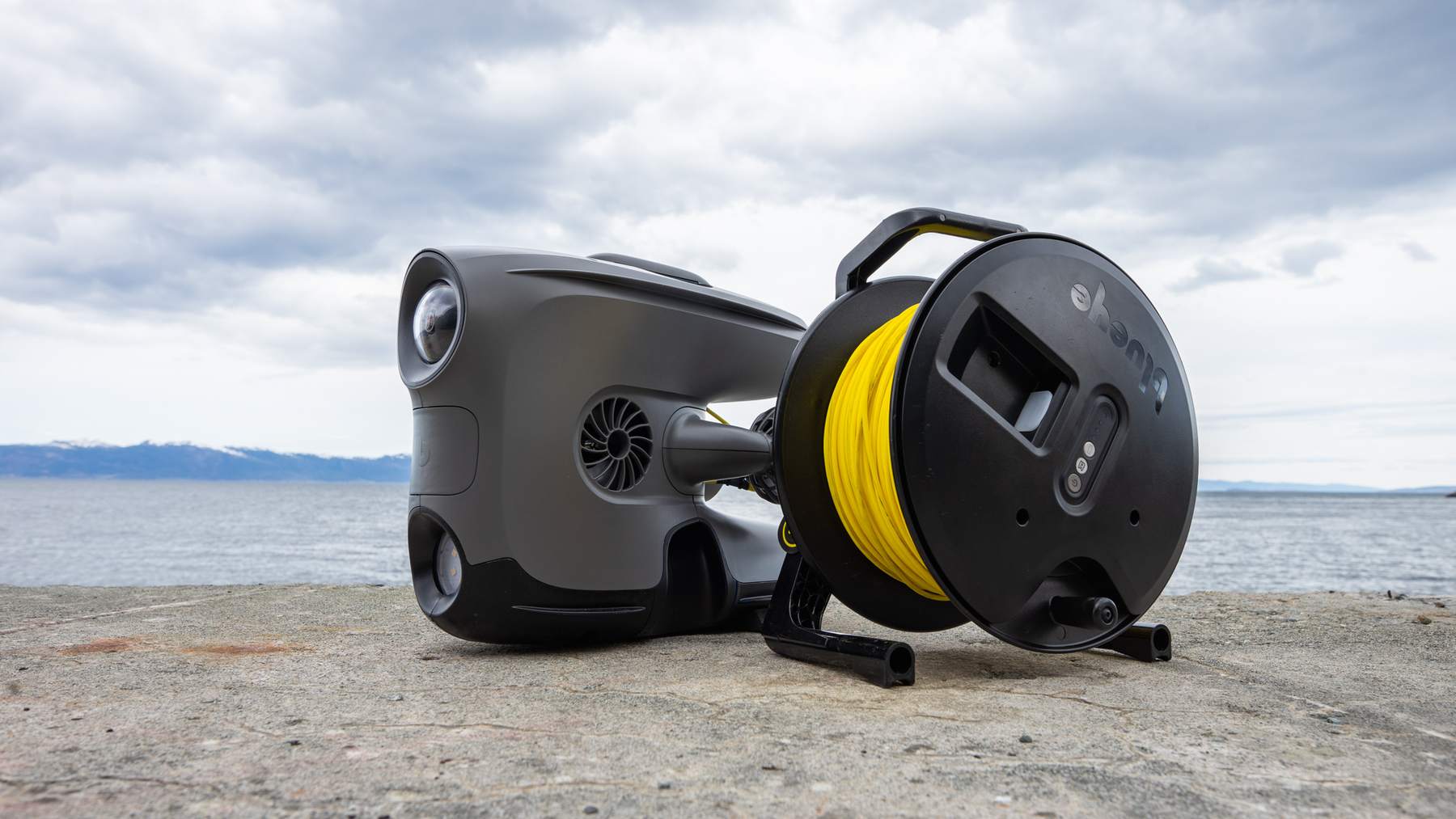
That would be a Blueye X3, a small inspection drone made by a Norwegian company called Blueye Robotics. According to Blueye, it’s about 19 inches long, 10 inches wide and 14 inches tall, it’s rated to 1,000 feet, and it pushes itself around with four 350-watt thrusters. It can work on a tether of up to 984 feet and carries an HD camera with its own lights.
If you haven’t run into the term, the X3 is what the Navy calls an ROV, short for remotely operated vehicle. It’s basically an underwater drone on a leash: a person flies it with a controller, and commands and video travel through a thin cable, since radio doesn’t get far in seawater. Nobody’s asking it to find its own way home. A sailor drives it the entire time.
Why couldn’t they just plug it in?
A torpedo tube is basically a 21-inch steel pipe with a door at each end. The inner one, the breech door, opens into the torpedo room so the crew can load it, and the outer one, the muzzle door, opens to the sea once the tube’s been flooded.
That works fine for a torpedo. A drone that needs a live connection for its whole trip is trickier, because its cable has to run from a pipe full of seawater to the controls in the dry spaces inside the boat. Every connection along the way has to survive the flooding and still carry enough data to fly the thing and send video back.
The team’s first idea was what the Navy calls a Temporary Alteration, in this case a Fiber Optic Penetrator that would carry the signal through the tube’s breech door. A temporary alteration is Navy-speak for a modification fitted to a boat for a specific job or trial instead of as a permanent change to its design. According to the Navy, that one typically runs about $200,000 per submarine.
A Navy repair shop printed the fix instead
The Navy’s Shore Intermediate Maintenance Activity, or SIMA, came up with a cheaper route. Its additive manufacturing team designed a custom waterproof housing and printed it in Formlabs’ Rigid 10K resin on a Form 4L stereolithography printer. If you’ve never seen one of those work, stereolithography uses light to harden liquid resin one very thin layer at a time. You end up with a stiff, smooth part instead of the stringy layers a cheap desktop printer tends to spit out.
SIMA’s 2M shop, which handles tiny electronics repairs, ran standard low-voltage wiring through that housing and tied it into the X3’s tether. Outside the tube, a second harness carried the link across the various points where the cable connects. Sailors from Pasadena worked on it, and technical reps from Blueye pitched in too. The release doesn’t spell out exactly how the line gets from the flooded tube to the controls inside. Frankly, on a nuclear submarine, I wouldn’t expect it to.
The final bill came in under $1,000 for parts and labor, according to the Navy’s release on DVIDS, and that doesn’t include the drone, since Submarine Force Atlantic already owned it. Put about $200,000 for the penetrator next to under $1,000 for the printed setup and you get a gap of more than 200 to 1. That’s a pretty good argument for keeping a 3D printer near the waterfront.
Chief Fire Control Technician Will McCrary called the project “proof of concept for rapid prototyping at the deckplate level.” Deckplate is Navy shorthand for the sailors who actually do the work, as opposed to the people writing the requirements. His shipmate, Fire Control Technician 2nd Class David Baker, said the reward was seeing a printed part do its job for the crew.
Was Pasadena underwater?
Honestly, I don’t know. The Navy pitches the test as a cheap, quick way to run underwater searches from a submerged submarine, but it never says whether Pasadena itself was submerged on August 24 or sitting alongside a pier in Norfolk.
The Navy also hasn’t published how far the drone went, how deep it dove or how it came back aboard, so I’d call this a working demo more than a performance test.
Green Remora started with divers
The test falls under Green Remora, a project Vice Adm. Rob Gaucher started while he was running the submarine force. It began as better search gear for the submarine force’s scuba divers, the people who sweep the hull for security threats and check equipment mounted outside the boat. Submarine Force Atlantic picked up two Blueye drones under it. A remora, if you’re wondering, is the fish that hitches a ride by sticking itself to a shark. That’s a pretty fitting name for a drone that stays tied to its submarine.
It’s easy to see why a submarine force would want one of these working alongside its divers. Getting a diver in the water takes people, gear and time, and a camera you can fly out of a torpedo tube is arguably a quicker first look.
It’s also a humbler job than the one the Navy’s bigger tube-launched drones are chasing. USS Delaware has already launched and recovered an autonomous drone through its torpedo tube, and that kind of drone has to find the tube and drive itself back in. The German drone submarine we covered recently is sized for a standard torpedo tube too, and it’s built to work on its own for days at a time. The X3 is a 19-pound camera on a leash, and I’d argue that’s exactly why a printed housing was enough to get it out there.
Next up is paperwork. The Navy says the command is writing an ROV Personnel Qualification Standard card, which is basically the checklist a sailor has to work through, with sign-offs, before being trusted to run a piece of equipment.
Submarine Force Atlantic posted the Pasadena release on October 2, and as of that date the card was still being written.
 A 1,123-foot aircraft carrier with eight defueled reactors is under tow from Newport News to Mobile, where a scrapyard will cut the hulk apart around those reactors over the next four years while a 100-yard safety zone moves with herMilitary · 18 hours ago
 A 13-foot-wide US Navy nuclear mini-sub rolled across the seabed off Scotland on wheels, found an F-14 upside down in fishing nets nearly 1,900 feet down and brought its secret Phoenix missile up with a Soviet spy trawler watching, after a month of sonar ships had come up emptyMilitary · 19 hours ago
 Drone boats that ride almost awash like a drug smuggler’s semi-submersible just went to three American companies to prototype, and the Pentagon’s spec asks each one to haul 18,000 pounds of Marine supplies up to 2,000 nautical miles alone and sink itself on commandMilitary · 1 day ago