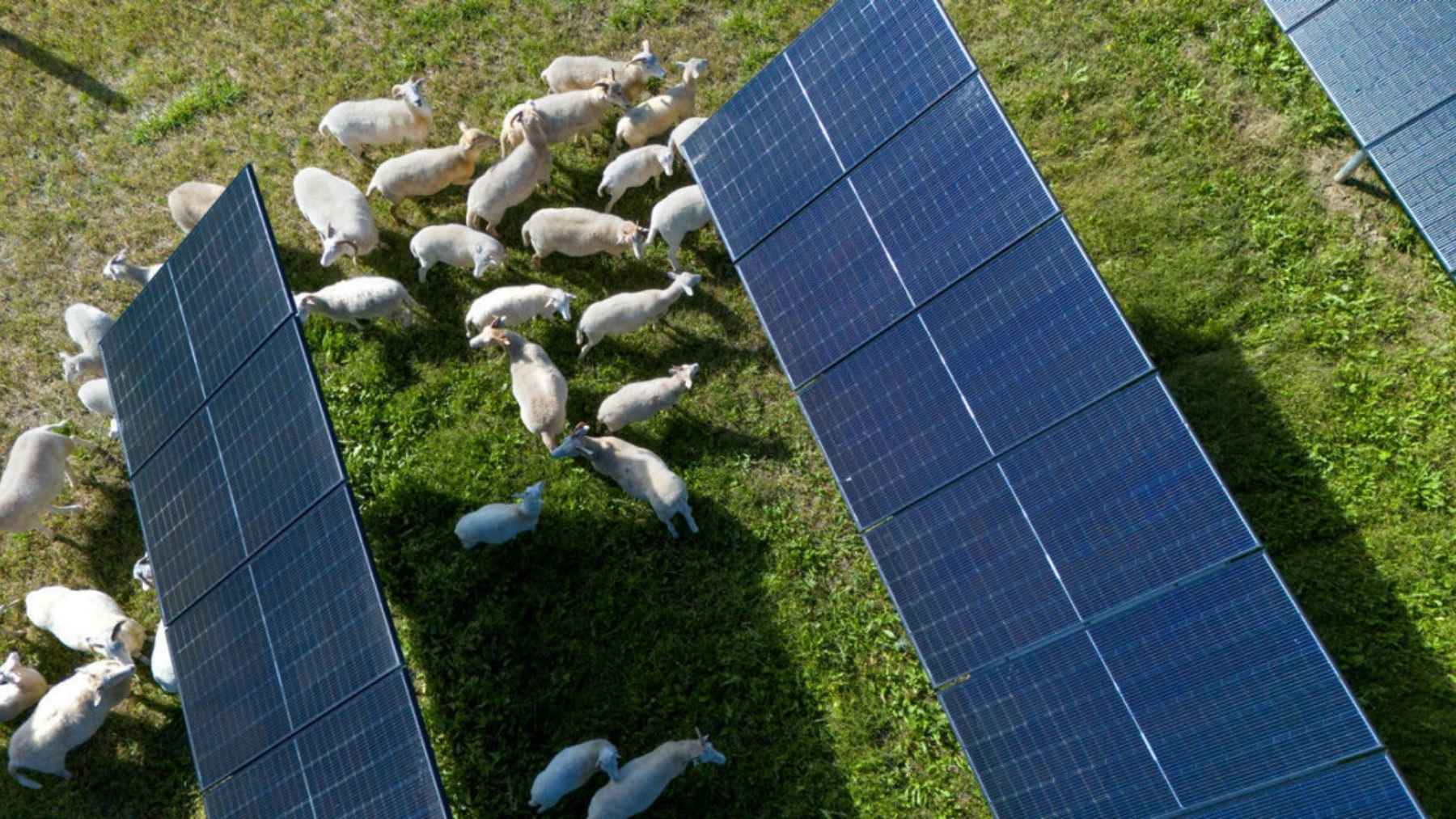

Grass grows under solar panels whether anyone wants it to or not, and once it gets tall enough to shade the bottom edge of the glass, somebody has to deal with it. For years that somebody was a guy on a mower, or a crew with string trimmers picking their way around a few thousand steel posts. Lately it’s sheep. The developer pays a shepherd, the mower stays in the barn, and everybody involved seems pretty happy with the arrangement.
So what’s the catch?
Apparently it’s the headcount. A team at Cornell spent three summers running its own teaching flock through a working 18-megawatt solar farm in Dryden, New York, at three different stocking rates, and counting the insects that showed up in each plot. The lightest grazing left 38 percent more wild bees, honeybees and ladybugs than a plot that was simply mowed. The heaviest grazing kept the grass down best of all and cut honeybee numbers by 45 percent. The paper came out in Environmental Research Letters on October 7, and Cornell wrote it up a week later.
You’d think a sheep is a sheep. It turns out the number of them matters as much as the fact that they’re there at all.
So what’s a stocking rate, exactly?
If you don’t farm, the phrase probably means nothing to you, so here’s the short version. A stocking rate is how many animals you put on a given piece of ground. The Cornell team ran theirs at two, four and eight sheep per hectare, which in American terms works out to two, four and eight sheep for every 2.5 acres. Even the heavy end of that is only about three sheep per acre, which doesn’t sound like much until you watch what three sheep do to an acre over a summer.
Light grazing leaves a fair amount of the pasture standing, and standing pasture gets to flower. Heavy grazing takes the plants down before most of them get the chance. Bees, as you’d expect, go where the flowers are.
That’s the plain-language read, anyway. The paper itself sits behind a paywall, so I’m going off Cornell’s summary and the abstract rather than the full methods, and I’d treat the mechanism as my interpretation, not the authors’ stated finding.
Three rates, three very different results
At two sheep per 2.5 acres, the researchers counted 38 percent more beneficial insects than in the mowed control plot, and the honeybees alone were up 83 percent. Lady beetles were in the count too, which is what entomologists call ladybugs, and they earn the “beneficial” tag because they eat aphids for a living.
At four sheep, the insect numbers landed about where the mowed plot did. The grass control was better than at two, though, so if you’re a developer who cares mostly about shading, four is arguably the sweet spot.
At eight sheep, the vegetation was as tidy as it got, and Cornell says the flock stayed healthy the whole time. The honeybees were the ones that lost out, down 45 percent.
One thing Cornell hasn’t said, at least not in the summary, is where those honeybees came from. Honeybees are livestock in their own right, and in upstate New York there’s a decent chance somebody’s hives sit within flying distance of the arrays. Wild bees were in the mix too, but the 83 percent figure is honeybees specifically, so I’d want to know whether the count was measuring habitat or measuring a neighbor’s beekeeping before I built a policy on it.
The farm itself is a real power plant
This wasn’t a test plot with a dozen panels. The Cascadilla Community Solar Farm is rated at 18 megawatts, spread over three sites in Dryden, and sends north of 30 gigawatt-hours a year to the NYSEG grid, which Cornell says is enough for about 3,000 homes. Cornell put the panel count at roughly 79,000 on a 125-acre parcel the ag school had written off as nonproducing farmland. The renewable energy credits cover the equivalent of 20 percent of the Ithaca campus’s electricity.
The sheep belong to Cornell too. The university’s own Sheep Program has been grazing the farm’s 54-acre south arrays for a while now, with the five fenced arrays doubling as the experimental blocks. So the animals in this study weren’t rented from a contractor for a season. They live there.
That’s one reason I’d put a bit more faith in these numbers than in a one-summer demo. Three years, one site, the same flock, and a mowed plot sitting right there for comparison is about as clean as a field trial of this kind gets. The flip side is that it’s one site, in one climate, with one grass mix, and nobody should assume a Texas solar farm in August behaves like Tompkins County in June.
What’s in it for the shepherd?
Quite a lot, from the looks of things. Leana Zoller, the postdoc who led the insect paper, told Cornell that grazing and insect habitat usually get studied as separate questions even though a developer has to decide both on the same patch of ground. Steve Grodsky, the senior author, said the team picked stocking rates specifically because a sheep farmer already thinks in those terms.
One of the co-authors, Nikola Kochendoerfer, isn’t an academic by day. She grazes 700 ewes on solar sites in New York and Vermont, and her pitch to Cornell was blunt: with solar, “you get paid to graze as opposed to having to pay to graze.” She says she’s working with farms that are scaling up because of it.
Cornell’s business school put a number on that side of things in a second paper, published September 28 in Manufacturing & Service Operations Management. Vincent Slaugh, Linwei Xin and Shane Henderson built a spreadsheet model that tells a shepherd how many sheep to buy or sell to cover a given set of solar contracts without ending up short of mouths when the grass takes off. An Ithaca outfit called United Agrivoltaics already uses it to onboard new graziers.
Slaugh’s bigger bet is that solar contracts could grow the American sheep industry outright. Cornell points out that about half the lamb and mutton eaten in the US is imported, mostly from New Zealand and Australia, so there’s room. I’d call that plausible rather than proven. A model is a model, and 700 ewes on two states’ worth of solar farms is a business, not an industry.
Sheep under panels have been a running theme on this site, from Oregon lambs that gained the same weight on 38 percent less grass to 4,200 merinos hiding under 755,000 panels in Australia. This is the first one I’ve seen that asks how many sheep is too many, and the answer, at least for the bees, is somewhere between four and eight per 2.5 acres.
Zoller’s paper went live in Environmental Research Letters on October 7, 2026, with funding from the Cornell Atkinson Center for Sustainability, the USDA’s National Institute of Food and Agriculture and the National Science Foundation.