
If you’ve ever dropped a 10mm socket down the back of an engine, you already know the drill. You don’t go in after it with your fingers. You drive to the parts store, buy one of those telescoping magnet pickups, and fish the thing out with the right tool.
Now picture the same problem at the bottom of a flooded reactor, where the thing you dropped is a 12-foot bundle of 216 fuel rods leaning at about 30 degrees. The parts store doesn’t stock that tool. So Holtec built one.
The company said on October 21 that DD41, the fuel assembly that tipped over inside the Palisades reactor in Michigan, is out of the core and in the plant’s spent fuel pool. And according to Holtec, the device that lifted it went from first idea to delivery on site in about two weeks.
Holtec’s chief nuclear officer, Fadi Diya, summed it up in the company’s statement: “When we encounter a challenge, what matters is how we respond.” That’s a pretty standard press-release line, but this time there’s an actual machine behind it.
Quick refresher if you’re new to this one. Palisades is the 805-megawatt plant on the Lake Michigan shore that Holtec is trying to turn into the first American reactor to come back after being shut down for decommissioning. Crews started loading its 204 fuel assemblies on August 30, Holtec had eight of them in the vessel by the next day, and DD41 leaned over after the loading machine let go of it. Holtec went public on September 21, fuel loading stopped, and we walked through the recovery plan the NRC approved earlier this month.
That plan has now actually happened. So let’s look at what Holtec built.
So what does a tool for a leaning fuel bundle look like?
The best description is in the license amendment request Holtec filed with the NRC on September 30, and it’s a pretty clever piece of hardware. Holtec calls it the Fuel Movement Device. It has 12 arms that clamp around the assembly, and clasps at the top and bottom keep the bundle from sliding out once it’s moving.
Some background helps here. A fuel assembly is a square bundle of long, skinny rods full of uranium pellets, held in line by metal grids along its length and capped with a plate at each end. The loading machine normally grabs the top plate, and that top plate is what DD41 damaged when it tipped, so the usual grapple had nothing to hold.
The new device gets around that by grabbing the bundle at the grids instead. Holtec’s filing describes it as forming a structural spine down the side of the assembly, which is basically a splint for a banged-up fuel bundle.
It doesn’t lift anything by itself, either. The device hangs from the containment building’s polar crane (the big crane that normally lifts the reactor head) on slings and two chain falls, with dynamometers in the rigging so operators can read the load live while it’s in the air. The filing also capped how hard the crew could pull while working DD41 loose at 1,800 pounds of force, a limit set by what the device itself can take.
One reader raised this under our last piece. The polar crane is built to move reactor parts that weigh many tons, so what stops it from simply tearing a fuel bundle apart? It’s a fair question. As far as I can tell from the paperwork, the answer is those live load readings, the 1,800-pound ceiling, and a rule that kept at least 10 feet of water over the fuel for the whole time the device had hold of it.
Then there’s the two-week claim. Is that fast? For a one-off tool that had to be checked against the ASME stress rules nuclear plants use for support structures, I’d say it’s pretty fast. Holtec’s own manufacturing arm engineered and fabricated it, according to the filing, and Holtec designs and builds spent fuel casks and canisters for a living, so it isn’t exactly starting from a blank page.
The canister had a 133-hour clock on it
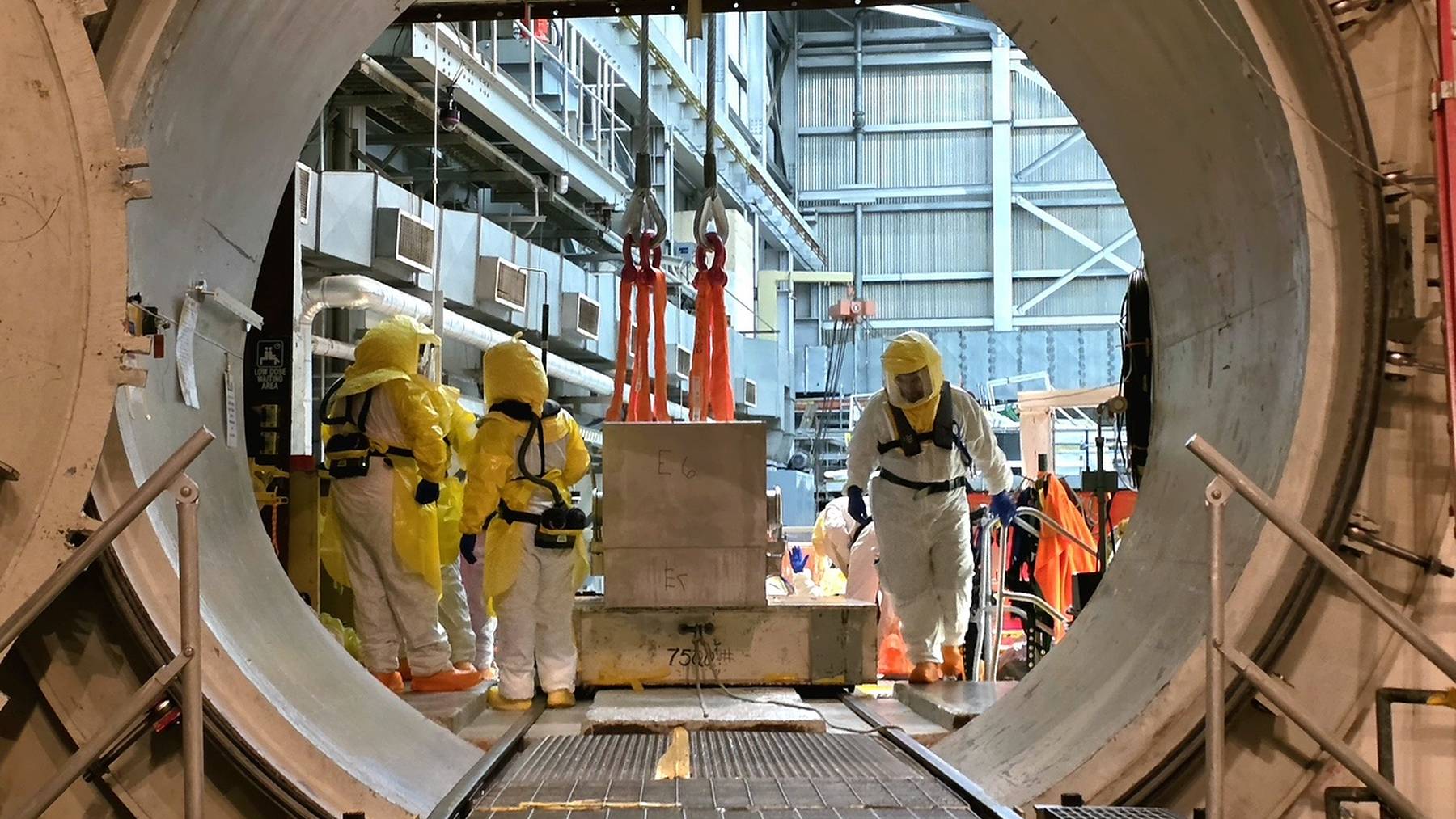
We covered the route in detail last time, so here’s the short version. Underwater, the device set DD41 down inside a custom canister on the floor of the flooded reactor cavity, and the crew installed the lid right there. The crane then lifted the loaded canister, about 49,000 pounds of it, out of the water. It was drained, rolled through the equipment hatch on a trolley into the fuel pool building, stood upright, and lowered into the pool.
The dry stretch is why this needed a license change at all. Normally, fuel never leaves the water on its way to the pool, because the water shields workers and soaks up heat.
Used fuel keeps making heat even after a reactor shuts down, so Holtec’s thermal analysis gave the crew a hard limit. From the moment the canister broke the surface to the moment it was fully submerged in the pool, the fuel couldn’t spend more than 133 hours out of the water. The same analysis put the hottest cladding at 517°F against a limit of 752°F. Cladding is the metal tube wrapped around the pellets, and it’s the first wall keeping radioactive material where it belongs.
What I can’t tell you is how long the canister actually spent in the air. Holtec hasn’t said, and the NRC hasn’t published anything on it yet. I’d expect that detail to turn up in an NRC inspection report eventually.
I also don’t know whether DD41 is still inside its canister. The plan Holtec filed has the assembly coming out of the canister later and going into a normal storage spot in the pool before it’s eventually moved to dry cask storage. Holtec’s statement only says the assembly is now stored in the pool.
So when does Palisades actually make power?
Nobody’s putting a date on it. Holtec says the team is moving on to finishing the fuel load, then testing, inspections and the rest of the readiness work, and that Palisades will return to service when that’s all done and the federal requirements are met. Nuclear Engineering International reported on October 26 that refueling is resuming.
That still leaves a lot of fuel to go in. Only a handful of the 204 assemblies made it into the core before loading stopped, and the vessel head has to go back on before the plant can start working its way toward power.
There’s also no public answer yet on why DD41 tipped in the first place. Holtec and the NRC are both still looking into it, and frankly, you’d hope they have it figured out before the rest of the core goes in.
One more item from this month needs a plain-English translation. On October 13, the same day it approved the recovery plan, the NRC sent Holtec what’s called a chilling effect letter. Basically, the agency’s inspectors found that employees in two departments at Palisades, supply chain and quality assurance, may not feel free to raise safety concerns. The NRC says the finding doesn’t involve any violations or significant plant safety issues, wants a corrective action plan from Holtec within 30 days, and doesn’t expect the finding to affect the restart. The letter isn’t about DD41, and I’m only bringing it up because it landed the same week.
Still, I’d call this the best Palisades news in a couple of months, and I don’t say that lightly about a project that’s already slipped by a year. Holtec built a tool, the NRC approved the plan, and the bundle is out. World Nuclear News has photos of the device and canister if you want to see the hardware.
Holtec’s contract with its two co-op customers, Wolverine Power Cooperative and Hoosier Energy, commits it to start selling power from Palisades by March 1, 2027.