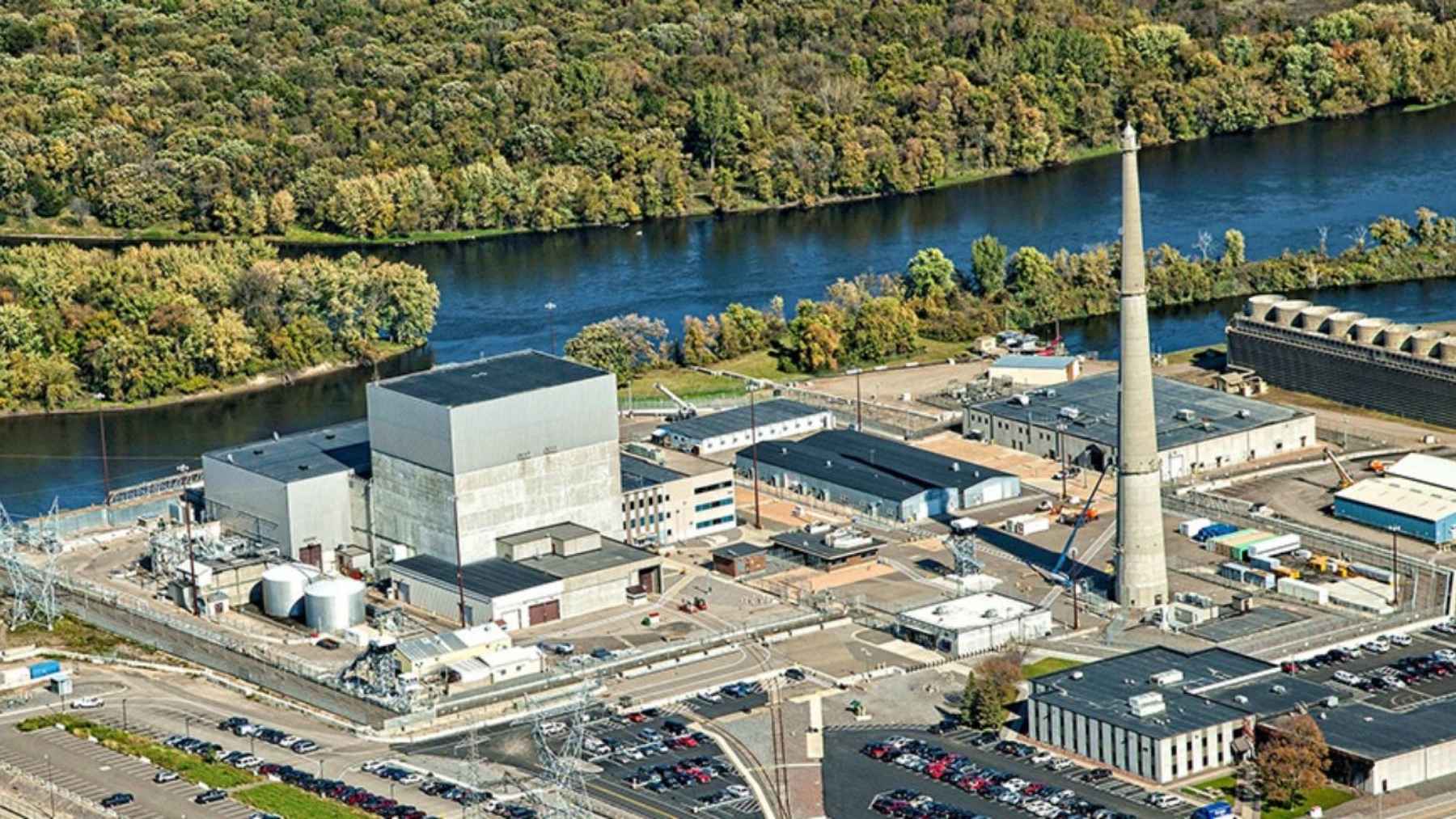

Ask anyone who fishes the Mississippi north of Minneapolis in February where the open water is, and they’ll point you at a nuclear plant. Xcel Energy’s Monticello plant, a single 671-megawatt boiling water reactor about 35 miles northwest of the Twin Cities, pulls river water in for cooling and sends it back warmer, so the stretch below the discharge stays open while everything around it’s locked in ice. Fish pile into it. Anglers follow the fish. There’s even a tournament built around the arrangement, called Freeze Your Bass Off, and it draws a decent crowd to the riverbank every February.
So what happens when someone turns the plant off the day before the tournament?
This February, we found out. On Friday morning, February 20, Xcel manually took the reactor offline for equipment repairs. The company said it’d worked with the equipment manufacturer on the fix and expected the plant to stay down for about 30 days. It didn’t say what had broken, and as far as I can tell it still hasn’t. The NRC’s daily reactor status reports, which are about as dry as government paperwork gets, list Monticello at 100 percent power that Friday morning and at zero the next, with the reason logged as “Maintenance Outage.”
Overnight, the river did what a Minnesota river does in February without roughly 290,000 gallons a minute of warm water pouring into it. It froze over, and by Saturday morning there wasn’t much left to fish beyond one small patch of open water.
So what did the anglers find?
Alec Wieker founded the tournament, and it’s now in its fourth year. Saturday’s high was 20 degrees with a strong wind, and 84 anglers showed up anyway, because that’s pretty much the point of an event called Freeze Your Bass Off. Wieker told the Monticello Times the first thing out of his mouth when he walked up to the water was that they’d turned it off.
Then he saw the fish. “There were thousands and thousands of dead fish,” Wieker said. Roughly half were dead when the anglers got there, and by his description the rest weren’t far behind. Smallmouth bass, walleye, northern pike, carp and channel catfish, strung out along the shoreline. Wieker’s explanation matches what the MPCA said three years ago, with fewer syllables: upstream water in the low 30s moves in the moment the warm water stops.
The anglers fished anyway. Eighty-four of them landed four fish all day, and the winner weighed 4 pounds, 8 ounces. A year earlier, with the plant running and the thermometer stuck at 18 degrees after a blizzard, a field about the same size fished a normal tournament and the winning smallmouth went 4 pounds, 13 ounces. The colder day was the better one, and the only difference I can see is the plume.
The state agency’s version
The Minnesota Pollution Control Agency confirmed the connection a couple of days later. Becky Lentz, the agency’s director of communications, said the maintenance at the plant “caused warm water discharge to the Mississippi River and led to a fish kill,” and that the MPCA would keep monitoring while the plant stayed down. The agency hasn’t published a count or a species list, so the only number anyone has is Wieker’s. The Department of Natural Resources, when asked, pointed reporters to the MPCA.
Xcel’s statement came through spokesman Theo Keith, who said the company acknowledged “the timing was unfortunate due to the impact to anglers.” No one’s accused the utility of breaking any rule, and I can’t find an enforcement action tied to the event. That matters, because what’s left to argue about is physics, and Xcel’s own people have explained the physics before.
So how does a reactor keep a river open?
A nuclear plant is a steam plant. The reactor boils water, the steam spins a turbine, and then the steam has to be turned back into water so it can go around again. That’s the condenser’s job, and it needs a huge, constant flow of cold water. Monticello is licensed for 2,004 megawatts of heat and turns 671 of those into electricity. The rest, call it 1,300 megawatts, has to go somewhere, and the somewhere is the Mississippi.
The plant runs on river water almost all of the time, about 98 percent of its hours by the NRC’s count. It pulls straight from the river, up to 645 cubic feet a second under its state permit, warms the water up and sends it back down a discharge canal. The NRC’s environmental review for the plant’s last power uprate puts that canal somewhere between 66 and 95 degrees depending on the season.
Now the fish. Fish are cold-blooded, so their bodies run at whatever temperature the water happens to be. In a river barely above freezing, a smallmouth bass basically idles until spring, while in a plume in the 60s it keeps feeding, which is why the fishing below Monticello is good in February. Take the plume away in a few hours and the fish that gathered in it don’t get a chance to swim somewhere warmer, because there isn’t anywhere warmer. The DNR has a name for it: thermal shock.
This has happened before, and it was smaller
In 2015, a reactor pump problem tripped the plant in late fall, and the Star Tribune reported the water near the discharge dropping from about 65 degrees to 40 in a few hours. Xcel counted 59 dead fish: crappies, sunfish, bass, catfish and carp.
In March 2023, Xcel took the plant down on purpose to fix a pipe that had been leaking tritium-tainted water into the groundwater, and Keith told KSTP the company “powered down the plant slowly to mitigate the impacts.” The count that time was 230, and the MPCA’s release called the kill “unfortunate but not unexpected,” which is about as close as a state agency gets to saying that’s just what happens when you switch the plant off.
Keith also told the Star Tribune back then that the utility tries to steer clear of winter shutdowns, since that’s when the gap between the plume and the river is widest. February’s about as wide as that gap gets. So a shutdown in the coldest stretch of the year, with the fish packed most tightly into the warm water, was arguably the worst-case version of a problem the company had already described in public. I can’t tell you whether the repair could’ve waited for April, because Xcel hasn’t said what the repair was.
So what did Xcel fix, and when did it come back?
The 30 days turned into about six weeks. The NRC log shows the reactor at zero into the first days of April, tripping a recirculation pump on the way back up, and at 100 percent by April 8. Xcel never named the equipment it was repairing, and I couldn’t find an NRC event notification for the shutdown, which fits a planned manual shutdown rather than an emergency. If you’re wondering about safety, the company said there was no risk to nearby residents, and the regulator’s logs don’t suggest otherwise.
What strikes me about the whole thing is how ordinary it was. Monticello didn’t lose a reactor to jellyfish the way the Gravelines plant in France did this summer, and it didn’t get buried under millions of gizzard shad like Canada’s biggest nuclear plant. In those stories the animals shut the reactor down. Here the reactor went off on its own schedule and the animals paid for it, because a plant that’s been warming one stretch of river since 1971 has basically trained the fish to live in its exhaust.
A bigger intake screen won’t help here, since the fish aren’t going into the plant. The only lever is timing, and Xcel said itself three years ago that winter is the time to avoid.
Monticello was listed at 100 percent power in the NRC’s daily status report for October 5, 2026, and the fish below it will need it to stay that way through February.