
AI data centers have a power and water problem nobody likes to say out loud. The machines training the models you’ve been chatting with are swallowing electricity and freshwater fast enough to crash into local grids and pick fights with city councils across the US.
Which is why it’s worth dragging a quieter story back up from a few years ago, because the fix may have been sitting on the seabed off Scotland the whole time.
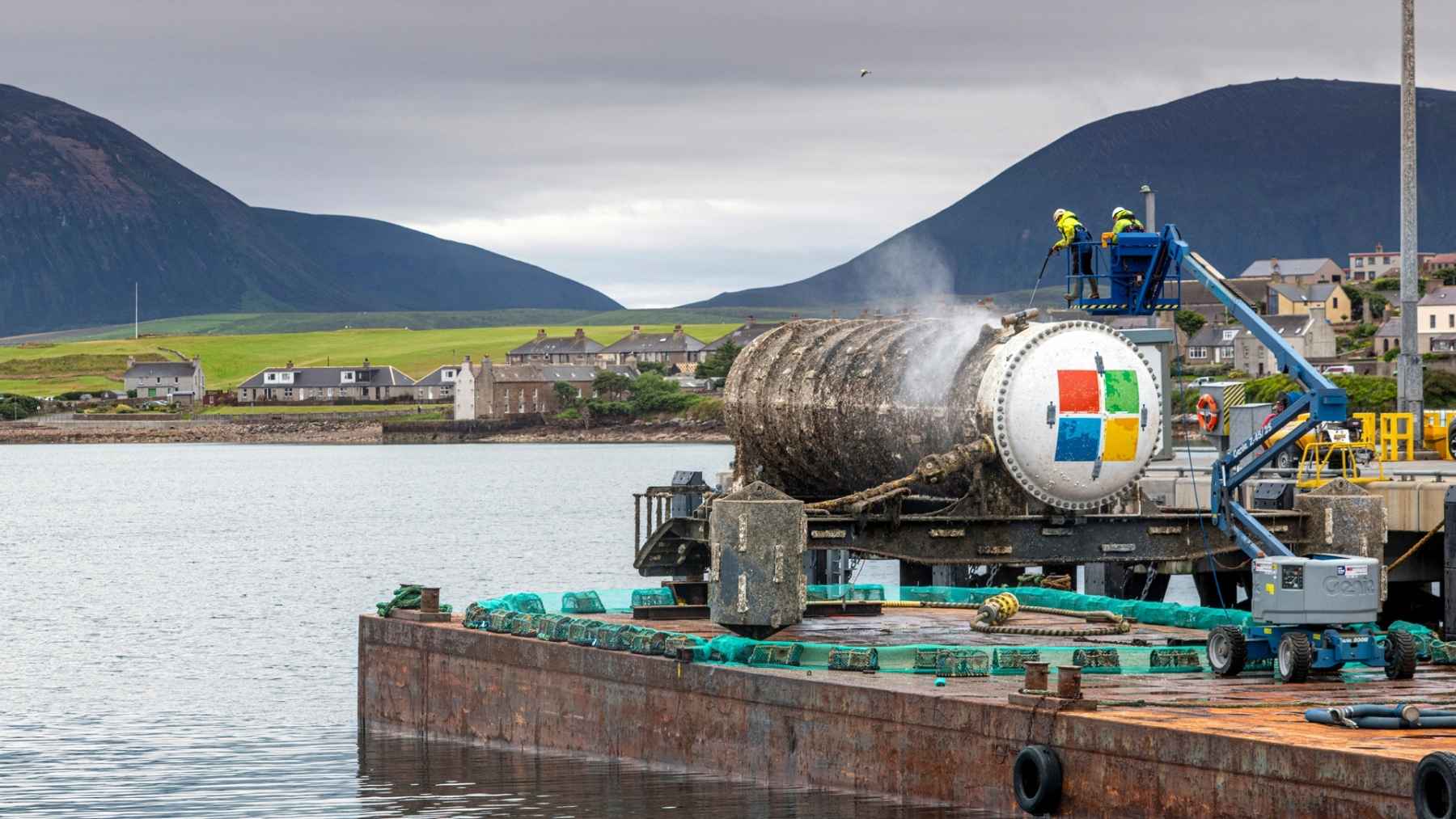
It was 117 feet under the North Sea, off the Orkney Islands, sealed inside a white steel cylinder about the size of a shipping container. Microsoft dropped it there in 2018 as part of something called Project Natick, left it alone for two years, then hauled it back up to see what the ocean had done.
The short version: the ocean barely touched it, and the servers inside ran better than the identical ones Microsoft kept running on land. And in 2026, that result stopped being a curiosity, because someone just switched on the production version.
What Microsoft actually sank
The cylinder, nicknamed Northern Isles, was not a scrappy proof of concept. It packed 855 servers across 12 racks, held 27.6 petabytes of storage, and drew a total of 240 kW, roughly 20 kW per rack.
Before it went under, the team pumped out all the ordinary air and replaced it with dry nitrogen. No oxygen means no oxidation on the components, no humidity working into the boards, and no human elbow knocking a cable loose, because nobody is allowed inside a sealed tube on the seafloor.
Then the whole thing was bolted to a ballast-filled triangular base and lowered next to the European Marine Energy Centre, one of the rougher patches of water in Europe and exactly why they chose it. The logic was blunt: survive there and you survive anywhere. The site had a second selling point.
Orkney’s grid runs on close to 100% renewable power, fed by wind plus the tidal and wave devices being tested at EMEC. A data center that gets cooled by the sea and powered by the weather above it, with no freshwater bill, is precisely the combination every AI infrastructure planner is currently losing sleep over.
The failure rate that broke the assumption
When the cylinder surfaced in the summer of 2020, one number did the rounds: the servers underwater failed at roughly an eighth the rate of the ones on land. Project Natick lead Ben Cutler put it plainly in Microsoft’s own writeup, saying the team’s “failure rate in the water is one-eighth of what we see on land.”
The raw numbers are sharper than the ratio. Microsoft lost six of the 855 servers in the sea. The control group running the same jobs in an ordinary data center on land lost eight, out of just 135. That works out to a 0.7% failure rate underwater against 5.9% on land.
Two things were doing the heavy lifting: the cold North Sea hauling heat away for free, and the nitrogen-plus-no-humans setup killing the slow corrosion and accidental-bump damage that quietly chews through land servers over time. It turns out the healthiest place for a hot rack is a sealed tube nobody is allowed to touch.
Why a 2020 footnote reads like a 2026 blueprint
Back in 2020 this was a neat engineering story. Now it’s a roadmap.
Training runs are pushing GPU clusters into power densities ordinary buildings can’t cool without burning through freshwater, and grid operators in Virginia and Texas are openly resisting new data center hookups. It’s the same strain pushing utilities to lean on giant battery fleets and developers to plan multi-gigawatt power campuses just to keep the lights on.
A sealed pod offshore sidesteps both halves of the problem at once: the sea absorbs the thermal load using zero freshwater, and the wind farm overhead handles the power.
The efficiency math is what makes planners stare. Natick posted a power usage effectiveness of 1.07, the ratio of total power drawn to the power the servers actually use. A score near 1.0 means almost nothing is wasted on cooling and overhead. Land-based hyperscale sites have spent years clawing down toward 1.2, and the wider industry still mostly sits above 1.5. Northern Isles hit 1.07 with no mechanical cooling at all.
Microsoft proved it, then walked away
Here’s the awkward part. Despite the numbers, Microsoft quietly shut Natick down, a decision it confirmed in 2024. Noelle Walsh, who runs Microsoft’s Cloud Operations and Innovation group, told Data Center Dynamics flatly: “I’m not building subsea data centers anywhere in the world.”
She allowed that the project had worked, and said the lessons on operating below the surface would feed into other efforts, mostly land-based liquid cooling and data center robotics. Part of the retreat is the brutal logistics of sending a technician to fix anything that breaks 117 feet down in a stiff current. Part of it is that Microsoft has spent the last few years pouring concrete on land at a pace it has no interest in slowing.
China just switched on the production model
Other players were less squeamish, and this is the part that turns a shelved experiment into a live race. In May 2026, a Chinese firm called HiCloud brought an offshore-wind-powered underwater data center off Shanghai’s Lingang district into full commercial operation.
It is the thing Microsoft demonstrated and then abandoned, except built for production: around 24 MW of capacity, roughly 2,000 servers including GPU clusters tasked with AI training and big-data work, sealed in pressure-resistant modules on the seabed, cooled by seawater, drawing power straight from nearby offshore wind.
The roughly $226 million facility scaled up from a 2.3 MW demonstration phase, and Chinese media put its PUE below 1.15. HiCloud has talked about pushing the model toward 500 MW.
It didn’t come from nowhere. HiCloud first sank servers off Hainan in 2021 and stood up its first commercial underwater pods there in 2023, part of a stated Chinese plan to deploy 100 underwater data cabins over five years. The cylinder Microsoft pulled out of the North Sea is, in effect, the reference design everyone else is now iterating on, while the company that built it watches from dry land.
The reef nobody planned for
One more detail is worth sitting with, because it cuts against the assumption that this hardware has to be ugly. When Microsoft raised Northern Isles, the outside of the tube had quietly become a small reef. The company’s own account describes a thin coat of algae and barnacles on the steel, and sea anemones grown to the size of cantaloupes in the sheltered nooks of the ballast base.
It’s the same thing happening on the foundations of offshore wind turbines, which have turned into accidental marine sanctuaries off the Dutch and British coasts. So the full picture is a wind turbine spinning above the surface, a server cylinder humming below it, and a colony of melon-sized anemones redecorating the outside.
What it means for the next build
None of this means the next big AI cluster is getting sunk off Long Island next quarter. Salt water still eats steel, a sealed pod is a nightmare the moment something inside it fails, and the permitting paperwork to drop hardware in coastal water near a major US city would make most CFOs cry. There’s a reason the company that proved the concept walked away from it.
But the engineering case is already closed. A cold ocean and a wind farm can power and cool a data center at an efficiency land sites can’t match, with a failure rate around an eighth of theirs, using no freshwater at all. AI’s infrastructure crunch won’t be solved by one clever idea.
Still, the next time someone insists the only way to feed the models is another inland gas peaker and another drained aquifer, it’s worth remembering there’s a barnacle-covered tube in a Microsoft warehouse that suggested otherwise, and a 24 MW version of it now humming off the coast of Shanghai.
 xavierx ROOKIE2 months ago