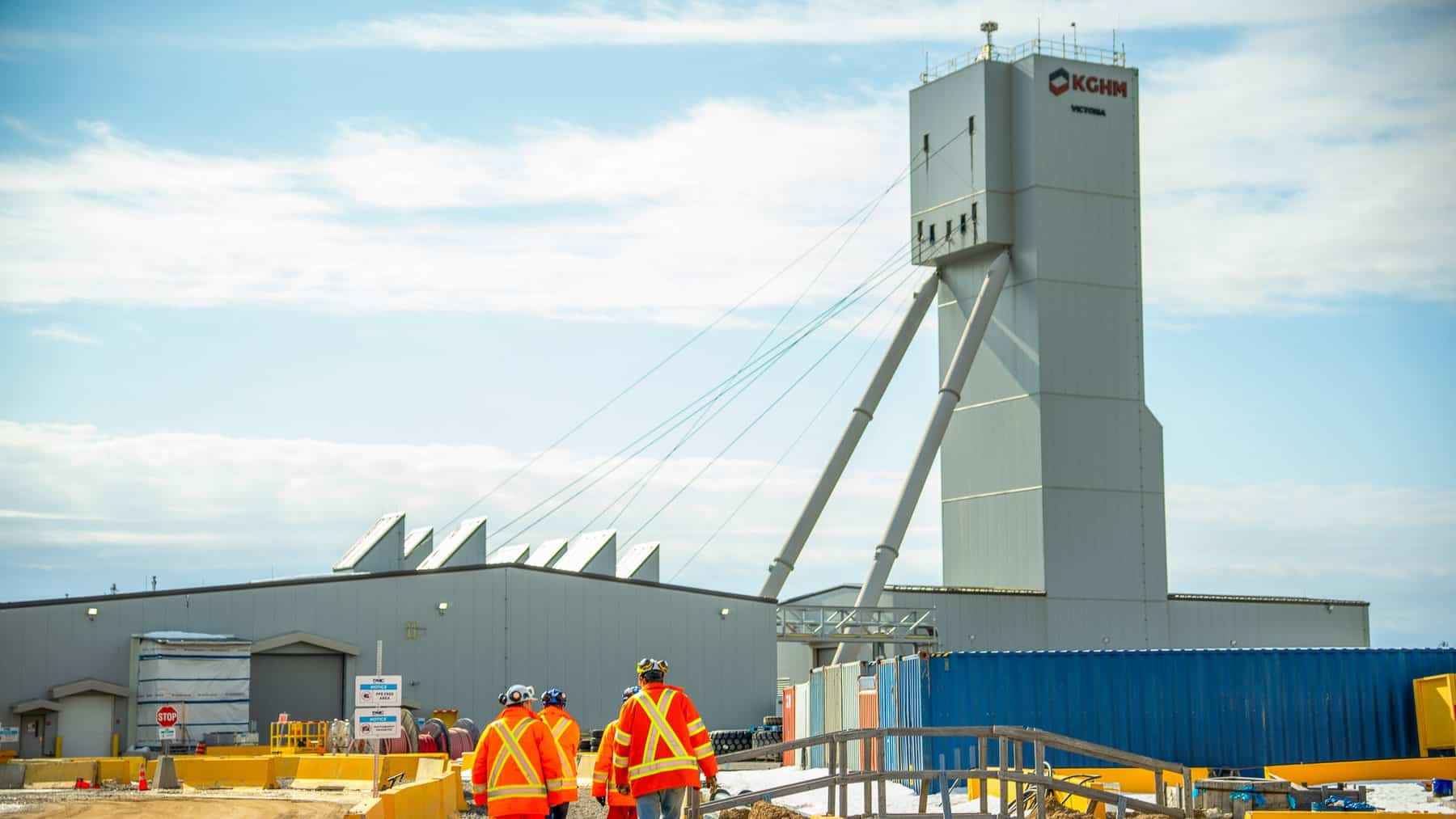

More than 12 years ago, a KGHM manager told the Greater Sudbury Chamber of Commerce that the company’s new nickel and copper mine in Ontario would be up and running in about five years. It isn’t. Frankly, you can’t even call it a mine yet. What KGHM’s got out there right now is a really big hole.
That hole keeps getting deeper, though. KGHM, a Polish copper producer, said in a post on X in late October that its Victoria project shaft, about 22 miles west of Sudbury, has reached 5,265 feet. It’s 22 feet wide, or about as wide as a two-car garage.
If you’re doing the math at home, that’s 15 feet short of a mile. Depending on how the last week or so has gone down there, it may have crossed that line already. I can’t find a newer number from KGHM.
So why would anyone dig nearly a mile down for a mine they haven’t formally decided to build?
Deep mines need two ways in
A mine this deep basically needs one shaft to haul rock out and another to move air, since nobody lasts long underground without a steady supply of it. KGHM’s project page lists both for Victoria. This one’s the air shaft, or it will be.
That’s according to Steve Dunlop, KGHM International’s general manager for Canada, who spoke to International Mining over the summer. KGHM’s own post calls it the “main shaft,” which threw me for a minute. I’d go with Dunlop here, since the shaft that’ll actually hoist the ore doesn’t exist yet. It’s planned at about 25 feet wide and it’s supposed to go below 6,560 feet. It also won’t get started until KGHM signs off on a final investment decision.
Until then, this shaft’s doing a second job as a scouting trip. Every 650 feet or so from the 3,940-foot level on down, there’s a station (basically a side room cut off the shaft) where a diamond drill can bore out into the rock. KGHM says that drilling is running at around the 4,590-foot level now, and the whole campaign should add up to about 37 miles of holes.
Why bother? Geologists sort ore into categories, and “inferred” is pretty much their way of saying they’ve got good reason to think it’s there. “Measured” means they’ve drilled it closely enough to plan a mine around it. KGHM wants to turn more of the first kind into the second, and find more ore while it’s down there.
Then there’s the bulk sample. At around 5,900 feet, KGHM plans to pull a big batch of ore and send it to an outside mill to see what kind of concentrate comes out, concentrate being the metal-rich stuff that goes on to get refined. That seems pretty sensible to me. You’d want to know how your ore behaves before you pay for a second, wider shaft.
But how deep is 5,265 feet, really?
Well, the Empire State Building tops out at 1,454 feet if you count the antenna, so you could stack more than three and a half of them in this thing. They wouldn’t fit, given the garage situation, but you get the idea.
It’s not a record, though. Glencore’s Onaping Depth project, also in the Sudbury area, reaches an ore body nearly 8,530 feet down, and Kidd Creek in Timmins bottoms out at 9,889 feet. The Polish outlet WNP says you’d need more than 9,840 feet just to crack the world’s 10 deepest shafts.
It’s a bigger deal inside KGHM. Polish press reports it’s now the deepest shaft in the whole company, ahead of the 4,423-foot Głogów Głęboki shaft back home.
The ore starts at 3,855 feet
Dunlop says the resource runs from about 3,855 feet down to 7,054 feet, so the shaft’s already deep enough to sit inside that range. I can’t tell you how close it actually runs to the ore, because I haven’t found a drawing that shows it.
Ontario’s mining ministry puts the deposit at about 16 million tons grading 2.5% copper and 2.5% nickel, according to Canadian Mining Journal, and there’s cobalt, platinum, palladium, gold and silver in there too. KGHM’s plan is to pull about 3,860 tons a day for 14 years and send the ore to Vale’s Clarabelle plant in Sudbury, since Victoria won’t be processing its own.
If you’re wondering why anyone goes this far down for it, you can blame outer space. NASA says an object slammed into this part of Ontario about 1.8 billion years ago and left a crater at least 120 miles across, and the basin it left behind is loaded with nickel and copper ore.
The Victoria name isn’t new, either. Ore first came out of that property back in 1899, according to the same journal, so this is kind of a comeback rather than a debut. The neighborhood’s getting busy again as well, with Magna Mining approving a new ramp into the flooded Crean Hill mine, also about 22 miles west of Sudbury.
The plan is all batteries
Deep mines have a heat problem. Air warms up as it gets squeezed on the way down a shaft, and diesel engines dump more heat and exhaust on top of that, so you’ve got to push a lot more air through and often chill it too.
Serge Tousignant, the project’s technical services and commercial manager, told International Mining that KGHM ran battery machines against a diesel baseline in its studies, and that “the BEVs stack up well.” BEV just means battery-electric vehicle. He says going that way cuts how much air the mine has to move and how much cooling it needs, which let KGHM design around a ventilation system based on the surface. He also says lifetime costs look lower than diesel, though that’s KGHM’s own modeling, so take it for what it is.
Polish outlet WNP adds that the rock at these depths runs cooler than it does at KGHM’s mines in Poland. It doesn’t give a temperature, and I can’t find one.
A mine is arguably a better fit for batteries than your driveway is. Nobody down there is towing a boat to Florida, and every diesel you leave on the surface is heat you don’t have to pull back out. None of that fleet’s down there yet as far as I can tell, though. It’s still a plan.
So when does it open?
Not soon. KGHM told investors on an earnings call about two years ago that the shaft was at around 1,970 feet, and it’s at 5,265 feet now. Dunlop had it at 4,869 feet on July 6, which works out to about 395 feet in roughly 16 weeks, or around 3.5 feet a day.
Keep that pace and you’d reach 6,102 feet around next summer. That’s my napkin math, not KGHM’s, and it doesn’t account for whatever else the crew has to stop and do. KGHM hasn’t given a date for the shaft itself, at least not anywhere I’ve looked.
KGHM says the project’s on schedule and on budget, though it hasn’t put a current price on it that I can see. CBC reported a few years back that the whole thing was expected to top $1 billion. I’d call that pretty patient money.
Dunlop expects the advanced exploration phase to run until about mid-2028, and KGHM’s late-October update has construction wrapping up in the middle of next decade.