
Subsea inspection has a cost problem. The issue is, you don’t really see until you price a job. Checking a pipeline, a cable route, or a wind farm foundation usually means a crewed support vessel, a launch-and-recovery team on deck, and day rates that keep running while everybody waits out the weather. The robot doing the actual inspection might weigh a few hundred pounds. The ship that exists to babysit it can run to thousands of tons.
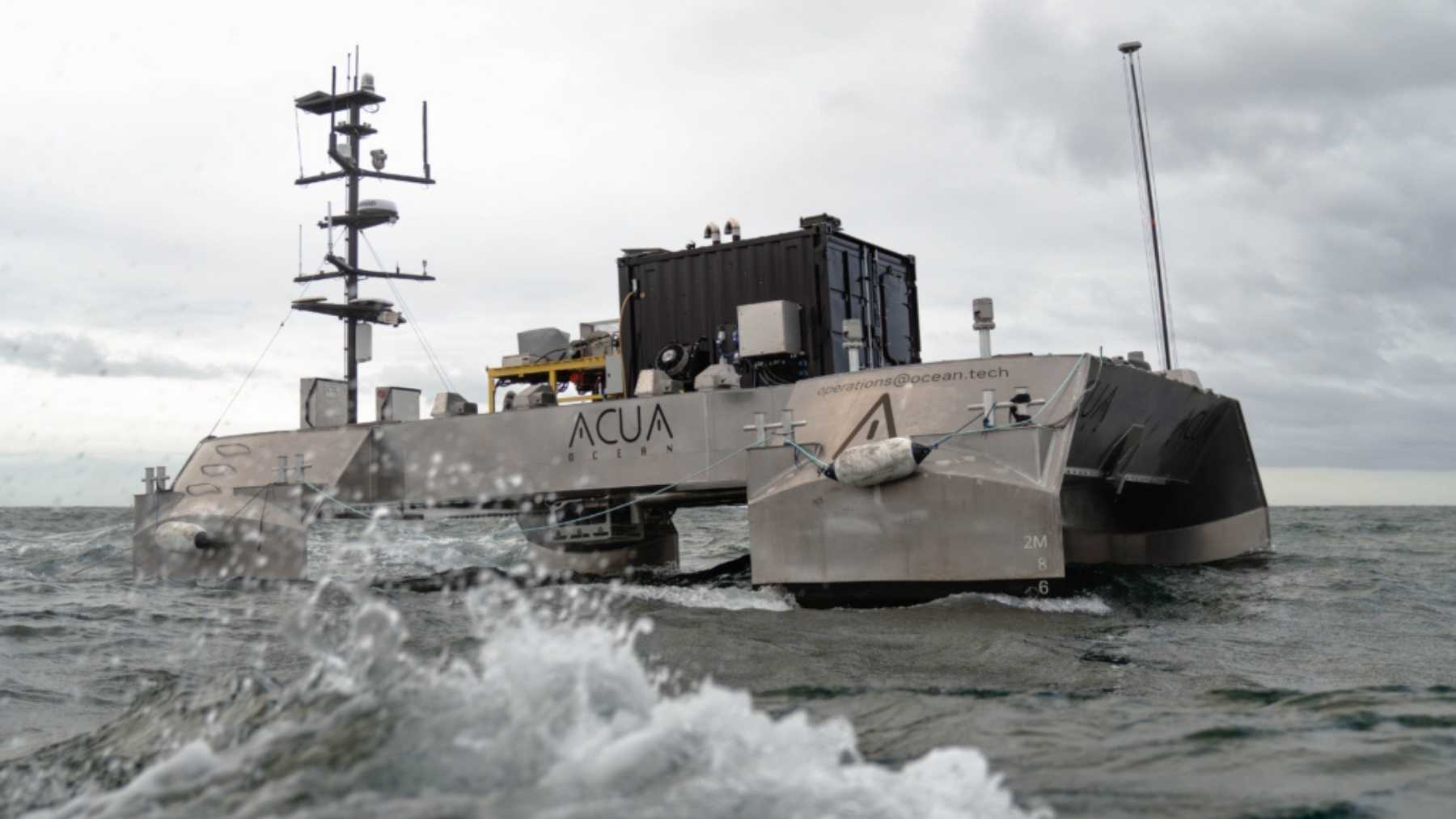
Two companies just finished a three-week campaign in Plymouth, England, where the babysitter wasn’t there. ACUA Ocean’s USV Pioneer, a 47-foot crewless boat, launched and recovered the ARGOS, a 375-pound remotely operated vehicle built by France’s Forssea Robotics, more than 40 times, with every launch, dive, and recovery commanded from shore. Nobody was on the water at all. The pilots sat in control rooms in England and France, and for one dive, the German military tuned in live from a third country.
Both companies announced the finished trials on September 28th.
So what’s actually hard about this?
Getting an underwater robot into the water isn’t the tricky part. You can honestly shove one over the side, and gravity handles the rest. Getting it back aboard a deck that’s rising and falling with every wave, with no deckhand there to grab the tether, is what keeps most of this work tied to big crewed ships. And as far as I can tell, that recovery step is exactly what this campaign was built to hammer on.
Over six days of actual sea time inside the three-week window, the pair logged more than 40 launch, dive, and recovery cycles, eight of them in a single day. The ARGOS reached and inspected the seabed in 66 feet of water with up to 115 feet of tether out, and dive operations ran in waves of around 3 feet, with winds averaging 18 knots and gusting to 30 knots (about 35 mph for land lovers). A separate set of runs south of Plymouth’s breakwater took place in 6.6-foot waves, and the companies say the robot came through them without damage.
The dives covered real inspection targets, too. The ARGOS filmed a wreck called the Poulmic, then located and filmed a concrete target block and a seabed feature in Cawsand Bay. That’s the same kind of task list a crewed inspection campaign gets paid to work through.
So what keeps a 47-foot boat that steady?
Pioneer isn’t a normal-looking boat, but that’s sorta the point. It’s a SWATH, short for small waterplane area twin hull, which basically means the buoyancy lives in two torpedo-shaped hulls running below the surface while the working platform stands above the water on narrow struts. Waves can only push on what they can touch, and a SWATH gives them almost nothing to grab at the waterline. Picture a shed standing on two small submarines, and you’re pretty much there. Oceanographers have used the layout for decades for exactly this reason.
Baird Maritime’s vessel review puts the aluminum boat at 46.6 feet, running on two 40-kilowatt electric drives, roughly 54 horsepower a side, and the trade magazine Uncrewed Systems Technology lists its displacement at up to 28 tons. ACUA Ocean built it as a hybrid-electric platform designed to take either a gaseous hydrogen or a low-emission diesel powertrain, and the company says wave-tank research at the University of Southampton showed stability on par with a single-hull vessel three times its length.
Neil Tinmouth, ACUA Ocean’s CEO, said the trials prove the setup can “open a weather window that conventional crewed vessels cannot work in.” That’s his sales pitch to make. But 30-knot gusts are the sort of forecast that cancels plenty of small-boat survey work, so the claim has at least some weather data standing behind it.
Two control rooms, one robot, and a German audience
ACUA Ocean ran the operation from its remote operations center at Turnchapel Wharf in Plymouth, while Forssea simultaneously supervised from its headquarters in Sète on France’s Mediterranean coast. One dive was live-streamed to Eckernförde, Germany, for the Bundeswehr’s Cyber Innovation Hub, which is a sentence I didn’t expect to type about a harbor inspection robot.
Flying the thing takes more than a video feed. The GPS dies a few inches down, so Pioneer carried a pole-mounted Sonardyne Mini-Ranger 2, an acoustic positioning system that pings a transponder bolted to the ARGOS, and calculates the robot’s position from the reply. The boat held station over each dive site using manual control and dynamic positioning, basically thrusters making constant small corrections so the hull doesn’t wander off and drag the robot around by its own tether. With the boat parked, a pilot hundreds of miles away can fly the inspection like the robot’s in a test tank.
So why is a space agency paying for boat trials?
The campaign ran under a contract with the European Space Agency, and that’s pretty much all the announcement says about it. I can’t find a program name or a project description attached. My guess is connectivity, since running a boat and a robot from two countries at once lives or dies on satellite links, and satellites are very much ESA’s department. Take that as informed speculation.
Turnchapel Wharf, meanwhile, keeps showing up in these stories. We covered a crewless boat at the same Plymouth wharf launching two robot sailboats in August, and a 56-foot drone boat with a shipping-container slot cut into its deck got its name there this summer. Somebody should test the water to find out what’s causing this.
Gautier Dreyfus, Forssea’s CEO, said he came away impressed with how Pioneer handled the sea state and congratulated ACUA’s engineers, with both companies pointing to a next phase that doesn’t have a date or a customer attached yet. Honestly, six days after the announcement, I wouldn’t expect one.
ACUA Ocean and Forssea Robotics closed the books on September 28th, 2026 after more than 40 dives of a 375-pound robot across six days at sea. The nearest pilot a wharf away in Plymouth. And the farthest one is sitting on the Mediterranean.