
Every navy on earth is currently locked in the same argument, and it is an expensive one. How many billion-dollar warships can you afford, how long until they show up, and what happens to the map you are trying to watch while you wait. Australia is running that same math on nuclear-powered submarines it won’t see float an Australian flag until the early 2030s at the earliest. So you’d figure the country’s ability to watch its own coastline is stuck in a waiting room for the next decade.
Then there’s the boat that just got named in a shed in the Hunter Valley. It is 24 feet long, carries nobody, buys no fuel, and Canberra just ordered 40 of them.
In late June, Minister for Defence Industry Pat Conroy christened the first hull of a machine called the Bluebottle at a boatbuilder’s facility north of Sydney. It is the opening unit of a AUD$176 million (about US$122 million) order that will take Australia’s fleet of these things from 15 to 55, which by the government’s own description makes it one of the largest fleets of uncrewed surface vessels anywhere in the world. And the whole pitch rests on one deeply unglamorous idea: a patrol boat that never has to come home.
A patrol boat that runs on weather
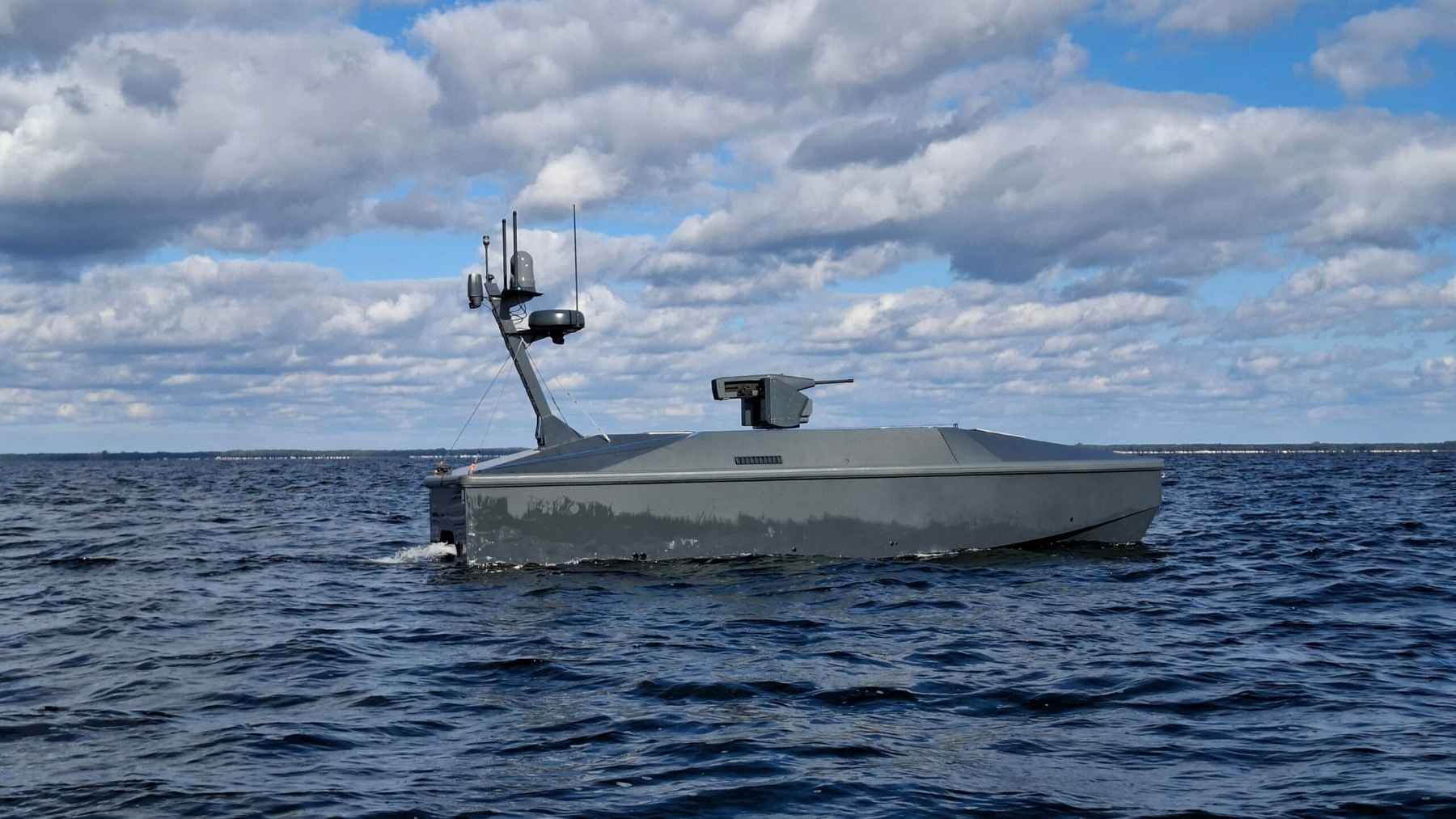
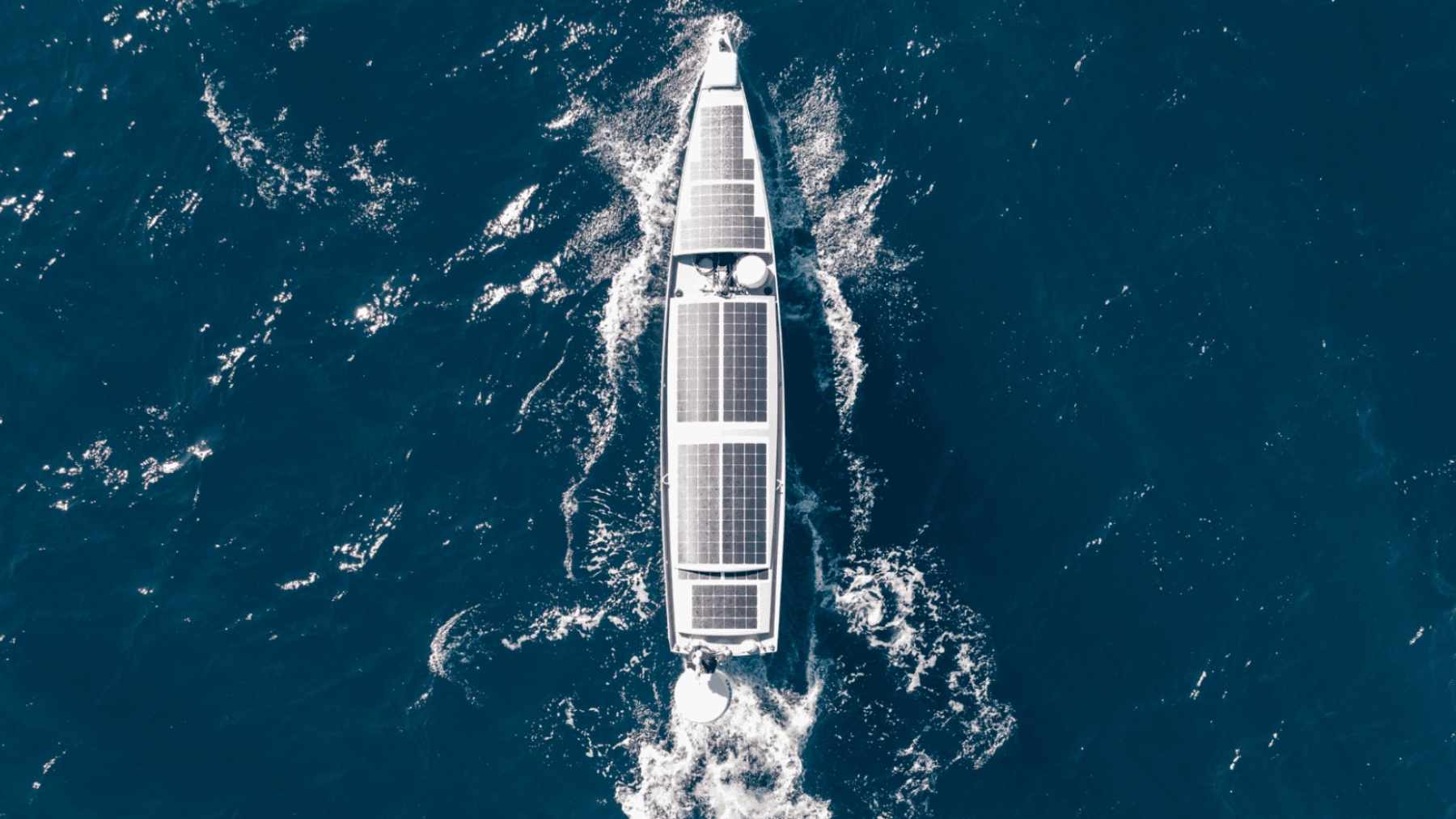
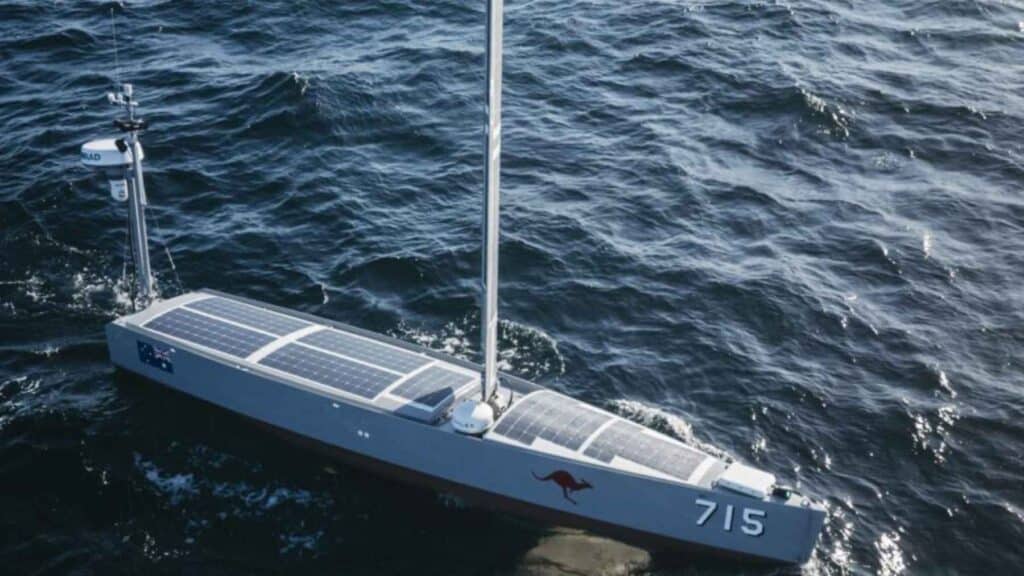
The Bluebottle is built by Ocius Technology, a Sydney outfit that has been at this for more than two decades. The machine itself is almost aggressively simple to describe. It is a 7.4-meter fiberglass hull with a hard sail sticking up top, a keel hanging underneath, and no engine in the conventional sense at all.
Power comes from three sources, all of them free. The deck and the sail are covered in solar panels. The sail itself is rigid, so it works the wind like any other yacht. And the keel does something cleverer: as the hull pitches up and down in the swell, a patented underwater fin converts that motion into forward thrust. Sun, wind and waves, harvested at the same time. According to Ocius’ own specifications, the boat is rated to keep working in sea state 8, which on the Beaufort scale is the kind of weather where crewed boats are thinking hard about heading for port.
There is a diesel version too, called the Bluebottle Hybrid, which bolts a generator onto the same hull for high-latitude winters and power-hungry payloads. But the standard boat runs on the ocean and nothing else.
The numbers that matter here are the boring ones. Ocius says the platform delivers up to 300 operational days a year, can stay at sea for months at a stretch, and holds a company record of more than six months continuously in the water without refueling or human intervention. The vessels have been in service with the Royal Australian Navy since July 2024. For a machine whose entire job is watching an empty patch of ocean until something shows up, endurance isn’t a nice-to-have. It’s the whole product.
Where the fleet actually is
Australia already owns 15 of these, and most of them are working right now. They support Operation Resolute, the Australian Defence Force’s border-security mission, running 24/7 out of the country’s northern approaches and feeding back persistent surveillance on anything moving across a very large stretch of water.
The new contract, announced back in March and formalized with that hull christening in June, adds 40 more. The math is straightforward: 15 plus 40 gets you to 55. The five-year deal also comes with a new state-of-the-art factory in Sydney to build the fleet, backed by a hull line in the NSW Hunter region run by Van Munster Boats, a composites shop Ocius has worked with for a decade. The hull Conroy named forms part of vessel BB 716, the first built under the program.
If you want a sense of how the industrial side is scaling, Ocius and Van Munster have talked about a mold capable of producing up to 300 hulls a year, one roughly every four days if it ever came to that. Nobody is building at that rate today. But the tooling exists, which tells you something about where they think this is going.
What 40 robot boats are actually for
Two jobs, mostly. The first is the surveillance work the fleet already does: persistent intelligence, surveillance and reconnaissance, the unglamorous business of parking a sensor somewhere and leaving it there for weeks. Ocius CEO Robert Dane likes to call the boats “satellites of the sea,” which is marketing, but it captures the idea. A constellation of cheap, quiet platforms that just sit and watch.
The second job is the one that makes navies pay attention: anti-submarine warfare. The Bluebottle carries its sonar array in a winch that lives in the keel, a cassette that displaces water ballast so deploying or swapping the sensor doesn’t upset the boat’s trim. Because the vessel makes almost no noise of its own, it works as an acoustically quiet picket, listening for the things that don’t want to be heard. That low signature is the point. A submarine hunter that announces itself with engine noise is not much of a hunter.
Defence Industry Minister Conroy told reporters in Canberra earlier this year that the government is also looking at arming the platform, exploring options to deploy smaller drones from the boats and to fit “armed packages to provide kinetic solutions,” per Australian Defence Magazine. That is a long way from a firm capability, and the boats are surveillance assets first. But the modular design leaves the door open.
The part that just got smarter
The endurance is solved. The next problem is people. Right now, running a fleet of these boats still takes operators watching screens, and 55 vessels is a lot of screens. So the newest piece of the story, announced on July 2, is a collaboration between Ocius and UNSW Canberra to build better autonomous control systems for the fleet.
The goal is to let one person manage several boats at once instead of one at a time. According to Defence Connect, the project is building what the team calls a “predict-then-optimise” model that uses AI to forecast how the boat will sail in given conditions and manages its power use to match. Ocius project investigator Nick Rozenauers framed it as a way to cut human oversight and let the Navy stretch a small crew across a bigger fleet.
It is the second research project between the two, following work on scaling up production. And it points at the real prize with any autonomous system: the platform is only cheap if you don’t need a room full of people to babysit it. Solve the boat, then solve the operator, and the whole thing starts to make sense at fleet scale.
Why this keeps happening in Australia
There is a pattern worth noticing here, and readers who followed the Ghost Shark drone submarine and the Ghost Bat combat drone already know the shape of it. Australia keeps fielding autonomous military hardware fast and cheap while its expensive crewed programs slip further into the 2030s and 2040s. The Bluebottle is the surface-water version of the same instinct: build it like a product, get it in the water, iterate.
The Bluebottle isn’t the only weather-powered boat working the world’s oceans either. American firms like Saildrone and Ocean Aero build their own solar-and-wind-driven vessels, and the US Navy has been experimenting with uncrewed surface craft for years. What Australia has done is commit to the idea at fleet scale with a firm order and a factory, rather than a demonstration and a press release.
The nuclear submarines will matter enormously when they finally arrive, and nobody at Ocius is pretending a 24-foot sailboat replaces a Virginia-class boat. But there is something clarifying about a defense program where the cheapest, slowest-moving-looking piece is the one already out there doing the job, powered by the exact weather everyone else is trying to keep their boats out of. The frigates are still being argued over. The Bluebottles are on station.
 @wesleyu ROOKIE3 months ago