
The complaint about drone defense on land has been the same one for years. Somebody flies a $2,000 quadcopter at a base, and the only thing on hand to stop it is an interceptor that costs more than a house. Run that trade a few hundred times and the cheap side wins on arithmetic alone.
The Pentagon has now written that argument into a shopping list for boats. In the last week of July, the Defense Innovation Unit opened a competition called Suitable Warfighting Adaptive Payloads, or SWAP-USV, with up to $100 million in prize money and a separate $200 million budgeted for whatever gets bought afterward.
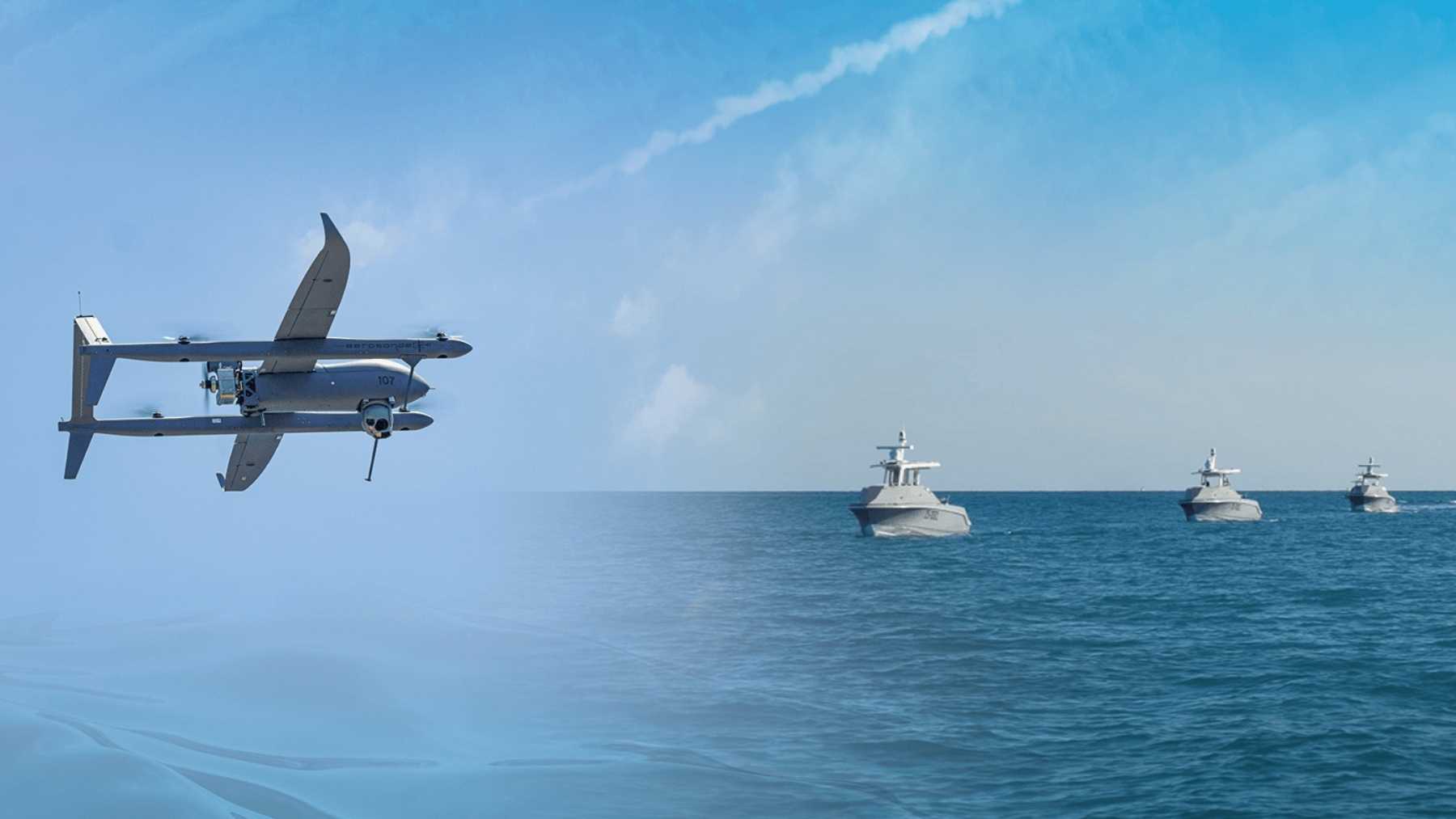
What it wants is a crewless boat that carries its own attack drones, throws them into the air while it is moving, and catches the reusable ones on the way back down.
Submissions for the first cohort close on August 10 at 11:59 pm Eastern. Defense News reported the solicitation on July 29, which leaves twelve days to write up a product that, per the rules, already has to exist.
The easy requirements come first
The performance floor is deliberately low. The boat needs a minimum operational range of 200 nautical miles and a sustained cruise of at least 10 knots. DIU calls those threshold numbers and says it expects the best entries to blow past them.
For scale, Saronic’s Corsair, the one the Navy already buys, is rated at over 1,000 nautical miles and 35-plus knots on a 24-foot hull. The bar is set where it is to keep the field wide open, not because 10 knots is impressive.
The aviation side is where the ask gets specific. Each entry has to carry, launch and control at least two drones, with at least one hauling a kinetic payload of 2 kilograms or more, roughly 4.4 pounds, and reporting back battle damage assessment afterward. DIU wants a mix of types: recoverable aircraft alongside single-use one-way attack birds.
Two kilograms is FPV territory. That is a racing quadcopter with a warhead taped to the nose, not a missile, and the whole point is that it costs a few thousand dollars instead of a few million.
Catching the drone again is the part almost nobody can do
Buried in the desired attributes is one line that quietly disqualifies most of the industry. If the drone is meant to come back, the solicitation says it has to manage “safe and repeatable recovery aboard the USV while underway,” in representative sea states, with minimal operator intervention.
Read that slowly. The landing pad is a small deck that is pitching, rolling and making way through a swell. There is nobody standing on it with a net. And it has to work every time, not once for the camera.
Launching off a moving boat is manageable. Landing back on one is the problem that has kept most maritime drone operations tethered to a crewed ship with sailors on deck to grab the aircraft.
The clearest public example of it working came two months ago, and it was not American. A German firm called CiS showed a sealed hangar, the ORKA Dock, that launches and recovers a drone from a crewless boat doing 15 knots, with a LiDAR altimeter reading the descent. Its founder called it a world first, and nobody has publicly disputed him.
That is the friction in this document. DIU states plainly that it is not interested in conceptual designs, developmental efforts or prototype-only solutions, and it wants an active production line for both the vessel and the aircraft. It is trying to buy off a shelf a capability that was being announced as a world first in May.
Twenty-nine days is the real entry fee
The August 10 deadline is only paperwork: a 15-slide deck in 16:9, submitted as a PDF. The filter comes after.
Companies that get down-selected for Sprint 1 have to produce a complete, mission-ready boat with the drone system already integrated, available for testing and evaluation within 29 days. Teaming arrangements that are not mature enough for the September evaluation get pushed to a later cohort.
Then there is the bill. Vendors cover all their own travel, logistics and deployment costs for the in-water testing. The government pays for its own people to show up and watch.
Testing runs in two stages. The first is at a site the vendor picks, covering autonomous transit, speed and endurance verification, underway drone launch and recovery, and sensor tracking.
The second is on government ground with military operators at the controls. That one adds navigation through active jamming, targeting coordinates handed over from off-board sensors, and simulated intercepts against maneuvering threats.
The target list runs from explosive speedboats to narco semi-submersibles
DIU names its threats openly: explosive uncrewed boats, Group 1 through 3 drones, “go-fast” smuggling boats and semi-submersibles. Group 1 through 3 is Pentagon shorthand covering everything from a hobby quadcopter under 20 pounds up to an aircraft of 1,320 pounds, which is a wide net.
Two of those four are not military. Go-fasts and semi-submersibles are drug-running hulls, and the second kind is genuinely hard to spot from the air, which is why cartels keep building them.
DIU has been working that specific problem from another direction since April, when it hired Textron to put rocket-armed Tsunami interceptor boats through the Navy’s Key West experiment and then into three months of joint operations with Southern Command and the Fourth Fleet, with the company’s own technicians riding along to run them.
What SWAP-USV adds is patience. A boat carrying its own aircraft can sit off a stretch of water for days, put a drone up when something moves, follow it, identify it and strike it if ordered, then get the drone back and wait for the next one. The solicitation asks the boat to shadow a vessel of interest and intercept an uncooperative, maneuvering one by itself, though it stops short of requiring that.
America spent July proving the other half of this
The offense is already settled. On July 12, three Saronic Corsair boats struck a submarine and ship maintenance facility at Iran’s Bandar Abbas naval base, which US Central Command confirmed the following day as the first time American forces had used sea drones in combat.
Five days later, off Kauai, the Navy did it again in an exercise. Two Global Autonomous Reconnaissance Craft from Unmanned Surface Vessel Division 32 went in against the hulk of the decommissioned amphibious assault ship Peleliu during a RIMPAC sinking exercise, one running past holes already torn by missiles from a submarine, aircraft and shore before detonating at the waterline, the other filming it.
Peleliu went down in 15,000 feet of water more than 50 nautical miles north of the island, according to the Navy.
Both of those boats are one-way trips. So is the Ukrainian Magura, the family that started this whole conversation and is now heading for licensed production in Oregon and South Carolina.
SWAP-USV is asking for the opposite economics. The boat is supposed to survive, come home and go back out. Only the small aircraft it throws are expendable, and half of those are supposed to fly home too.
The prize pot is smaller than one contract the Navy already signed
The $100 million splits across three sprints, each with its own pot and its own window:
- Sprint 1, up to $40 million. Submissions by August 10, in-water testing this fall, stated objective of forward operational fielding inside 120 days.
- Sprint 2, up to $40 million. Submissions in the fall, testing in early 2027, aimed at expanded payloads, better autonomy and multi-vendor integration.
- Sprint 3, up to $20 million. Submissions in spring 2027, testing that summer, goals still unwritten.
Add the $200 million set aside for follow-on prototype and production agreements and the whole ceiling is $300 million. The Navy’s single Corsair production contract, awarded in December 2025, was $392 million on its own.
So this is not a fleet purchase. It is the Pentagon paying to find out who can actually do the trick, with a procurement wallet attached in case somebody can.
It is also, right now, most of what DIU is doing. The office’s open solicitations board currently lists exactly two live opportunities, both prize challenges filed under autonomous warfare, and zero conventional commercial solutions openings.
The Navy’s own drone boat program is sitting in federal court
The contrast is hard to miss. While DIU runs a twelve-day open call, the Navy’s formal Medium Unmanned Surface Vessel effort is being litigated.
Blue Water Autonomy and Saildrone filed complaints in the US Court of Federal Claims on July 14, alleging they were improperly cut from a program that had selected seven other companies for at-sea testing in June. Saildrone told Defense News it believed “there has been a misunderstanding in the evaluation of our bid.” The Navy said it could not comment on pending litigation, and no court has ruled on either claim.
That earlier program, MASC, was itself cancelled in March and replaced. Companies had already spent money building hulls for it.
A prize challenge under 10 USC 4025 sidesteps a lot of that machinery. There is no contract to protest until somebody wins one, which is convenient if your goal is to have hardware in a theater by winter.
The call is open to US and international vendors, and DIU is encouraging standalone bids from boat builders, drone makers and payload suppliers separately, with the government matchmaking the pieces during testing. That is a tell. If it expected complete integrated systems to be sitting in a warehouse somewhere, it would not be offering to assemble the teams itself.
So August 10 is not the date worth watching. Anyone can write fifteen slides in twelve days. The date that matters is 29 days after the down-select, when somebody has to put a real boat in real water and land a real drone back on its deck while it is moving.
That list of companies is short enough that DIU could probably write it out from memory today. Which may be exactly why it only gave them twelve days.