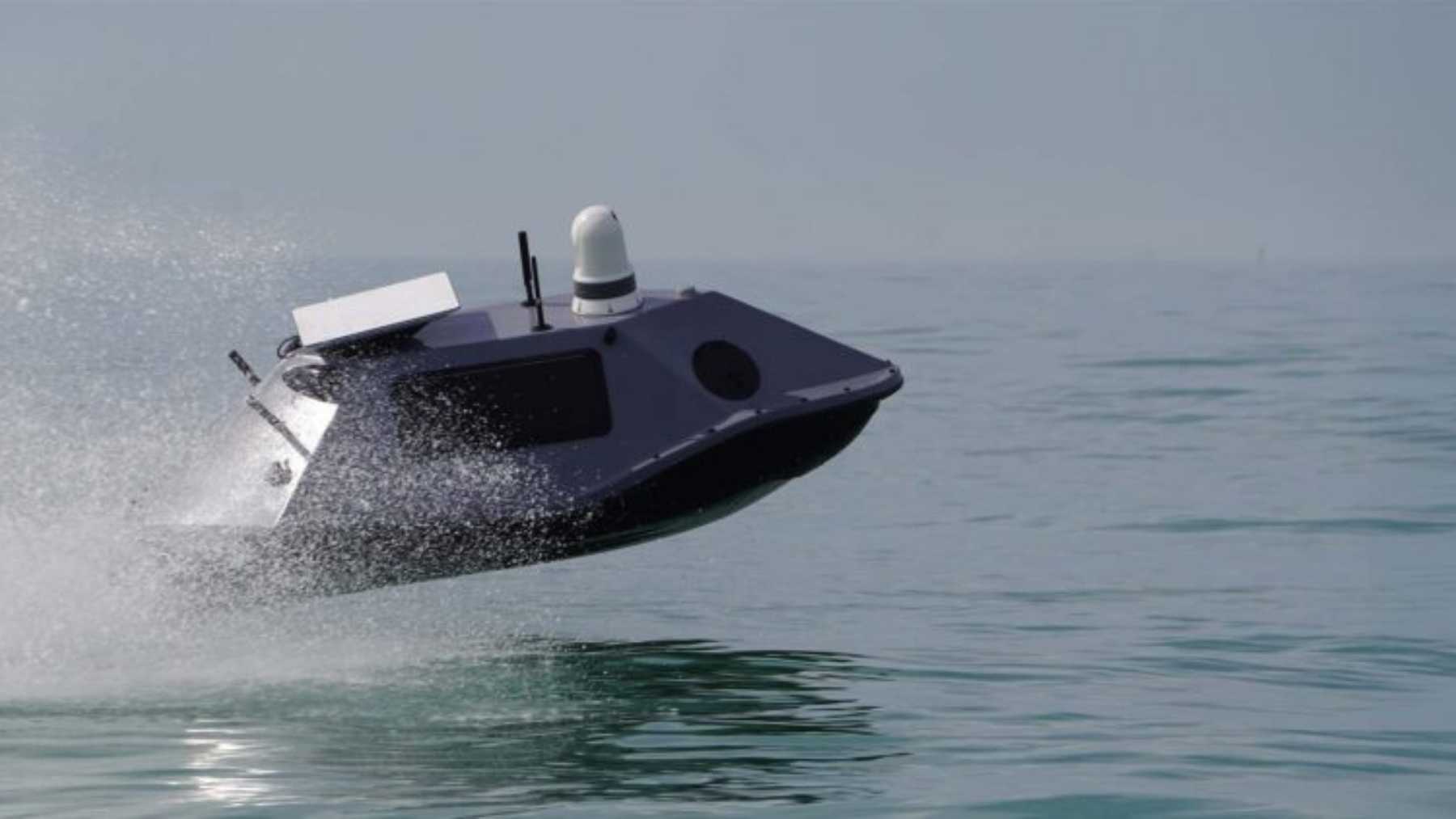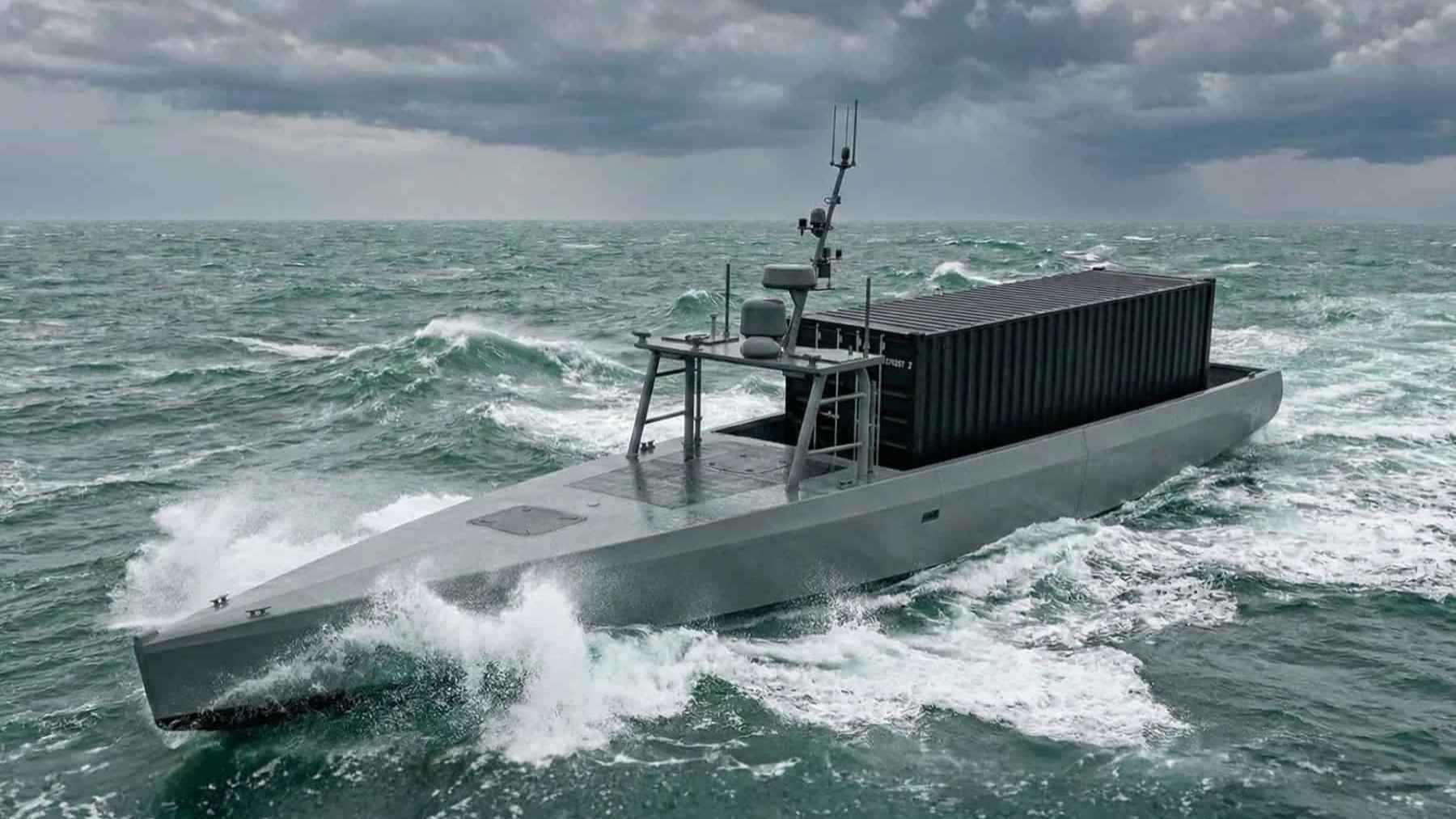

Ship naming ceremonies follow a script. Somebody important swings a bottle at the bow, it breaks, a band plays, and the crew takes the thing to sea. On Wednesday afternoon at Turnchapel Wharf in Plymouth, England, that script gets run on a 56-foot aluminium boat with no crew to hand the rest of the bottle to.
The boat is the Oceanus17, first of a new class from a British outfit called ZeroUSV, and the date is not a coincidence. The naming is set for August 12, the opening day of the British Firework Championships across the water on Plymouth Hoe, which ZeroUSV is co-sponsoring this year alongside Associated British Ports. The championships pull more than 100,000 people to the city each summer, so the boat gets a crowd whether it wants one or not.
What makes it worth stopping on isn’t the autonomy. Crewless boats have been leaving that particular wharf for years. It’s the hole in the middle of this one: a 20-foot slot cut to shipping container dimensions, rated to 4,000 kilograms, and wired with 30 kilowatts of power that belongs to the payload and nothing else.
The useful part of this boat is the hole in the middle
Most uncrewed vessels are built around a mission. You want a survey boat, you engineer a survey boat. You want a sensor platform, you cut the hull open and fit the sensor. The Oceanus17 is built around a standard instead, which is a different proposition entirely.
The payload bay is ISO-compatible at 20 feet, so a customer can assemble a mission inside a box on dry land, in a workshop, with people standing up and drinking coffee, and then drop the finished box into the boat. ZeroUSV says the vessel can be re-roled in a very short period. The 30 kilowatts is what makes that claim mean something, because a slot with no power supply is just storage.
To put 30 kilowatts in perspective, the entire propulsion system on the smaller Oceanus12 is two 40-kilowatt electric motors. The bigger boat hands the customer most of a small vessel’s drive system and tells them to spend it on whatever they like.
There’s a catch, and it’s a physical one. Navy Lookout, which published a detailed technical briefing on the class in April, notes that if you load an actual TEU container into the bay, the empty box eats roughly half the margin and leaves about two tonnes for the contents. The 4,000-kilogram figure is real. It just isn’t all yours if you insist on a literal container.
The idea itself isn’t unique to Plymouth. A German yard has an 82-foot crewless boat stacked out of shipping containers sitting in a shed, built around the box rather than sized to accept one. The difference is that the Oceanus17 keeps a conventional hull and treats the box as a socket.
Fifty days at sea changes what the boat is for
ZeroUSV puts operational endurance beyond 50 days and range beyond 5,000 nautical miles, which is around 5,755 statute miles. Navy Lookout’s briefing goes further, putting the figure as high as 11,000 nautical miles if the vessel carries external fuel tanks.
Set against the class it grew out of, the jump is steep. Navy Lookout compares a 13.7-tonne Oceanus17 to a 4.5-tonne Oceanus12, and the payload goes from roughly one tonne to four. The earlier boat measures 11.55 meters, or 37.9 feet, against 17 meters here.
None of that makes it fast. Sprint speed is quoted at over 10 knots, and the Oceanus12 cruises at 5 to 7 knots with a ceiling around 12. This boat is not going to chase anything, and Navy Lookout is blunt about it, arguing the contribution of a vessel like this lies in persistence and reach rather than in making the decisive detection itself.
What it does have is logistics. The hull is road-transportable without an escort and fits inside the cargo bay of a C-17, so a customer can put it on a runway in Plymouth and take it off a runway somewhere considerably less convenient. The aluminium hull is certified to the UK Maritime and Coastguard Agency’s Workboat Code Edition 3, Annex 2, for uncrewed vessels and unlimited operations.
Scale matters for reading the claims properly. At the other end of the same market, Navantia UK has been showing a 246-foot crewless warship displacing more than 1,000 tonnes. The Oceanus17 is a workboat. It just happens to be a workboat with a container slot and nobody aboard.
Level 4 is doing less work in that sentence than it looks
The navigation comes from GuardianAI, an autonomy suite built by MarineAI, a sister company inside the same MSubs group that owns ZeroUSV. The company describes it as level 4 autonomous navigation, capable of running as a single vessel or as part of a coordinated fleet.
Level 4 is a real category in maritime, and it isn’t the same one used for cars. The International Maritime Organization’s scale runs to four degrees, and Degree 4 is a fully autonomous ship whose operating system makes decisions and determines actions by itself. Degree 3 is a remotely controlled ship with nobody on board, which is a meaningfully different animal.
The rulebook for any of this is very new. The IMO adopted its first International Code of Safety for Maritime Autonomous Surface Ships at a session that ran from May 13 to 22 this year, and it took effect on July 1. It is non-mandatory. The binding version is not expected to be adopted until 2030, with entry into force pencilled in for January 2032. Under the code as written, a human master stays responsible for the ship and must be able to intervene, even when that master is standing in a building on land.
In practice the Oceanus17 answers to something older and more local. The MCA’s Workboat Code Edition 3 has covered remotely operated unmanned vessels in UK waters since December 2023, through an annex that defines Remote Operation Centres and named remote operators and bans these boats from carrying any crew, industrial personnel or passengers at all. So the vessel has no people on it. That is not the same as no people.
The last crewless boat to leave that wharf had to divert twice
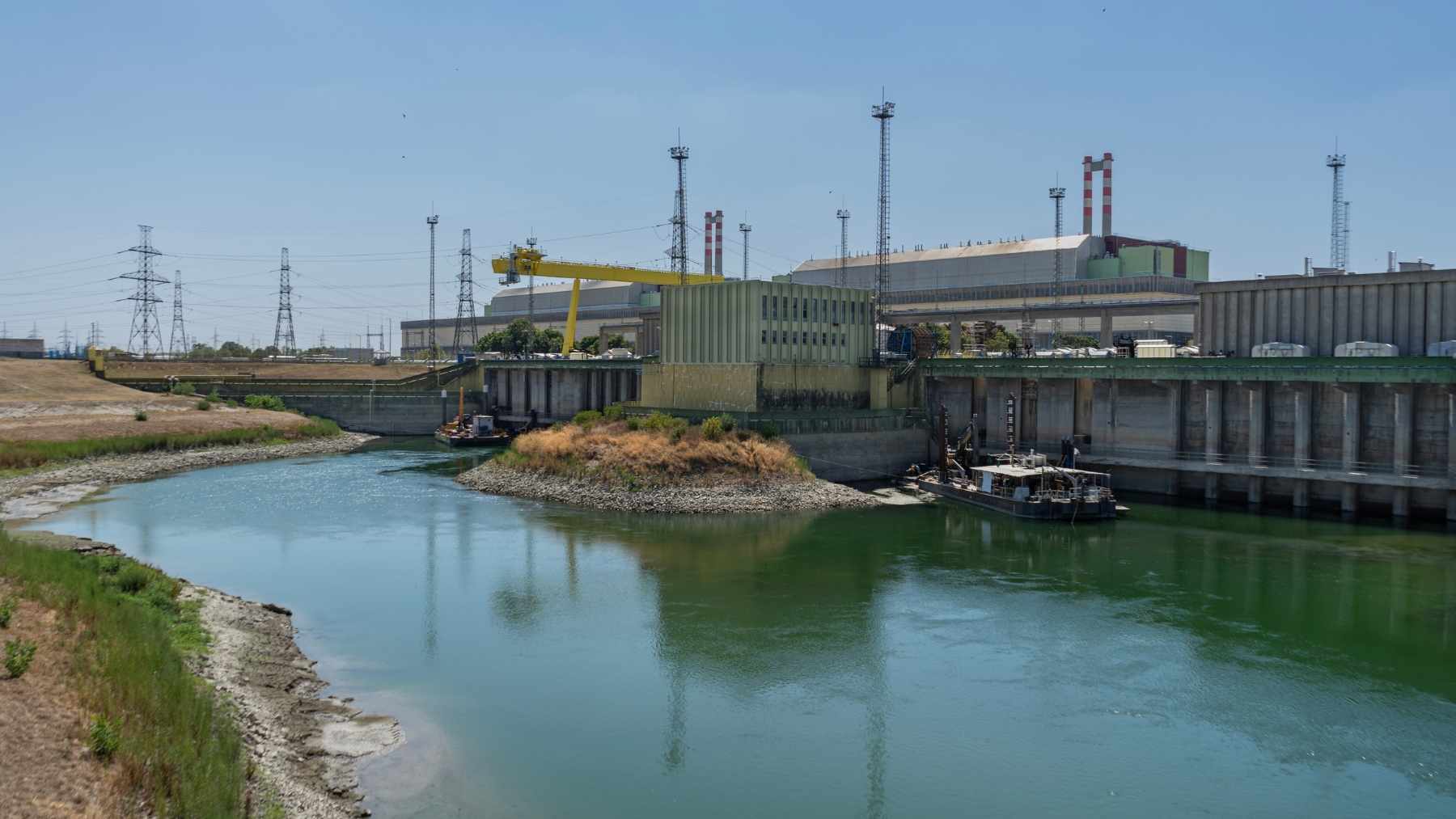
Turnchapel Wharf has form here, and it is the reason the redundancy claims deserve more than a shrug. At 5:30 in the morning on April 27, 2022, the Mayflower Autonomous Ship left that same wharf to attempt a transatlantic crossing with nobody aboard, driven by MarineAI’s software in a project run with MSubs, IBM and the research non-profit ProMare.
It did not go smoothly. The ship developed a mechanical problem with its generator and diverted to the Azores. It then developed a fault in the charging circuit for the generator starter batteries, had to switch to its backup navigation PC, and diverted again, this time to Halifax. It finally reached Plymouth, Massachusetts on June 30, 2022. An earlier attempt in June 2021 was called off after three days over a hybrid propulsion glitch.
Read the failure list and a pattern jumps out. The autonomy held up. Generators, charging circuits and computers 1,000 miles from a dock did not, and the boat only kept going because there was a spare navigation PC to fall back on. IBM’s own account of the departure gives the times and the technology; the diversions were published by the project as they happened.
Navy Lookout traces the Oceanus design philosophy of duplicating critical systems directly back to lessons from that programme. ZeroUSV now describes the Oceanus17 as having a dual redundant architecture with full component failover and 100 per cent system redundancy, which is a lot of words for one idea: nothing on the boat should be the only one of itself.
Four boats, two known customers and an empty bay
ZeroUSV has built four Oceanus12 vessels so far. Navy Lookout reports one delivered to Leeway Marine in Canada for commercial hydrographic work and another supplied to a US defence customer for intelligence, surveillance and reconnaissance, with a further vessel understood to be going to an additional operator. That is a small fleet, and it is also more paying deployments than most autonomy startups reach.
The Oceanus17 is aimed at the same split. ZeroUSV lists defence work including ISR, force protection and mine countermeasure support, alongside hydrographic survey, environmental monitoring and scientific research. Mine hunting from a small crewless hull is not theoretical, either; Britain has already sent a 12-meter drone boat into the Strait of Hormuz to look for mines with nobody on board.
Matthew Ratsey, ZeroUSV’s co-founder and managing director, said the vessel “significantly expands what operators can achieve at sea”. The company says larger designs are already in development, with more announcements expected before long.
The fireworks go up at 9:30 that night from Mount Batten Breakwater, a few hundred yards of water away from the wharf where the boat will be sitting. By then it will have a name, which is more than it has now.
What it does not have in public is a customer for the bay. A 20-foot slot with its own power supply is an excellent sales pitch and not yet a contract, and ZeroUSV has not said whose equipment goes in first. That answer will tell you more about what this class is actually for than anything that happens on Wednesday.