
I spent an afternoon once grinding rust off the floor pan of an old car. It threw sparks across the garage, ruined a shirt and left a patch I still wouldn’t show anyone. Crews on the ITER fusion project in southern France have just finished the industrial version of that job. Theirs ran three years and ended with 2,205 pounds of silver on the shop floor.
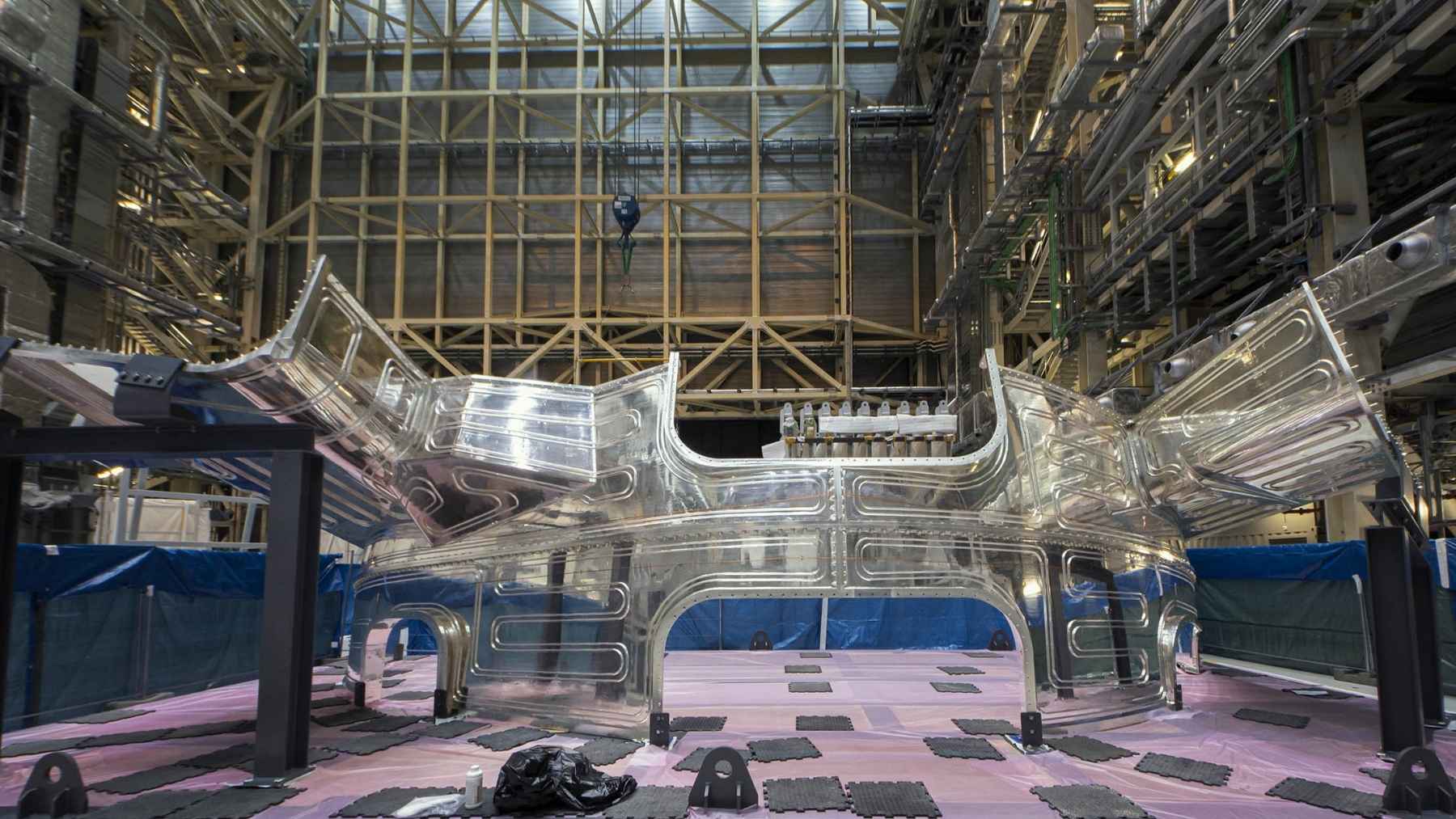
The ITER Organization put the news out on September 7. What they’d been fixing is the vacuum vessel thermal shield, the thin silver skin that sits between the reactor’s plasma chamber and the enormous magnets wrapped around it. Workers stripped 6.8 miles of cooling pipe off the panels, ground the silver coating away, welded new pipe on and polished every surface back to a mirror. The work wrapped up in July, and ITER says the contractor got there ahead of schedule, which isn’t a sentence anyone’s gotten to write about this project very often.
So why is a fusion reactor plated in silver?
Because silver is about the best thing you can put on a panel if you want it to bounce heat radiation instead of soaking it up. The superconducting magnets behind that shield run at 4 kelvin, which is minus 452 degrees Fahrenheit, and every stray watt that reaches them has to be hauled back out by the cryogenic plant. So the shield has one job, and that’s stopping heat before it arrives.
It isn’t a slab of silver, in case you’re picturing one. The panels are steel, about three-quarters of an inch thick, with silver plating on the surface and small pipes welded all over them carrying cold helium gas. There’s roughly 14 miles of that pipework welded onto the panels in total, and this repair program accounted for 6.8 of those miles.
So what was chlorine doing anywhere near a machine like that?
The cracks started in a cleaning bath
Before the panels get their silver, they go through a hydrochloric acid wash and a nickel coat. That chlorine wasn’t supposed to stay there. ITER says some of it didn’t wash back out and got trapped in small pockets near the welds that hold the cooling pipes on. Bending and welding those pipes left stress in the metal, the leftover chlorine worked on it slowly, and what you’re left with is a failure mode called stress corrosion cracking. The steel doesn’t rust away anywhere you can see it. It splits.
Helium leak tests in November 2021 turned it up in three panels that hadn’t even been installed yet. The deepest crack ITER measured ran 0.09 inch, a hair over two millimeters, and went clear across the width of the pipe wall. You can’t get at a coolant leak inside a sealed tokamak with a wrench, so the project assumed every pipe was suspect and committed to replacing all of them. That decision also meant pulling a module back out of the assembly pit after it had already gone in, which is about as unwelcome a call as a construction project ever has to make.
The panels came back polished instead of plated
Grinding the silver off is deliberate. The machining takes the coating plus a sliver of the steel under the old pipe path, so the contaminated layer leaves with it and there’s no chlorine rinse to do afterward. New pipe gets bent and welded on. Then the panel is polished until it’s a mirror, which brings back the low emissivity the plating used to provide. For a problem the plating process caused in the first place, that’s a fairly elegant way out.
ITER’s September note doesn’t put a cost on the three-year program, and it doesn’t spell out how the rest of the shield’s pipework was handled. I’d rather tell you that than guess at it.
The rest of the machine didn’t wait around
Sector module #1 went into the pit at the end of July, the sixth of nine wedges that make up the plasma chamber. We wrote about that 30-hour lift, which landed almost six months early, when it happened. That’s two-thirds of the chamber standing in the ground now. Three vacuum vessel sectors are sitting on their own gravity supports, and once sector #5 was transferred in August the teams judged the arrangement steady enough to start preparing for the welding that turns nine wedges into one ring.
Bellows installation started too. There are 93 of them in the design, they connect the vacuum vessel to the cryostat and the cryostat to the building, and they’re in there because the chamber moves up to an inch in any direction as it heats up and cools down. Five sets are bolted in and several are already being welded. That’s five out of 93. The welding program that includes those bellows is scheduled to run five years, and I don’t think anyone expects that number to shrink.
Sector #3 was handed over to the assembly teams on September 2 after a summer of bevel repairs, which closes out a three-year campaign on the sector edges that get welded to their neighbors. It also carries 120 sensors for reading magnetic field once the machine runs, which puts it among the more heavily wired sectors of the nine.
A 364-ton magnet is next in line for 34,000 amps
ITER also runs a magnet cold test facility on the site, which it says is the biggest superconducting magnet test bench anywhere. The idea behind it isn’t complicated. You chill a finished coil down to 4 kelvin, push current through it and find out how it behaves before anyone lowers it into the machine. You’d much rather turn up a bad joint on a test stand than in the pit.
The coils on that bench are the toroidal field magnets, the D-shaped ones that bolt onto the flanks of each sector. They’re a different animal from the central solenoid, the column of magnet that stands in the middle of the machine and got its final module in June.
Testing began in May, when toroidal field coil #7 went down to 4 kelvin and took 10,000 amps. Engineers reworked the electrical system for higher current after that and installed coil #17, which got cold in about 10 days.
Early checks on #17 found more resistance than expected in one feeder joint, and the cause turned out to be oxidation on a contact surface. ITER says the issue has been resolved and the coil goes back down to 4 kelvin for a campaign aimed at 34,000 amps, more than triple the 10,000 amps the bench managed in May. That coil weighs 364 tons. The 68,000-amp tests come later, after more structural reinforcement, and they’ll start with coil #19.
Next in the assembly hall is sector module #9, which picked up its two toroidal field coils in August and is having its thermal shield pipes and intercoil structures connected now. Jens Reich, ITER’s machine assembly program manager, calls that module “particularly important because it is on the critical path,” since the ninth and last sector can’t move into the sub-assembly tool until #9 vacates it. ITER aims to finish the connection work by the end of November and transfer the module into the pit at the beginning of December.