
ITER has spent two decades earning a very specific reputation. The giant fusion project in southern France is the one people point at when they want to explain why megaprojects run late, and its own director-general acknowledged earlier this year that the delays have pushed the bill past €22 billion, according to NucNet. When we covered the last big lift at the site while the cranes were still holding the load, the honest framing was slow, expensive and institutional.
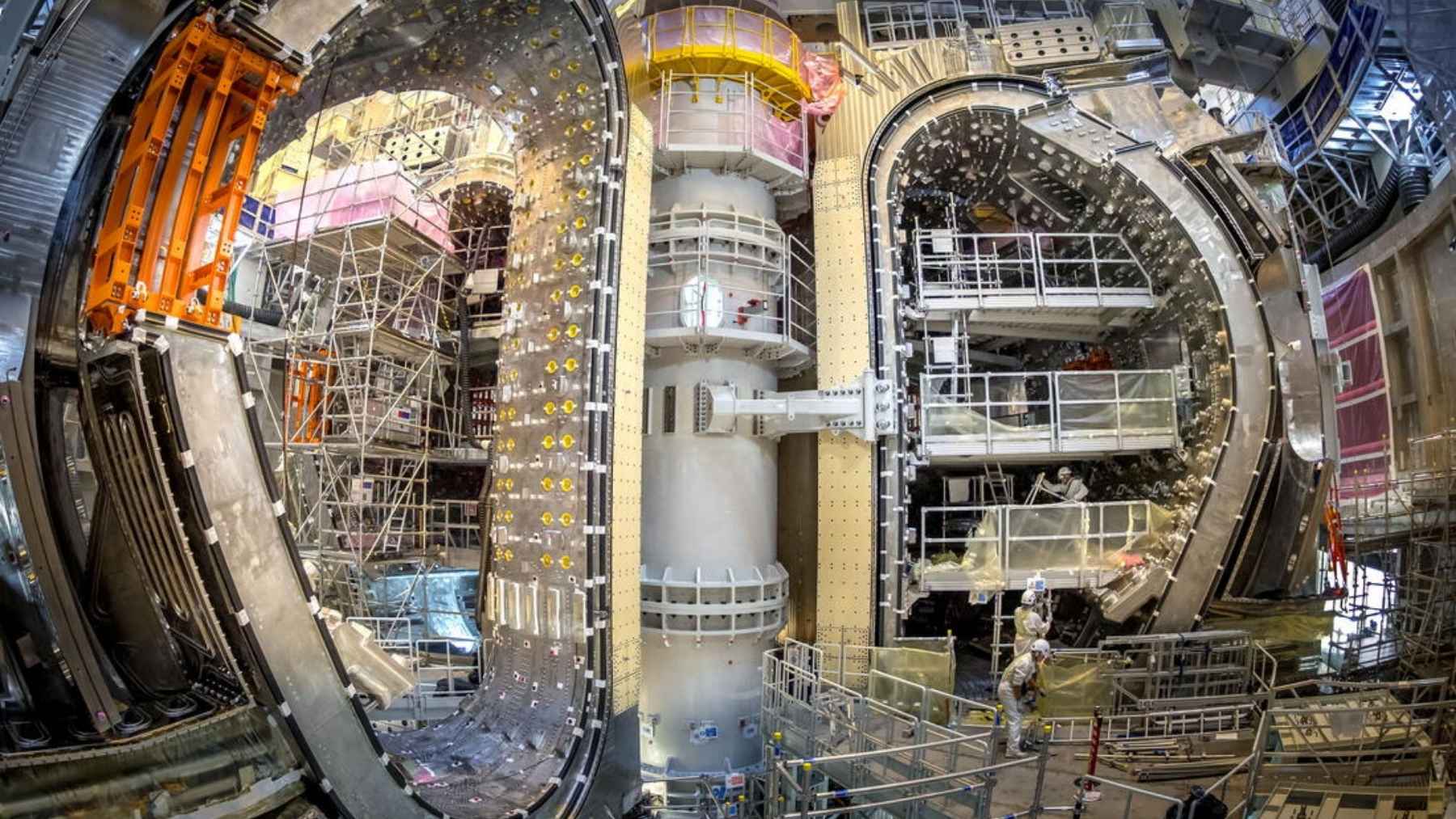
So the next sentence takes some getting used to: ITER is running ahead of its own schedule. On the afternoon of Tuesday, July 28, the sixth of the machine’s nine tokamak sector modules landed in the assembly pit at Saint-Paul-lez-Durance, almost six months earlier than the project’s baseline called for. Two-thirds of the reactor’s core is now standing in the ground.
The landing took 30 hours and more than 100 people
The thing that went down is a 40-degree wedge of the eventual plasma chamber. At its core sits a double-walled stainless steel vacuum vessel sector weighing 440 tonnes, wrapped in thermal shielding, with two D-shaped superconducting coils bolted to its flanks. Assembled, the package weighs roughly 1,100 tonnes, and once the lifting rig is attached the cranes are holding nearly 1,400.
ITER compares a bare sector to a jumbo airliner. The finished module is two and a half of those, hanging from four hooks, drifting through a building.
The operation began early on Monday, July 27, with a pre-job briefing in the Assembly Hall, and the module was guided onto its supports in the 30-meter-deep pit the following afternoon. Call it 30 hours door to door, which is quick for this particular chore. ITER’s own accounts of earlier installations put the typical run at 36 to 48 hours from pre-lift checks to landing.
More than 100 staff and contractors worked the lift in shifts. It came with a quirk, too: the module is officially sector module #1, because the numbering follows position in the ring rather than order of arrival, and it entered the pit backwards, outboard edge first, to be set down across from the five already in place.
There was a ceremonial layer as well. This sector is the fourth and last of the four that Korea manufactured, with Europe building the other five, and ITER marked the handover with a Korean Fusion Day on July 22, six days before the landing. That is the kind of event you get to schedule when the hardware is actually showing up.
Somebody has to watch the numbers
A load this size does not get eyeballed into a hole. The components inside a module have different centers of gravity and get picked up progressively, so there is a stretch of every lift where the suspended mass is not lined up with the crane’s lifting point and the load distribution shifts. Get that wrong and parts start touching parts.
So ITER runs a control desk for every one of these descents, and the July operation gives a decent picture of what that involves. Eight strain gauges are glued around each of the rods supporting the coils, then sealed under resin. Load cells sit on the bracing, laser sensors track clearances, inclination sensors watch for tilt. The array records ten times a second, which adds up to millions of data points over a single move.
“Someone must always be watching the numbers,” said Jordi Utges, a mechanical engineer with ITER contractor Arial Industries, in the organization’s account of the lift. He has worked the control desk on all six modules now in the pit. For this one, his team started installing sensors in May, two months before the crane took the weight.
The last 500 millimeters are the tense part. The module hangs there, half a meter off its supports, for hours while metrology crews confirm the alignment before anyone commits.
The last time this machine made news, it was going backwards
If you have followed this project for a while, you know the pit was not always a place where things arrived. In 2022, inspectors found millimeter-deep cracks in the cooling pipes that thread through the thermal shields, and dimensional defects along the welding bevels of the vacuum vessel sectors themselves. All nine sectors were affected to some degree, since they were built with the same welding techniques.
The one module already installed was hauled back out of the pit and stripped for rework. Sector assembly stopped in September 2022. Seven of the nine thermal shield sets went to a contractor in India for repairs, two more were remanufactured from scratch in Korea, and the 2024 baseline that came out of the whole episode moved first plasma to 2034 and deuterium-tritium operations to 2039.
Module installation restarted in April 2025. Six have gone in since. The gaps have tightened from a 100-millimeter offset on the early landings to about 10 millimeters, teams have threaded modules past obstacles with as little as 0.4 millimeters to spare, and the lifts keep getting shorter.
“Installing six sector modules is not simply a question of repeating the same operation six times,” said Sergio Orlandi, who heads the ITER Construction Project, in the release accompanying the milestone. The scheduling upshot: the final module was slated for December 2027 and is now expected by mid-2027, with the organization looking for further gains.
Early against which calendar, exactly
A fair question with a short answer. ITER is early against the 2024 baseline, which is itself the product of a nine-year slip from the original plan. First plasma in 2034 and deuterium-tritium burns in 2039 remain the targets, and a smooth crane operation changes nothing about the physics waiting at the end. Being six months early to a party you already postponed is a strange kind of punctuality.
Still, it is the first time in roughly two decades that this project’s dates have moved toward the present instead of away from it, and the movement is showing up in hardware rather than press conferences. The pieces are converging from every direction, too: the American-built central solenoid, the pulsed magnet that will drive current through the plasma, completed its final deliveries this spring, with five of its six modules already stacked in France.
The seventh sector module is expected in the pit before the end of the year. After the ninth, the welding starts, and joining nine jumbo-sized steel wedges into one leak-tight torus roughly 19 meters across and 5,200 tonnes heavy is its own multi-year argument between engineers and tolerances. Nobody at Cadarache is claiming the hard part is over.
But the pit is two-thirds full, the cranes keep landing what they pick up, and the punchline machine has strung together six clean lifts in fifteen months. For a project that spent years watching its own hardware come back out of the ground, keeping things pointed downward counts as a genuine plot twist.