
If you’ve ever cut a board an inch short, you know the rule: measure twice, cut once. The people building the world’s largest tokamak in southern France have stretched that idea about as far as it goes. ITER didn’t just measure twice. It built full-size replicas of three slices of its reactor chamber, and this summer it started driving real machines through them to find out what breaks while breaking things is still cheap.
The first results went up on ITER‘s site on September 14. Official testing at the Trial, Test and Training Facility started in July, and the opening campaign covers three machines scheduled to work inside the actual reactor in early 2028, once crews begin welding its nine steel sectors into one continuous chamber. Two of them came back with homework.
And ITER, from the looks of things, couldn’t be happier about that.
So why build copies of a fusion reactor?
Because the real one is a terrible place to discover a problem. ITER’s plasma chamber, called the vacuum vessel, arrives in nine separate curved sectors that get welded together inside a concrete pit. If a machine jams or fouls a rail down there once assembly is underway, the schedule slips, the budget takes a hit, and a lot of people have a very bad month. Daniel Coelho, the project coordinator who oversaw the testing, put it plainly: you can learn a lot from 3D models, but skip the physical trial and “you are going to miss things.”
We’ve covered ITER’s heavy hardware on this site before, from a 1,400-ton chunk of the machine being lowered into the pit to a heat shield that had its silver plating ground off. Practicing the delicate work on a copy first strikes me as the sensible companion to all that heavy lifting, and frankly the cheapest insurance this project will ever buy.
Two of the three machines need changes
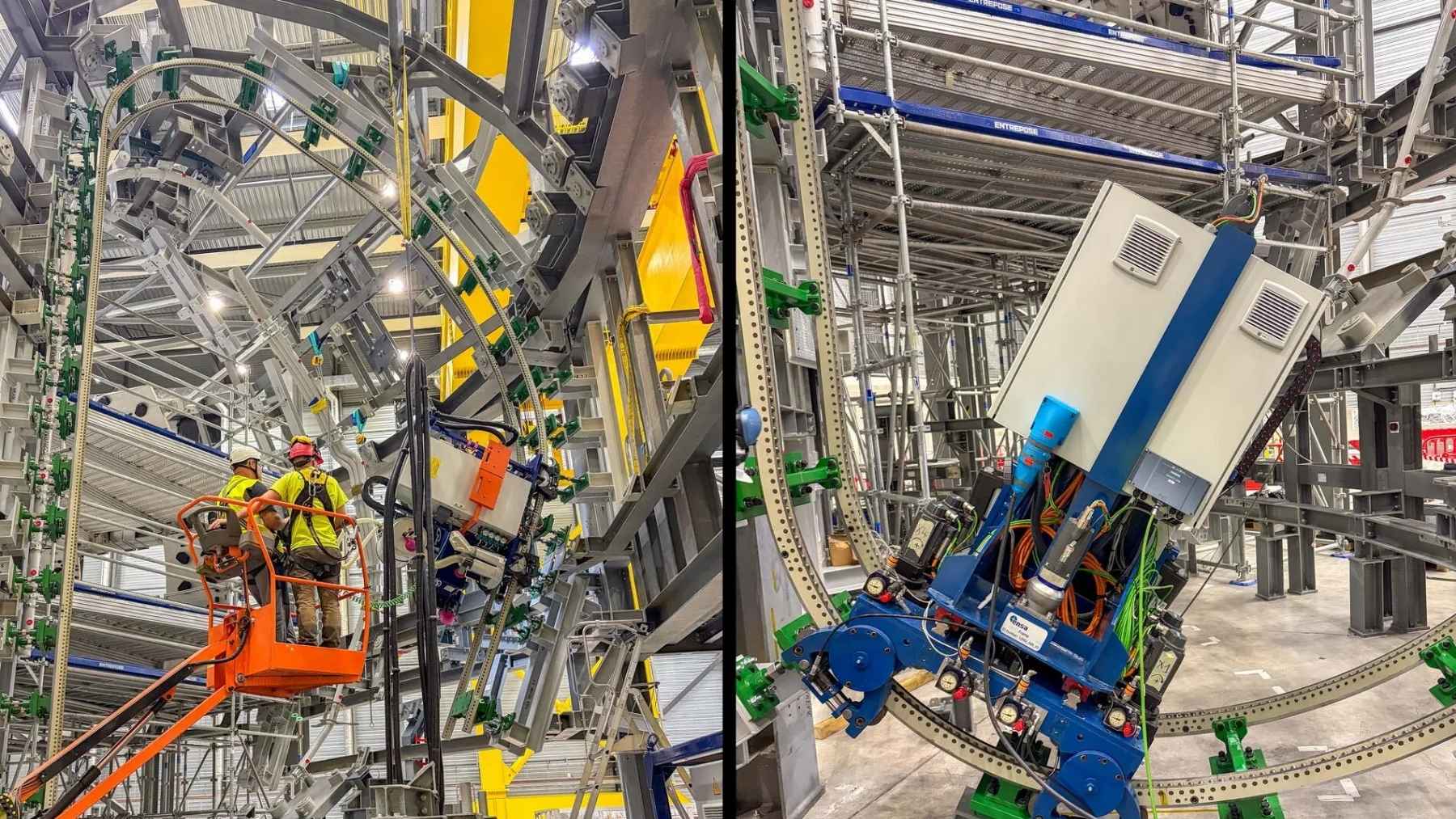
First up is the LINAC, short for linear accelerator. Its job, once welding starts, is to ride a set of D-shaped rails around the inside of the vessel and shoot high-energy X-rays through the finished welds. That’s non-destructive testing, which is engineer-speak for checking a weld without cutting it open, the same way your dentist X-rays a tooth instead of drilling in to have a look. What got tested this summer wasn’t the X-ray part at all. It was the trolley that will carry the beam head, and the first runs flagged an interface that needs improving before it can move along those rails smoothly.
Then there’s CRENO, a milling machine that drills the holes for what ITER calls biscuits. If you’re picturing breakfast, adjust. A biscuit here is a round steel splice plate that bridges the joint between two sectors, keeping the seam strong and leak-tight, and CRENO can also shave material off one if a weld defect needs repairing. Its test went well. ITER says the machine’s narrow wheelbase handled the tighter bends in the D-shaped rails just fine, which arguably makes it the only one of the three that showed up ready.
The splice plate positioning system had a rougher outing. The machine holds those plates in exactly the right spot while they’re welded across a joint, and testing revealed it ran short of clearance against the rail at certain points. Design modifications are coming. ITER hasn’t said where the clearance ran out or by how much, so I can’t tell you whether we’re talking about a rethink or a few shaved brackets.
Coelho says catching these problems in 2026 beats catching them in 2028, and honestly it’s hard to argue with a man who just found his mistakes on the practice floor instead of the real one.
The practice floor sits two football fields from the real thing
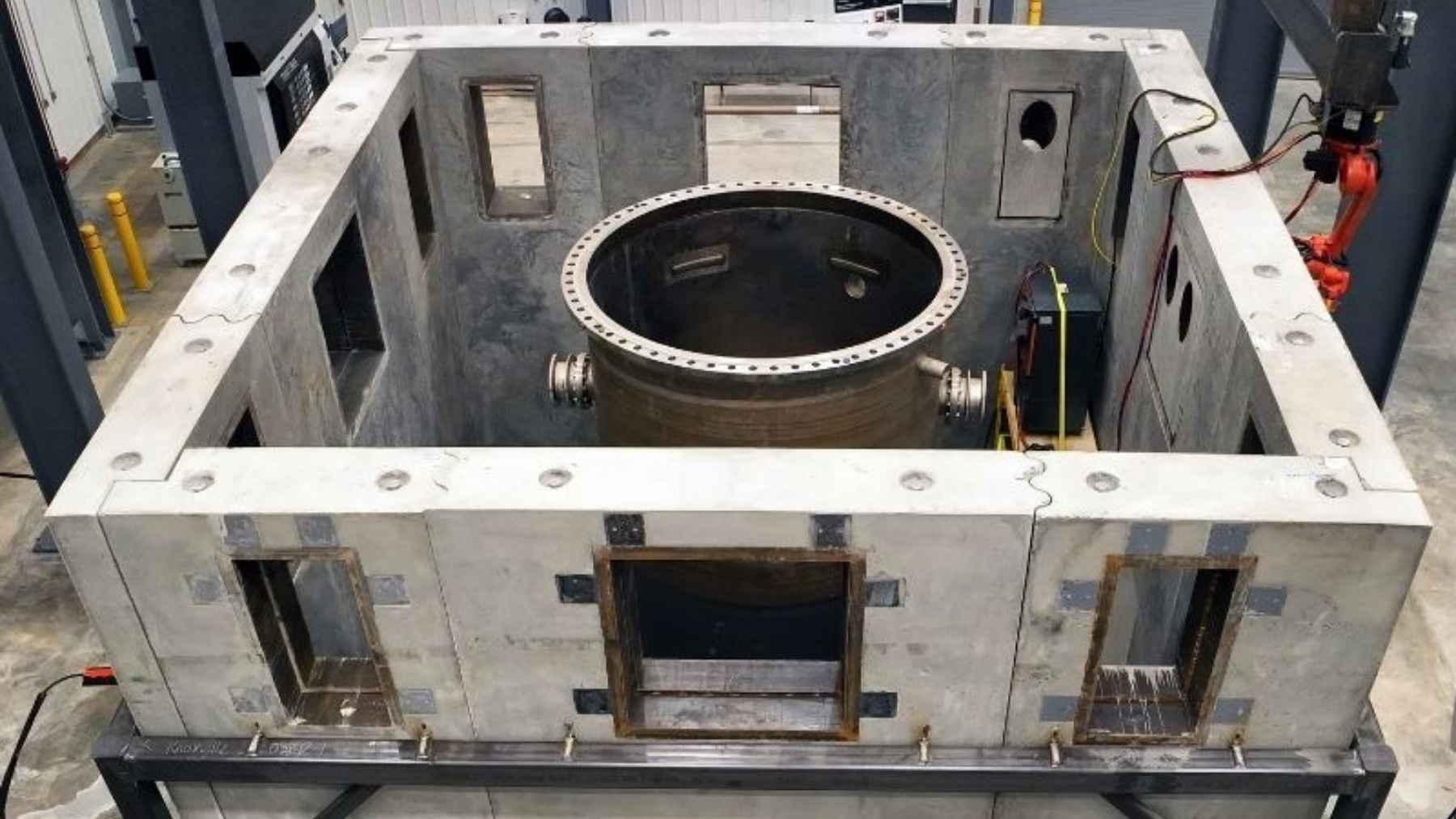
The Trial, Test and Training Facility takes up 5,382 square feet inside ITER’s former Cryostat Building, about 656 feet from the tokamak itself, a distance ITER describes as roughly two football fields. The structure started life at an industrial site near Toulon, where an earlier round of tool testing took place, and it was later taken apart, trucked to ITER and rebuilt so the installation crews wouldn’t have to travel to their own rehearsals.
Each of the three replica sectors is set up for a different job. One carries the D-shaped rails for welding practice. One is reserved for blanket modules, the armor plating that lines the chamber, and comes with a tower crane plus a cherry picker for moving them around. The third is being fitted out for instrumentation work, so teams can practice installing looms, the bundles of diagnostic cable that have to be crimped and laid out in exact patterns along the interior walls. There’s even a replica port cell and its extension, so the monorail that ferries components in through the ports can be rehearsed too.
Davide Macioce, the magnet engineer supervising the instrumentation training, gave my favorite justification for the whole building: nobody should be handling a loom cable inside the actual tokamak “the first time in their lives that they are picking one up.”
Testing on the three welding machines runs until November, and ITER expects the facility to keep hosting training into the early 2030s. The hardware all this rehearsal serves keeps closing in too. ITER said on September 16 that the ninth and final vacuum vessel sector was leaving Italy, expected on site within a few weeks. Once it lands, every slice of the chamber these machines will eventually crawl through will be sitting a short walk from where they’re practicing.