
Tunnel boring machines get treated pretty well at the start of a job. They get a woman’s name painted on the shield, a local priest comes out to bless them, and somebody important cuts a ribbon in front of the cutterhead. What they don’t get, as a rule, is a trip home.
Snowy Hydro, the Australian government-owned utility building the Snowy 2.0 pumped hydro project, said on October 22 that it’s started decommissioning its first boring machine, Lady Eileen Hudson, now that she’s finished her second tunnel. The company puts her career at 5.3 miles of tunnel, and it ended with her nose inside a cavern complex roughly half a mile under the Snowy Mountains.
So what does decommissioning mean for a machine that’s half a mile inside a mountain? It means she comes out in pieces, if she comes out at all.
The same release says her sister machine on the project, Florence, is almost at the halfway point of a 9.3-mile drive. One machine done and being taken apart, the other with a bit more than 4.6 miles of rock still in front of her.
So who is Lady Eileen Hudson?
Two answers. The person was the wife of Sir William Hudson, the first commissioner of the authority that built the original Snowy Scheme, and Snowy Hydro’s fact sheet credits her with promoting the scheme and cutting the ribbon on one of its tunnels.
The machine is a 2,535-ton hard-rock borer, which Snowy quotes as 2,300 metric tons. She’s 449 feet long, and her cutterhead is 36 feet across.
That cutterhead alone weighs 417 tons and carries 70 cutting discs at roughly 640 pounds each. Fourteen electric motors rated at 350 kilowatts apiece spin it. Snowy’s fact sheet puts her average progress at about 52 feet a day, with a crew of 15 to 20 people riding inside her, and says she was built to work around 2,300 feet underground.
Her career came in two parts. First she bored the main access tunnel, the one workers now drive down to reach the power station site, and finished it in 2022. Then the project took her apart, hauled her to the Talbingo end of the job, fitted a new cutterhead and new shields, had the local parish priest bless her, and relaunched her in July 2023 into the 3.7-mile tailrace tunnel.
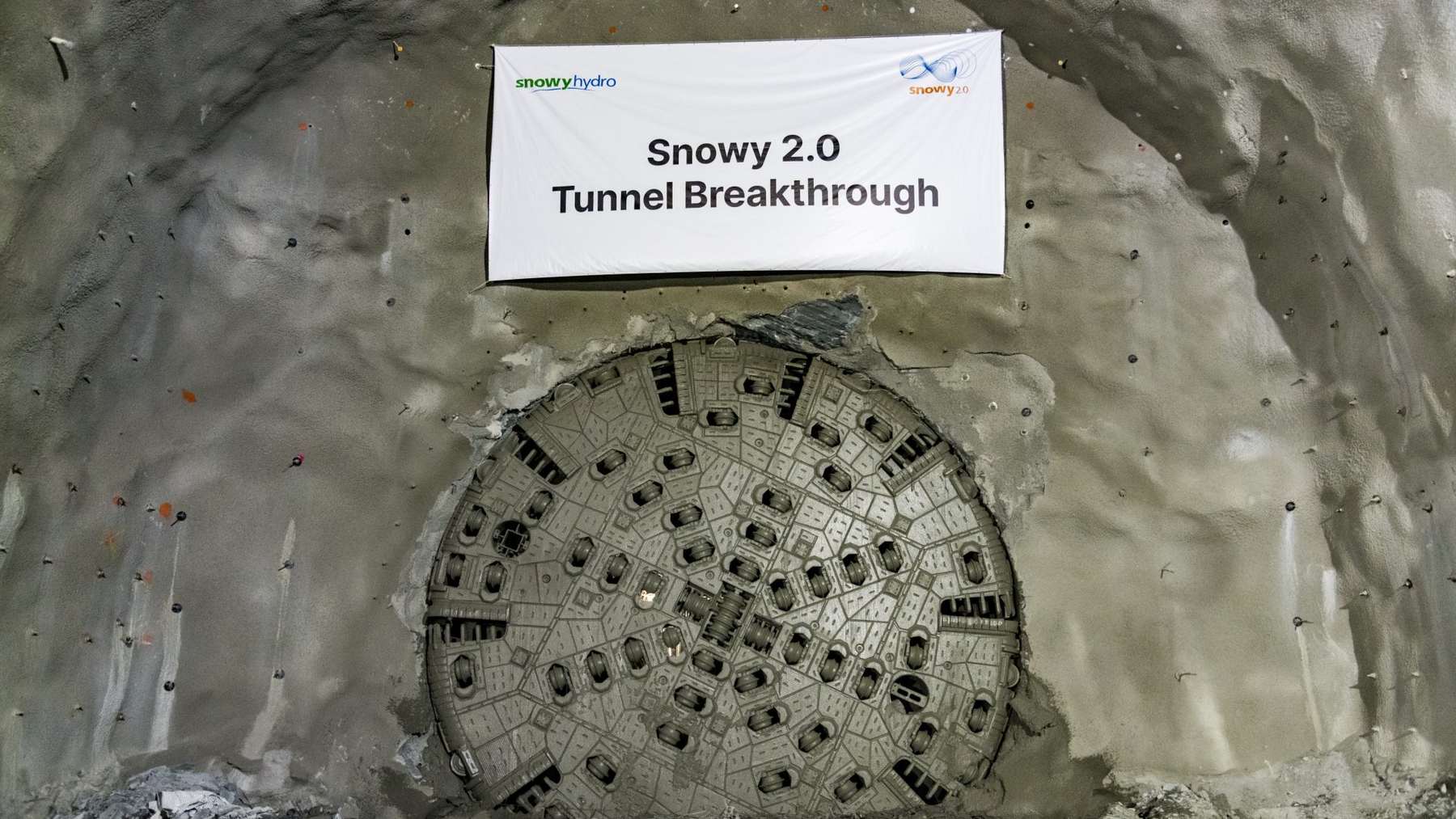
That’s the pipe that will carry water from the underground power station back down to Talbingo Reservoir. Snowy Hydro announced on May 15 that she’d broken through into the cavern complex, and we covered that breakthrough in June.
One thing I should admit here. Snowy’s own figure for that first access tunnel has wandered between 1.6 and 1.8 miles over the years, depending on which update you read, and the company’s current total for both tunnels is 5.3 miles. I’m going with the company’s total.
Why can’t they just drive her back out?
Because a boring machine builds the tunnel behind itself as it goes. Every few feet, an arm inside the machine sets precast concrete segments into a ring, and hydraulic rams push off that fresh ring to shove the whole thing forward.
The finished, lined tunnel is a bit narrower than the hole the cutterhead cut, so the front end of the machine is now wider than the only way out. As far as I can tell, that leaves one option: cut it up and carry it.
Which is apparently the plan for the other two machines as well. Snowy said in May that Florence and the project’s fourth borer, Monica, are digging toward each other from opposite ends of the same tunnel, will meet in the middle, and will then be disassembled deep underground.
This isn’t even Lady Eileen’s first time in pieces. After the access tunnel she was pulled apart and extracted so she could be rebuilt for the tailrace, which Snowy described at the time as a big task.
The difference now is that she’s sitting in a cavern complex the company says is 90 percent excavated, so there’s at least room to work. Snowy hasn’t said how long the teardown takes or whether any part of her gets reused, and frankly I’d like to know what happens to a 417-ton cutterhead that no one needs anymore.
Florence is the one with the reputation
If you’ve read anything about Snowy 2.0 before, it was probably about Florence. She’s a 469-foot machine, launched at the Tantangara end of the job in 2022 to bore the headrace tunnel, the long pipe that brings water down from the upper reservoir.
She hit soft, wet ground almost immediately. A sinkhole opened on the surface above her inside Kosciuszko National Park, and when she stopped she’d managed about 500 feet of a tunnel meant to run 9.3 miles.
The fix wasn’t quick. Crews pumped grout into the ground ahead of her and converted the machine to run in a sealed, pressurized mode so it could push through soft material without the roof coming down behind it.
She sat close to idle for the better part of two years. By May of this year Snowy was saying she’d found a new lease on life and was hitting personal bests, and Snowy Hydro CEO Dennis Barnes put the general situation in one line: the ground under the mountains is “making us work for every meter.”
Monica is coming the other way. She’s the newest machine on the project, custom-built to get through a stretch of broken rock called the Long Plain Fault Zone, and she’s cutting the opposite end of Florence’s tunnel. I’d put decent odds on that meeting being this project’s next big photo op, but Snowy hasn’t put a date on it.
So what is Snowy 2.0, exactly?
It’s a battery made out of two lakes. Tantangara Reservoir sits roughly 2,600 feet higher than Talbingo Reservoir, and Snowy 2.0 connects them through 17 miles of tunnels and a power station buried about 2,600 feet underground at a place called Lobs Hole.
When the grid has more wind and solar power than it can use, the plant pumps water uphill. When the grid needs power, the same water runs back down through six reversible turbines. Then you do it again.
Snowy Hydro rates the plant at 2,200 megawatts with 350,000 megawatt-hours of storage, and the company’s own comparison is that this equals around 26 million home batteries, or enough to run 3 million homes for a week. Those are Snowy’s numbers and Snowy’s framing. What they mean in practice is that this thing is built to cover a cloudy, windless week, which is the gap a shipping container full of lithium cells doesn’t cover.
Does Australia need something that big? The Australian Energy Market Operator thinks the national grid needs about 649 gigawatt-hours of dispatchable storage to hit net zero by 2050, and Snowy says this one project covers more than half of that on its own. Here’s where the project actually stands, by Snowy’s own progress table, compared with where it was at the 2023 reset.
The bill is now A$22.2 billion
The October 22 release that confirmed Lady Eileen’s retirement was really about money. Snowy Hydro’s new target cost to finish the project is 22.2 billion Australian dollars, with an allowance for a scenario of 25 billion, up from the 12 billion figure set at the 2023 reset.
Full commissioning is now targeted for late 2029. The company blames design that wasn’t mature enough when the investment decision was made, a contractor that missed its productivity targets, and global cost escalation, more or less in that order.
Barnes called the increase disappointing and argued that dropping the old fixed-price contract in 2023 saved the project from a bigger one. You can decide for yourself how convincing that is. What I’d point out is that the same contract reset is the reason the machines kept turning, and the progress numbers above are the result.
For a sense of how this compares to a machine that’s just getting started, a 3,858-ton borer named Mary began spinning under Adelaide’s houses in July, and a 1,680-ton one turned its cutterhead for the first time in a New Jersey pit this fall to start the new rail tunnel under the Hudson. Both of them have their blessings and their ribbons behind them.
Lady Eileen Hudson has the other end of that story. Snowy Hydro says more than 5,000 people are working on Snowy 2.0 right now, that Florence should pass the halfway mark of her 9.3 miles before long, and that decommissioning of Lady Eileen Hudson started this year after 5.3 miles of tunnel, as stated in its October 22, 2026 cost reassessment.