
- 3 MONTHS AGO · INDUSTRYA 197-foot German shaft borer is hanging like a chandelier under an English national park, 2,966 feet down, a spinning drum milling 8-inch passes while a vacuum sucks the rock out — nobody on the floor, no explosives, 2,283 feet still to go
- 2 MONTHS AGO · INDUSTRYA 551-ton boring machine front end is cutting under a Melbourne suburb on a leash of cables and hoses dropped down a shaft too short to hold the whole machine, and the rest of it, more than 300 feet of trailing gear, gets bolted on inside the tunnel it has already dug
- 2 MONTHS AGO · INDUSTRYA 706-foot boring machine cut north under the Potomac all summer with most of its body still parked in the daylight, while a crane fed the rest down a 100-foot shaft 30 tons at a time, and with the last car bolted on it has 350 feet to go before it stops for two months
- 1 MONTH AGO · INDUSTRYA 1,200-ton boring machine stretching 700 feet was assembled at the bottom of a 100-foot hole in a Washington park, because the complete machine could not fit down the shaft, and after her first 350 feet of digging she parks for two months to trade river teeth for rock
- TODAY · THIS ARTICLEA 481-ton boring machine spent 17 months cutting 2 miles under a Welsh estuary and came up in a 187-foot shaft with 2,774 concrete rings bolted in behind it, so 10 steel towers carrying 400,000 volts across a national park can come down and the view go back to the way it was
Remember when you were younger and daydreamed about that random man parkouring across benches, buildings, and gates to keep up with your car? I swear, that wasn’t just me. But as you stare out the window of a moving car, power lines are one of those things you sorta stop seeing after a while. It’s just expected. Part of the background.
A row of steel towers marches across a valley, the wires sag between them, and after a couple of years nobody who lives there notices anymore. Unless the valley happens to be inside a national park, in which case a lot of people notice, and they write letters about it.
Britain’s grid operator has a whole program for exactly that complaint. It’s called Visual Impact Provision; it’s funded through the country’s energy regulator, and the idea’s pretty simple: in a handful of protected landscapes, take the ugliest stretch of high-voltage line and bury it. In Snowdonia, which the Welsh call Eryri, burying it meant digging a tunnel under a tidal estuary.
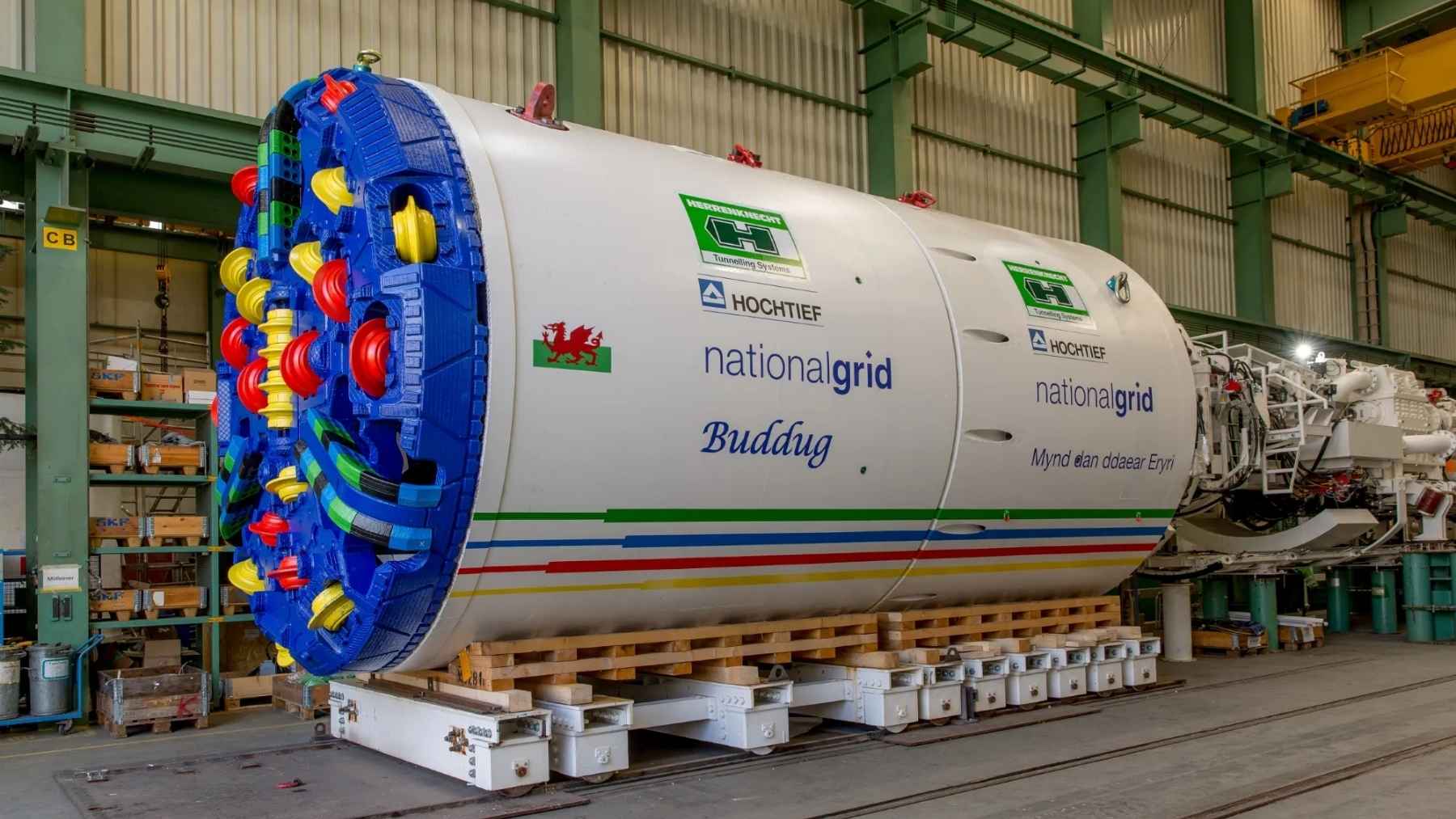
That tunnel’s now done. National Grid announced on October 13 that its boring machine, a 481-ton Herrenknecht named Buddug, had broken through into a 187-foot reception shaft at Llandecwyn after cutting 10,922 feet, just over two miles, under the Dwyryd Estuary. Tunneling started in May 2025, so she was underground for about 17 months.
And all of that so 10 towers can come down, which I’ll get to.
So what is Buddug, exactly?
If you’ve never seen a tunnel boring machine in person, the short version is that it’s a spinning cutterhead on the front of a very long steel tube. Every time the machine shoves itself forward a few feet, a crew behind the cutterhead bolts a ring of curved concrete pieces into place, so the tunnel’s already lined by the time the machine has moved on. Then it pushes off that ring and does it again. That’s the whole trick, and it hasn’t changed much in decades.
Buddug is 545 feet long, which is a football field and a half with the end zones in, and weighs 481 tons. She’s also used. According to National Grid’s project newsletter, the same machine dug about 0.9 miles of tunnel in Singapore before Herrenknecht took her back to Germany and rebuilt her for this job. I’d argue that’s the smart way to buy one of these, frankly. A machine this size is a one-trick tool, and the trick doesn’t change from one country to the next.
Getting her to Wales was a project in itself. She crossed the North Sea in pieces to Immingham, on England’s east coast, and then rode the last stretch across North Wales in 27 separate truck deliveries between November 18 and 29, 2024. The front section, the shield, showed up on November 25 and apparently drew a crowd. A local schoolgirl named her through a competition, and Buddug is the Welsh form of Victoria, in case you’re wondering.
From there, the pieces went down into a launch box at the Minffordd end, 45 feet below the surface and 226 feet long, where they assembled her and pointed her east.
The ring count is a bit of a mess
National Grid published two progress reports along the way. By September 16, 2025, Buddug had cut 2,794 feet and built 682 rings. By October 28, 2025, that was 4,157 feet and 1,056 rings, with the machine running 24 hours a day, seven days a week. Over the next 11 months or so, she covered the remaining 6,765 feet to Llandecwyn.
If you look on National Grid’s site, both updates list the total ring count as 2,274. National Grid’s own newsletter says 2,774. I did the arithmetic, and the progress figures work out to a hair under 4 feet per ring, and 10,922 feet at that spacing is 2,774 rings. So that’s the number we’re using, and the 2,274 looks like two digits that got swapped.
She did arrive a few months later than the company first said. When the machine showed up in late 2024, National Grid expected her to reach Llandecwyn “in mid-2026.” The breakthrough came in October. The release says the ground under the estuary was tough and kept changing along the route, and that’s as specific as it gets. I couldn’t find any more detail on what she actually ran into down there, so you’ll have to settle for that.
Then there’s the dirt. By late October 2025, with a little over a third of the tunnel done, the project had already pulled out more than 55,000 tons of material and trucked it away in roughly 2,000 loads, with 85 percent going to a quarry just up the road in Minffordd for reuse. At that point National Grid figured another 83,000 tons or so were still waiting to be dug. Which means the whole tunnel comes out to something north of 135,000 tons of estuary bed, carried out on a conveyor belt and stacked at the Garth site before the trucks took it.
That’s a lot of trucks for a project that’s supposed to make the place look nicer.
Why dig two miles of tunnel to remove 10 towers?
You may be wondering why anyone would spend 17 months boring under an estuary when the line already works fine. The answer is that it does work fine. The whole point is the view.
The existing line crosses the Dwyryd Estuary on 10 steel lattice towers. National Grid calls them pylons, which to an American sounds like an orange traffic cone, but they’re ordinary transmission towers. One side of each tower carries a 400,000-volt circuit, and the other side carries a 132,000-volt circuit for the local distribution company. Nearly two miles of that line runs across the open estuary, and according to the project page, screening or redesigning the towers wouldn’t make enough of a difference, so the decision was to put the whole section underground.
And when I say under, I mean under a lot of things. Along the way, Buddug passed beneath a highway bypass, the Cambrian Coast rail line, a narrow-gauge steam railroad, a roundabout and a business park, and National Grid says all of that went through without incident. The company says the finished tunnel will rank among the longest in Wales, which is strange for a project whose whole purpose is scenery, but here we are.
Would a US utility get this funded? I’m skeptical. Burying a transmission line is expensive everywhere, and over here it usually takes a wildfire or a hurricane to make the case. Doing it because hikers and the coastal rail line get a nicer view is a pretty specific kind of priority, and the British regulator decided it was worth paying for in five protected landscapes. Snowdonia got the tunnel.
She isn’t out of the ground yet
Breaking through is the dramatic part, but it’s not the end of the machine’s job. The 187-foot shaft at Llandecwyn exists to get Buddug out of the ground, and National Grid hasn’t said how long that takes or where she goes afterward. Given that she came in on 27 trucks, it’s safe to assume she leaves in pieces too.
Steve Ellison, National Grid’s senior project manager on the job, explained in the announcement: “There is still important work ahead as we prepare to install the new cables.” After the machine comes out, the cables go in, and if you’re picturing a two-mile tube full of very thick wire, that’s basically it. Then come the headhouses, the buildings that sit over each shaft, and a sealing end compound at the eastern end where the buried cables meet the overhead line that stays.
Only once all of that is live do the towers come down, so don’t expect before-and-after photos anytime soon.
If this sounds familiar, National Grid had another Herrenknecht machine, Caroline, break through under the Thames less than a month ago on a similar cable tunnel, and a much bigger one just started turning in New Jersey for the Hudson rail tunnel. Buddug’s the smallest of the three, and the only one digging for the scenery.
National Grid’s timeline has the overhead line and its 10 towers across the Dwyryd Estuary coming down in 2029, and tunneling on the Eryri project officially ended with the October 13 breakthrough.
Image credit: New Civil Engineering
 A 990-foot ocean liner that crossed the Atlantic faster than any liner before or since has just started her last trip out of Mobile behind tugboats, headed for a spot 22 nautical miles off the Florida Panhandle where she’ll be sent down into 180 feet of water on WednesdayIndustry · 12 hours ago
 A nearly 23-foot tunnel boring machine just broke through into its first station under downtown Toronto after cutting about 4,265 feet and lining the tunnel with roughly 780 concrete rings, and its twin is due to punch through right beside it in DecemberIndustry · 3 days ago
 A 13,632-ton freighter lies broken in two 530 feet down in Lake Superior, 51 years after she sank in a November storm with all 29 men aboard, and federal scientists estimate up to 1,191 barrels of heavy fuel oil could still be inside a wreck with no reported leakIndustry · 4 days ago