
The Brenner Base Tunnel has been soaking up the attention lately, and it earned it. Two German-built machines are grinding out the last few kilometers of the longest railway tunnel ever dug, 64 kilometers under the Alps between Austria and Italy, with the final breakthrough expected sometime this year.
The same German factory that built those borers has been turning out bigger ones for a second job a few hundred kilometers west. Almost nobody outside France and Italy is watching it happen.
The newest of those machines turned up in May, and it did not arrive the way you would picture it. No flatbed, no crane lowering a shield into a shaft, no switch to flip. It came in pieces, more than 500 kilometers by road from the Herrenknecht plant in Schwanau, Germany.
Crews are bolting it back together underground, inside the tunnel it is meant to dig, because the finished machine is too big to move any other way. Put together, it runs 334 meters, roughly three football fields end to end, and weighs 3,200 metric tons. It will not cut a meter of rock for months.
This is the Mont Cenis base tunnel, the 57.5-kilometer core of the future high-speed line between Lyon and Turin. It is one of the longest railway tunnels in the world, and the whole line carries a price tag of about $29 billion.
At peak, seven of these machines will be running at once. After years of work, the crews are roughly 29 percent of the way through.
The newest machine is being built where it will dig
The borer that arrived in May is a gripper machine, headed for the piece of the route that actually crosses the border underground, from the French access point at Villarodin-Bourget/Modane to a safety cavern at Clarea on the Italian side. It has 18 kilometers of rock to work through.
Per TELT’s June site report, the machine’s parts are still arriving in batches, each one hauled down the access tunnel and assembled directly in the gallery. That process runs several months before the thing can even start. Its cutting wheel measures 10.4 meters across.
Behind it comes a second machine, 650 meters long, that lines the fresh tunnel with concrete as the borer moves ahead. Its name is Würm. The gripper up front breaks the rock; Würm follows and builds the wall.
Assembling a machine inside the hole it will dig is not as odd as it sounds. Crews under Sydney Harbour did the same thing last year, building a five-story borer inside a cavern carved out under a cricket ground. When the finished machine runs that long, you build it where it starts.
The Italian side got a borer with a decompression chamber
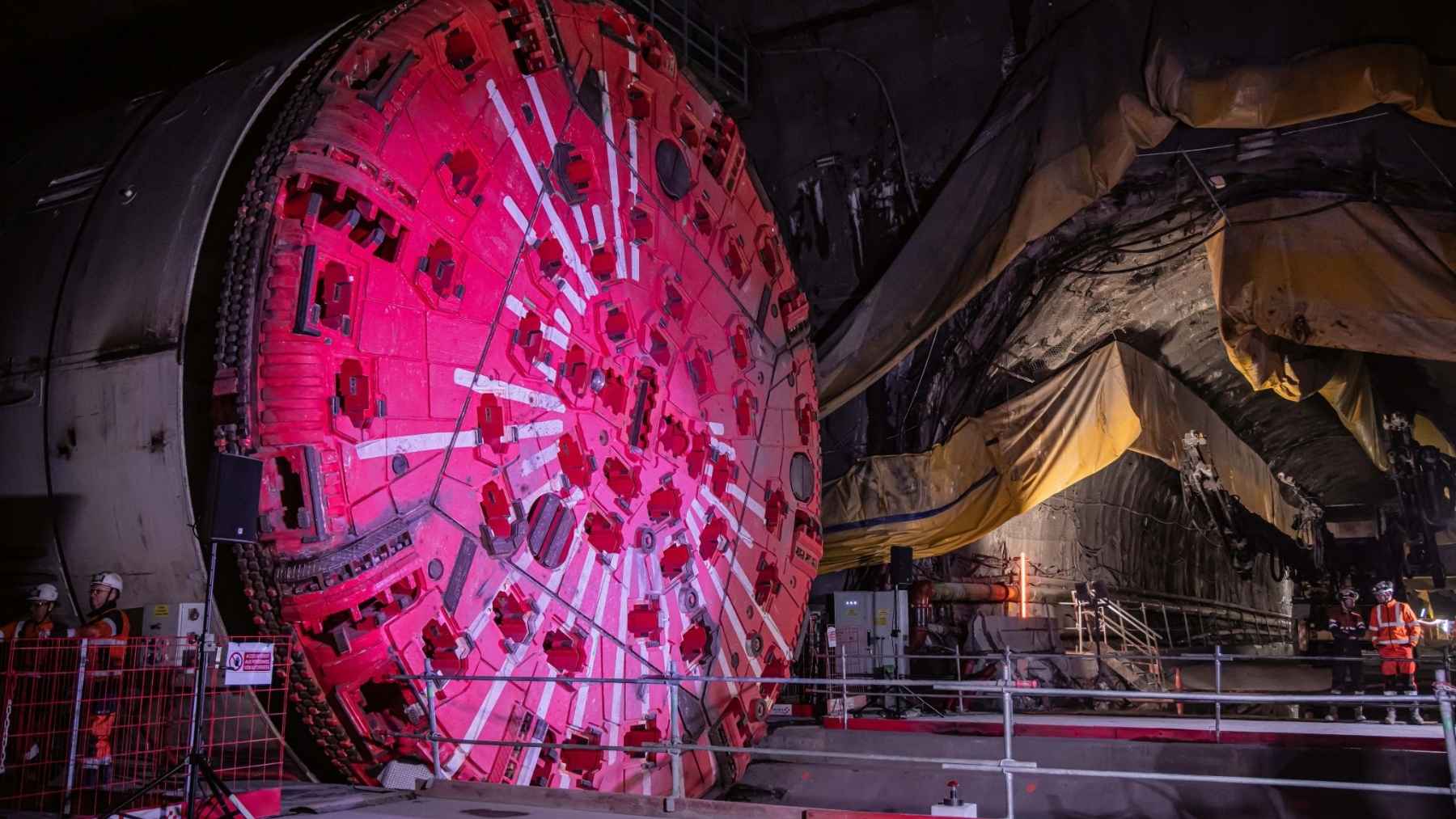
Back in March, the Italian half of the project got its own monster, and it came with a ceremony. Ministers from both countries spoke, the cutterhead was spun for the cameras, and Ghella, one of the firms building it, handed it over at the Herrenknecht plant.
That machine runs 235 meters, two football fields, with a 10.16-meter cutterhead driven by 4,550 kilowatts, a little over 6,000 horsepower. It is a dual-mode borer, built to switch between hard rock and loose, water-bearing ground without stopping.
The detail that sets it apart is the pressurized chamber built into it. At its deepest the tunnel sits under 2,000 meters of rock, where the pressure and heat climb, and the chamber lets crews work at the face and decompress on the way out, the way divers do. The machine advances about 10 meters a day.
Then comes the part the ceremony left out. After the handover, the whole machine gets taken apart again, trucked to the Chiomonte site, and reassembled in the yard. It does not start its descent into the mountain until 2027, when it will grind about 10 kilometers toward the town of Susa.
Thirty years of argument over one railway
The reason for all of this is grade, same as the Brenner. The old Lyon-to-Turin railway climbs the mountains on slopes steep enough that heavy freight mostly gives up and rides a truck instead.
A flat tunnel deep under the peaks is meant to flip that, pulling long freight trains off the roads and cutting the trip between the two cities from close to four hours toward half that. That is the pitch, and it has not gone unchallenged.
The project has drawn opposition for the better part of 30 years, much of it from the Italian side of the valley, where the No TAV movement and environmental groups argue the mountains do not need a new tunnel when a rail line between the cities already exists. The cost and the timeline have been the sharp end of that fight.
And the bill is real money. The cross-border section that holds the base tunnel runs around €11 billion on its own, with the EU’s infrastructure agency covering about 40 percent and France and Italy splitting the rest. It is a central link in the bloc’s Helsinki-to-Malta rail corridor, which is much of why Brussels keeps writing checks.
Seven machines, and a finish line that keeps sliding
For all the hardware, only one borer is deep in the rock and cutting right now. A machine called Viviana is working the north tube in a stretch of the massif so geologically messy that it has not been able to hit its normal pace. The rest of the digging is either conventional drill-and-blast or machines still being built.
Around 3,300 people are on the job today, spread across sites on both sides of the border, and more than half the excavated rock is being crushed and reused, much of it to make the concrete segments that line the tunnel. Nothing about this is small.
The tally, as of TELT’s early-2026 count: more than 47 kilometers of galleries dug out of a planned 164, a bit over 20 of them in the base tunnel itself. Two of the four ventilation shafts are fully lined. Roughly 29 percent of the digging is done.
Trains are supposed to run through the finished cross-border section by the end of 2033, a date that already slipped a year from 2032. And even that is only half the story. The new access routes on the French side that are meant to feed the tunnel are running years behind it, with some estimates putting the full connection into Lyon well into the 2040s.
So the machines being bolted together under the Alps this summer will spend the back half of the decade creeping forward at about 10 meters a day. The photos will be the cutterheads and the handover ceremonies. The 10-meter days, the shafts, and a tunnel that opens years before the tracks reach all the way to Lyon are the parts doing the actual work.