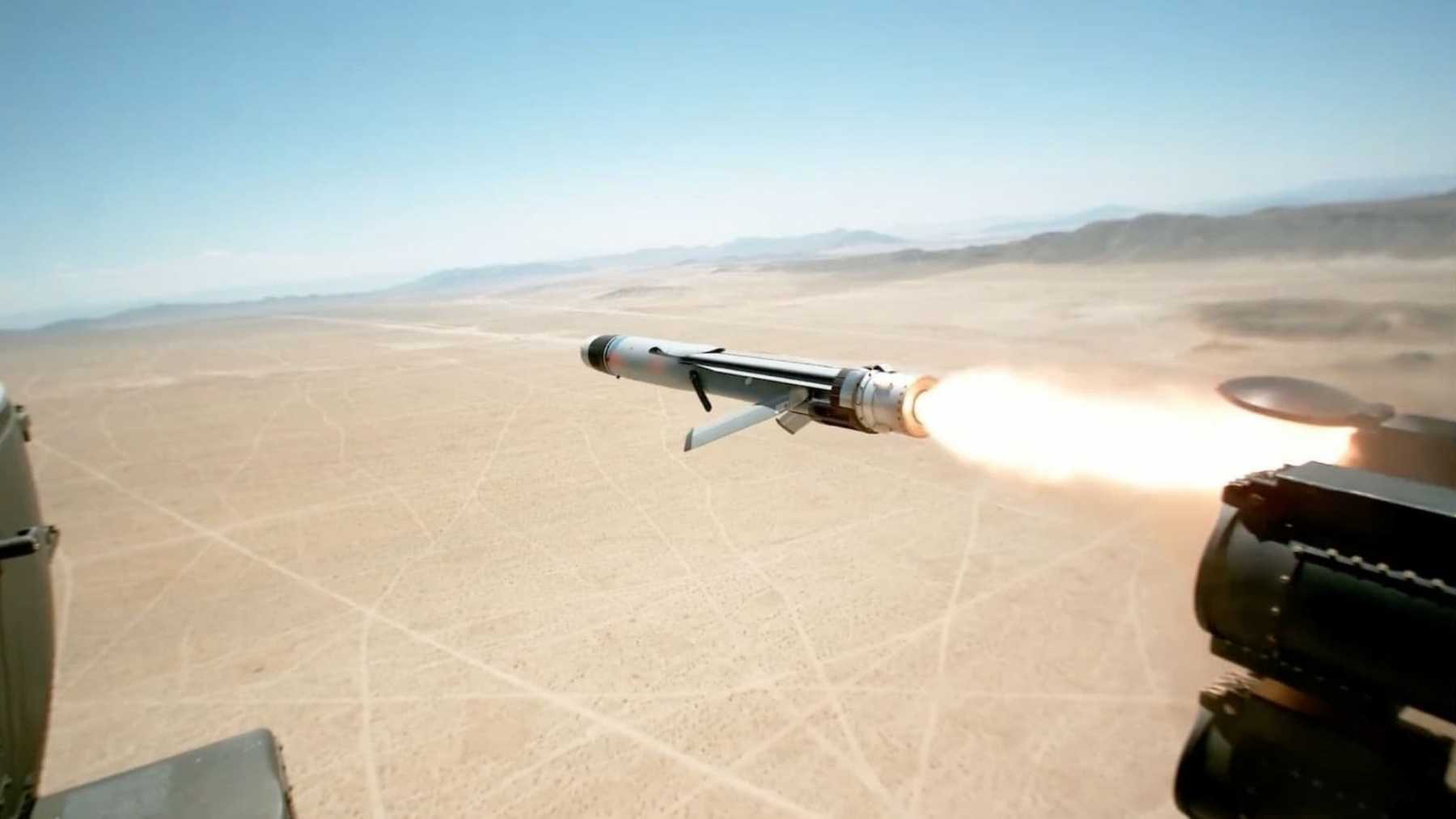

You know what a Black Hawk looks like even if you have never once thought about one. It carries troops, it carries cargo, it lands in the movie, and when somebody in that movie needs shooting at from the air, the script calls in an Apache. So the clip Anduril posted on August 31 takes a second to sort out. There is a UH-60M in it with a tube on its wing pylon, and something leaves that tube on a rocket motor and just keeps going.
The something is an Altius-700. It flew off across the Mojave, joined up with others like it, picked out a target, told the rest of the group where that target was, and one of them hit it.
Nobody in the helicopter flew it there.
The Army has been working toward this for six years, and it got its public airing in July at Project Convergence Capstone 6, the service’s annual experimentation blowout at Fort Irwin, California. It ran July 20 to July 29 with roughly 10,000 participants and more than 90 technologies, concepts and formations, which makes it the biggest one the program has held.
So what is a launched effect?
An air-launched effect, which the Army writes as A-LE, is a small uncrewed aircraft fired out of a bigger aircraft to go do something risky somewhere else. It can carry a camera, a signals-intelligence package, a jammer, a radio relay, a decoy or a warhead. You launch it, it flies out ahead, and it handles the job you would otherwise have to fly the crewed helicopter into. The lethal version has its own program name, the Long-Range Precision Munition, or LRPM.
Anduril describes the group in its footage as a “hunter-killer team.” Several drones, some of them looking, one of them hitting, all of them passing what they find to each other rather than back to somebody on a controller. The crew released them and then let them sort it out.
Two different aircraft share the Altius-700 name, and the specs get mixed up constantly, so separate them in your head before anybody quotes a number at you.
The plain Altius-700 is the sensor version, reported at around 285 miles (460 km) of range and roughly four hours in the air, carrying ISR, signals intelligence, electronic warfare or communications relay payloads. The Altius-700M is the munition, quoted at up to 100 miles (160 km), about 75 minutes of endurance, and a warhead of up to 33 pounds (15 kg). The 100-mile figure that went around this week belongs to the 700M.
Anduril labeled everything in the video simply as an Altius-700. The Aviationist pointed out that one of them strikes what looks like an armored ground vehicle, and that before the exercise the Army had specifically named the armed 700M as the LRPM it intended to fire from a Black Hawk. That makes the kinetic one a 700M in all probability. I cannot find a line from the Army or from Anduril confirming it outright. Neither has said how many the helicopter was carrying that day.
The Hellfire makes you get close
An AGM-114 Hellfire reaches between 4.4 and 6.8 miles (7.1 to 11 km) depending on the launch altitude and the trajectory the crew picks. That is a good missile. It is also a missile that obliges the helicopter carrying it to fly within about seven miles of the thing it wants to kill, and a modern air defense network is very interested in helicopters seven miles away.
An Altius-700M quoted at 100 miles lets the crew sit more than 90 miles further back than a 6.8-mile Hellfire does. The Army is bolting launch tubes onto a utility helicopter rather than building a new gunship for exactly that reason.
The Black Hawk is not becoming a gunship
The Apache still does that job. The Army built something else here: a utility helicopter that hands the shooting to a cheap machine flying an hour out in front of it. That is a different idea, and from the looks of things a cheaper one. The Army says Increment 1 of the A-LE capability is fully government owned and designed, developed with the Utility Helicopters Project Office and DEVCOM’s Aviation and Missile Center. The modified H-60M also works as a gateway, relaying information between the aircraft in the air and the units on the ground.
Brig. Gen. Kevin Chaney, Deputy Portfolio Acquisition Executive for Maneuver Air, said the launches meant the service was “changing the battlefield geometry.” That is press-release phrasing, but it is also literally what a 100-mile drone does to a 7-mile problem.
None of this arrived overnight. The Army fired an ALTIUS off a Black Hawk for the first time at Yuma Proving Ground, Arizona, on March 4, 2020, and spent the years afterward proving the thing could survive the launch and the rotor downwash and still fly a mission. An AH-64E Apache launched an Altius-700 for the first time on February 26, 2026, also at Yuma. In June, over three days at Fort A.P. Hill in Virginia, H-60M crews launched and controlled several medium-range effects from one aircraft, closing out a 13-month push to get the system onto the airframe. Fort Irwin in July was the next step, and the desert heat was part of the test rather than a nuisance, since the Army wanted to know whether the electronics would hold up.
Anduril also builds Thunder, the autonomous attack rotorcraft it unveiled at Farnborough in July, which the company says can carry up to sixteen launched effects of its own. The company’s Fury is one of the two American combat drones now in Air Force flight testing. You can see the shape of the plan without anyone drawing it for you.
The Army wants a contract signed next month
The LRPM is the piece the Army is in a hurry about. A market survey published in January asked industry for a prime integrator able to deliver between 200 and 600 fieldable prototypes, with an award targeted for October 2026, deliveries running from June 2027 to September 2031, and funding somewhere between $100 million and $200 million. The requirement is to take out integrated air defense systems from beyond 62 miles (100 km).
Soldiers have already used the munition overseas. At African Lion 2026 in Tan-Tan, Morocco, an Army operational user employed five LRPMs, two in a simultaneous strike on May 2 and three more on May 4. At Fort Irwin, in a demonstration separate from the Black Hawk work, the Army says it validated its first production-line LRPMs when a crewed aircraft launched one that “independently identified and terminated” a high-priority threat. Fielding is targeted for fiscal 2027.
So who approves the shot?
The Army’s language is about autonomy and one-to-many control. Anduril’s is about a team that found the target on its own. We covered a 30mm counter-drone turret shown at SOF Week in May whose makers were flatly explicit that somebody in the vehicle still has to approve and fire, and they put that sentence in the press material themselves. I cannot find its equivalent in anything published about the Black Hawk launches, and it is a sentence I would like to read.
Anduril says the next stop for the Altius-700 is a deployment with a Cavalry unit. The Army published its own account of the Fort Irwin flights on July 31, 2026, and the prototype award it wants for the armed version is penciled in for October.