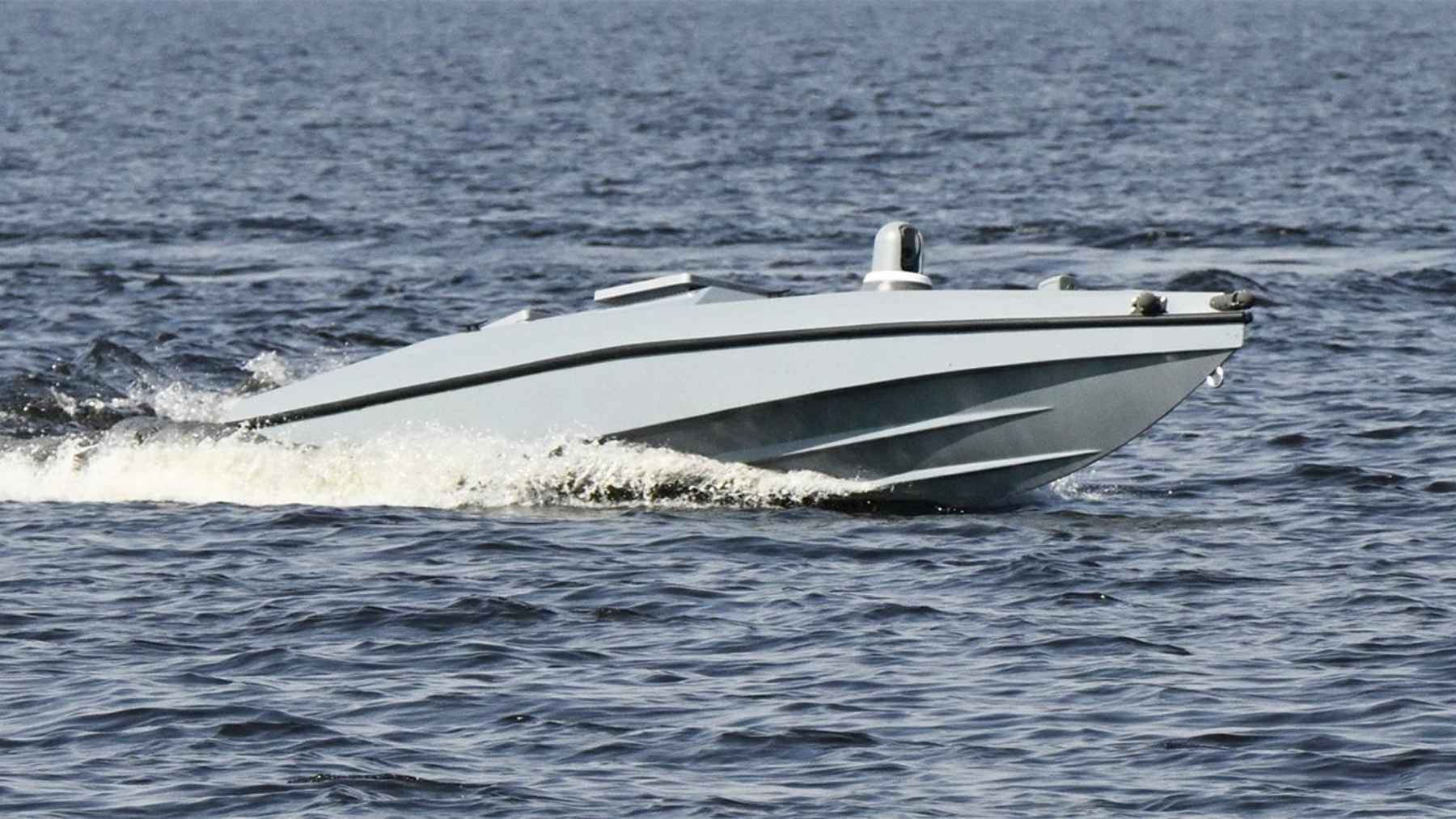

Ukraine’s sea drones have spent most of this war doing one job, and doing it well: slipping up on Russian warships in the dark and tearing holes in them. The reason Russia’s Black Sea Fleet now spends so much of its time tucked away in port is a handful of cheap, crewless boats that kept hunting it down. But on April 19, one of those boats did something it had never done before. It didn’t ram a ship or a bridge support. It launched a drone of its own straight up off the water and knocked a Russian Shahed out of the sky.
Ukraine’s Unmanned Systems Forces called it a first, with no documented precedent: a drone-on-drone kill, fired from an uncrewed boat at sea. The footage went out April 19 on the Ukrainian Defense Ministry’s account, and according to Breaking Defense, the operators came from the naval drone division of the 412th Brigade Nemesis, working in the Black Sea. Ukraine didn’t say which boat it used, or which interceptor. What it did make clear is that the sea is now a place you can launch air defense from. And that lands harder than it sounds, because the stretch of sky those Shaheds cross is exactly the stretch nothing on land can reach.
A patch of sky that ground air defense can’t reach
Here’s the geography, because it’s the whole reason this is a big deal. Russia sends much of its Shahed campaign against southern Ukraine out over the Black Sea, a lot of it launched from occupied Crimea and pointed at cities like Odesa. For a long stretch of that flight, the drones are over open water, well past the truck-mounted guns, mobile fire teams, and short-range systems Ukraine uses to knock them down once they’re over land.
A boat rewrites that math. Put an interceptor on a crewless vessel, park it out on the water, and you can engage a Shahed while it’s still over the sea, before it ever reaches the coast. Defense Express, the Ukrainian outlet, described the move as opening a fundamentally new dimension against large-scale Shahed attacks. That’s not spin. It’s a layer of defense that simply didn’t exist over the water before. Sam Bendett, who advises on Russian military technology at the U.S.-based Center for Naval Analyses, told Breaking Defense the setup “adds another protection layer for Ukrainians” against incoming long-range drones, and that by open-source measures, Russia hasn’t managed anything like it.
The scale is what makes a fresh layer worth building. The Ukrainian Air Force has tallied more than 22,400 Shahed and Gerbera-type drones thrown at the country since the full-scale invasion began in 2022. They arrive in waves, usually at night, designed to swamp the defenses and slip through the seams. Anything that closes a seam earns its keep, especially one out over water that nothing else can cover.
Nobody’s saying which boat, or which interceptor
This is where it pays to be careful, because the juiciest details are the ones Ukraine left out on purpose. Defense Express reported that the interceptor type and the exact location were held back for security, with only the video released as proof the intercept happened. Defense News went a step further and identified the interceptor as a Sting drone, the small Ukrainian-built interceptor that’s already been running down Shaheds from the air. Ukraine itself never confirmed the model, so treat the Sting as a solid report, not an official line.
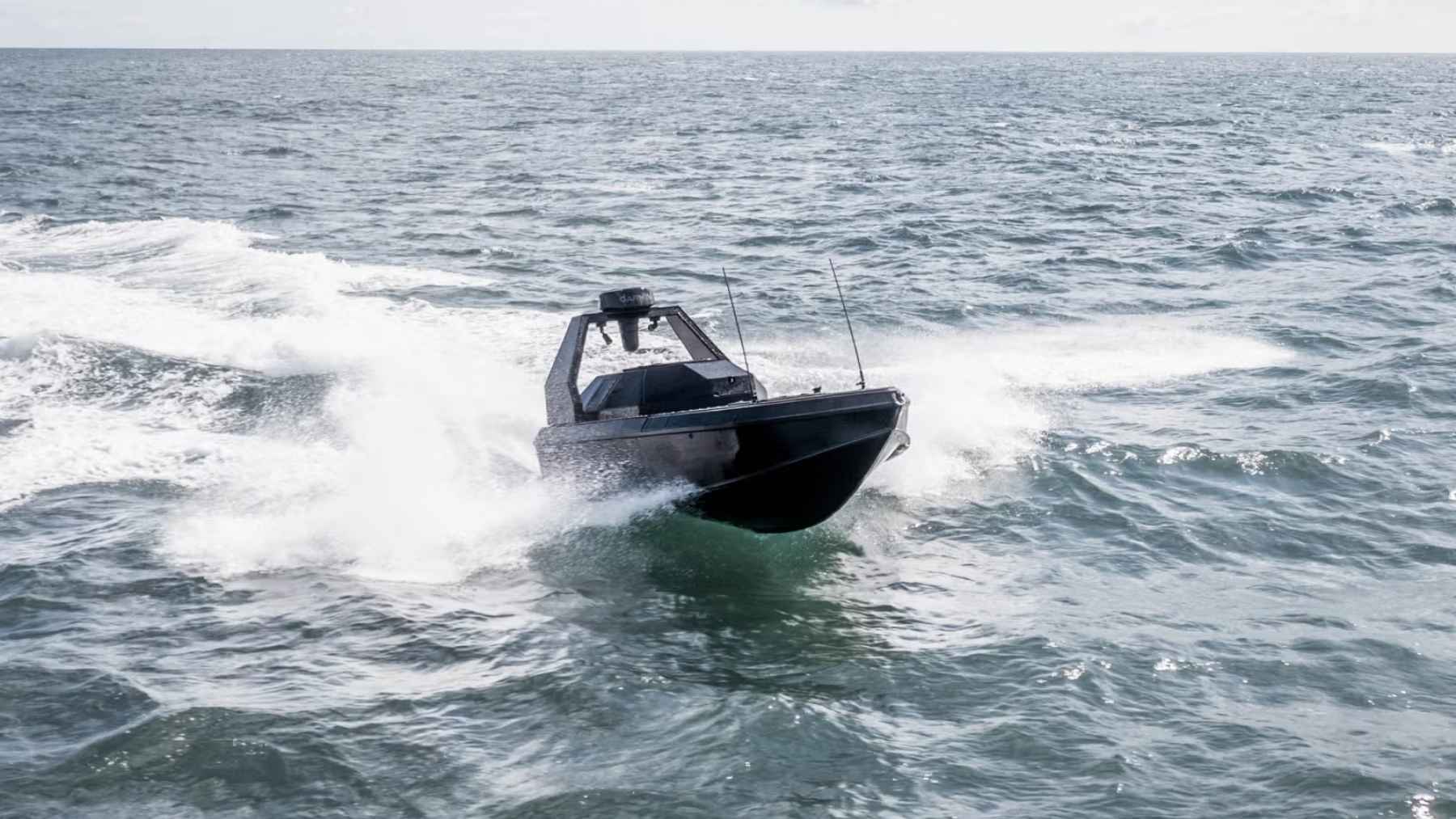
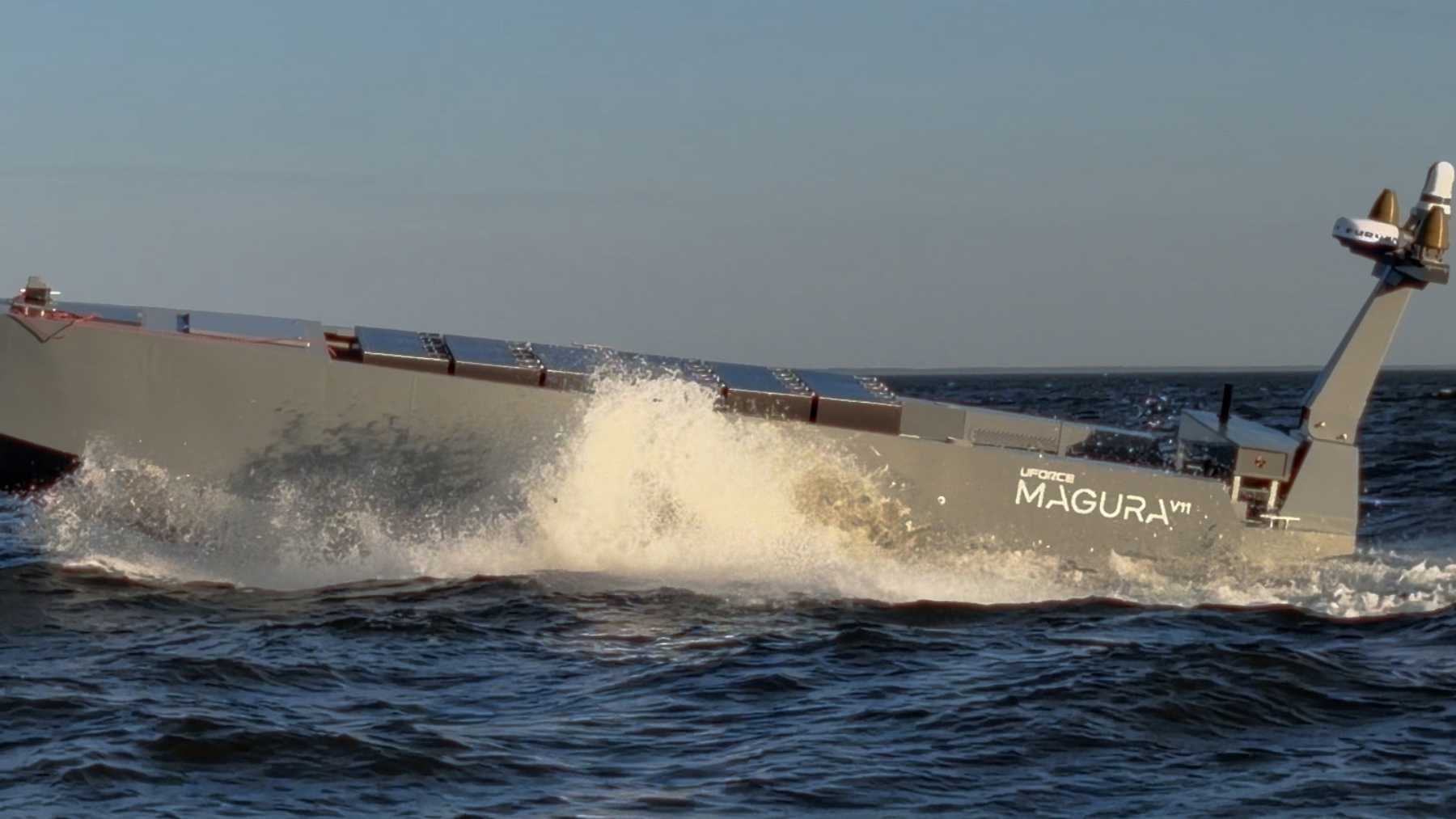
The boat is blurrier still. No one has officially named the uncrewed vessel that served as the launch platform. What is on the record: back in March, reports indicated that Ukraine’s Magura-family sea drone, the same lineage that’s spent this war putting Russian warships on the seabed, had picked up a modification built to launch interceptors. That makes it the likeliest candidate, and “likely” is as far as the evidence honestly goes. The exercise wasn’t about showing off a specific hull anyway. It was about proving the concept holds up in combat, and the video did that much.
The unit behind it runs more like a startup
The 412th Brigade Nemesis isn’t a traditional air-defense outfit. It’s part of Ukraine’s Unmanned Systems Forces, a branch built around drones, and it’s earned a name for moving faster than the usual military clock. The Economist has reported that Nemesis alone accounted for roughly a sixth of all Shahed shootdowns across Ukraine in January 2026, a startling share for a single brigade. Its chief of staff, a former financial analyst, has described the unit’s method in plain startup terms: build a prototype, test it, scale what works, shelve what doesn’t, and run it back.
That’s how a naval drone unit ended up inventing a new flavor of air defense. The same operators who taught crewless boats to hunt ships looked at the Shahed problem and asked why a boat couldn’t carry something that fires back at the sky. One of the unit’s operators put the April result plainly to Defense Express: “We took down a Shahed from a surface platform,” adding that they’re still refining the tactics. That’s the whole philosophy in one line. Try it, confirm it works, keep tuning.
The Pentagon’s already buying the cheap-drone playbook
If you’re reading this from the States and wondering why a Black Sea intercept belongs on a U.S. site, here’s the thread. The Shahed stopped being Ukraine’s private problem a while ago. American forces in the Middle East have been on the receiving end of the same Iranian-designed drones, and the Pentagon has been watching Ukraine’s answers closely.
The economics are the uncomfortable part. A single Patriot interceptor runs about $4 million, per Defense News, and trading $4 million missiles against drones that cost a sliver of that is a losing exchange. The whole point of a mass Shahed raid is to make you burn the expensive stuff first. That’s why the U.S. Army went shopping for cheap interceptors: Army Secretary Dan Driscoll told lawmakers the service had bought 13,000 low-cost interceptor drones to deal with the threat. The push runs past interceptors, too. The broader bet across allied navies is on uncrewed hardware that does the dangerous work with no one aboard. The U.S. Navy is testing Lockheed’s Lamprey undersea drone, built to ride a warship’s hull and release small aircraft of its own, while Australia has started fielding Ghost Shark autonomous submarines by the dozen. Ukraine’s sea-launched interceptor is the air-defense corner of that same shift.
From one intercept to a boat that carries 27
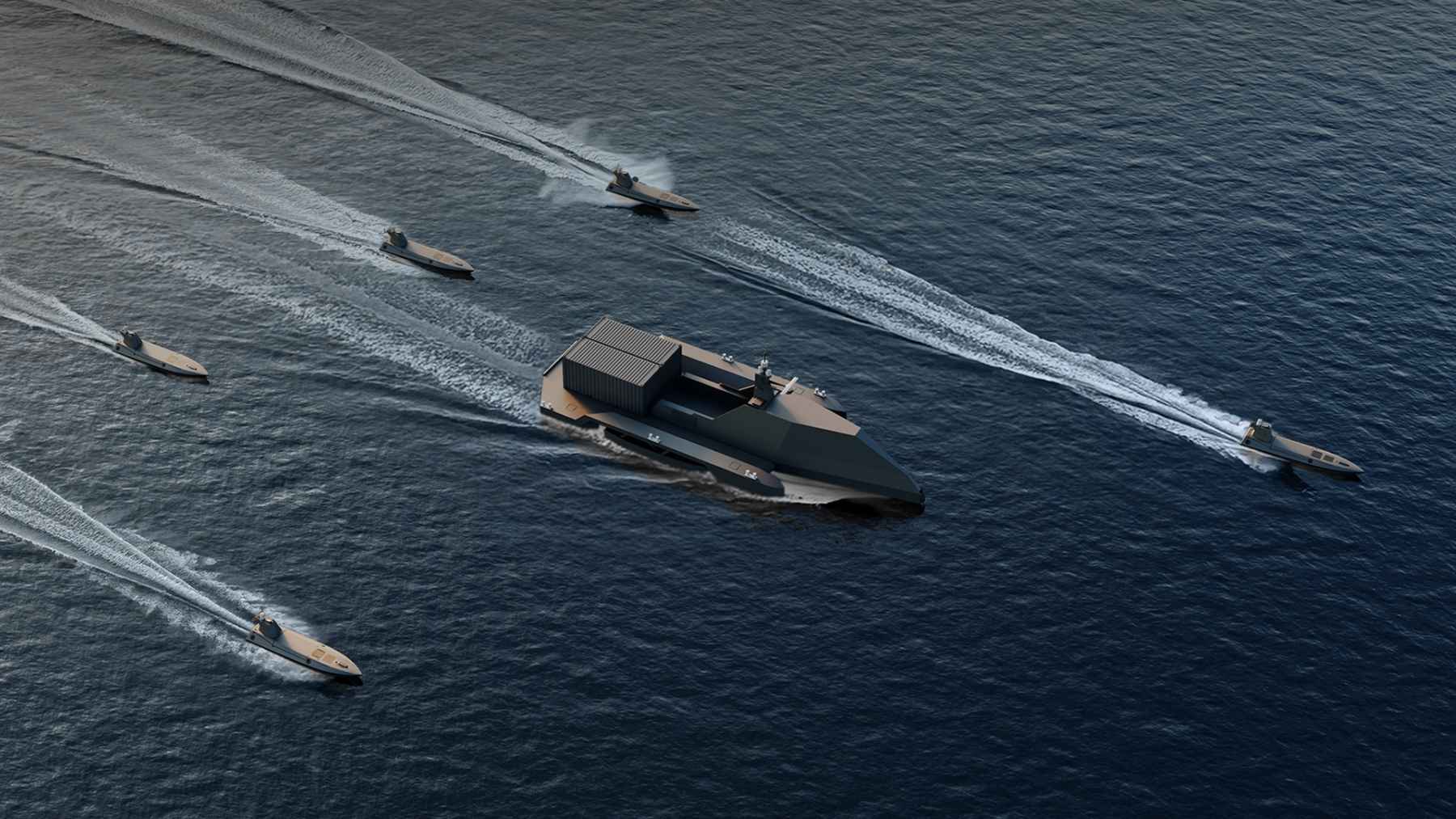
The April kill was one drone, from one boat, as a proof of concept. Eight weeks later, the idea already has teeth. In May, a Kyiv company called MAC HUB showed off a purpose-built sea drone, the Katran X1.2, designed from the keel up to do this at scale. As The Defense Post reported, a demonstration run had it carrying 27 AI-guided interceptors at once.
This came from a different team than the one behind the April first. The Katran was developed with the Black Sea Legion, a naval unit under Ukraine’s military intelligence, which is sort of the tell. When two separate Ukrainian groups arrive at the same concept within weeks of each other, it stops reading like a one-off stunt and starts reading like a doctrine taking shape. The Katran is a 9-meter (30-foot) boat with a range around 1,600 km, roughly 1,000 miles, enough to work across the Black Sea, and its interceptors are built to hit about 380 km/h, near 235 mph, which the developers say is fast enough to chase down a Shahed. It can also be fitted with R-73 air-to-air missiles to go after aircraft and helicopters, not just drones. The same coastal cities the April intercept was meant to protect, Odesa included, are exactly what a boat like this is pitched to cover.
This is still early. One confirmed intercept from the Nemesis brigade, a boatload of interceptors shown off on a river by a separate team, and a pile of detail kept off the record on purpose. The concept still has to prove it can do this reliably, in real numbers, against the kind of mass Shahed raids Russia actually launches, not once for a camera, but night after night.
The basic idea is hard to un-see, though. The sea that Russia has been treating as a free corridor to fly drones at Odesa can be turned into a wall instead, a layer of air defense floating out where nothing on land can reach. Ukraine spent four years learning to fight at sea without sailors. Pointing those same crewless boats up at the sky is a small change in hardware and a much bigger one in what a sea drone is even for.
Image credit: AFP