
Ask most people to picture nuclear waste and you’ll probably get glowing green goo leaking out of a yellow drum. Some of it really is tricky, hard-to-handle stuff. But a big share of the waste left over from America’s Cold War bomb-making is ending up as something a lot more boring: gray grout, pumped into giant concrete tanks in South Carolina until there’s no room left.
On October 13, the Department of Energy announced that the first of the really big ones is done. Saltstone Disposal Unit 6 (SDU 6, if you’d like to save some breath) at the Savannah River Site is now completely full, eight years after the first batch went in. DOE didn’t give the exact day the last load went in, so that announcement is the first public word that it’s topped off.
I’ll admit it’s a slightly odd thing to celebrate. A tank getting full isn’t usually news. But SDU 6 is a pretty strange tank, and the plant feeding it pulled off something it had never done before on the way to the finish line.
So what’s actually inside it?
The short version is salt. Savannah River spent decades making nuclear materials for the weapons program, and the chemical leftovers ended up in dozens of big underground steel tanks as a mix of sludge and salty liquid.
Before anything gets near SDU 6, the site’s Salt Waste Processing Facility pulls the highly radioactive material out of that salty liquid. Those high-activity leftovers head to a separate plant where they’re melted into glass, a process called vitrification (it’s the same basic idea as the 300-ton furnace at Hanford we’ve covered before). What’s left is a decontaminated salt solution that still carries some low-activity radionuclides.
That solution goes to the Saltstone Production Facility, which mixes it with fly ash and slag. If you’ve never run into those two, fly ash is the powdery residue left over from burning coal, and slag is a byproduct of making iron and steel. Both are pretty common ingredients in regular concrete.
The resulting grout gets pumped into the disposal unit while it’s still runny, and it hardens in there into one big solid block. DOE’s own Saltstone Disposal Units fact sheet describes the end product as a monolithic, nonhazardous solid. It’s basically designed to sit in one place and never go anywhere again.
Why wrap a tank in 289 miles of wire?
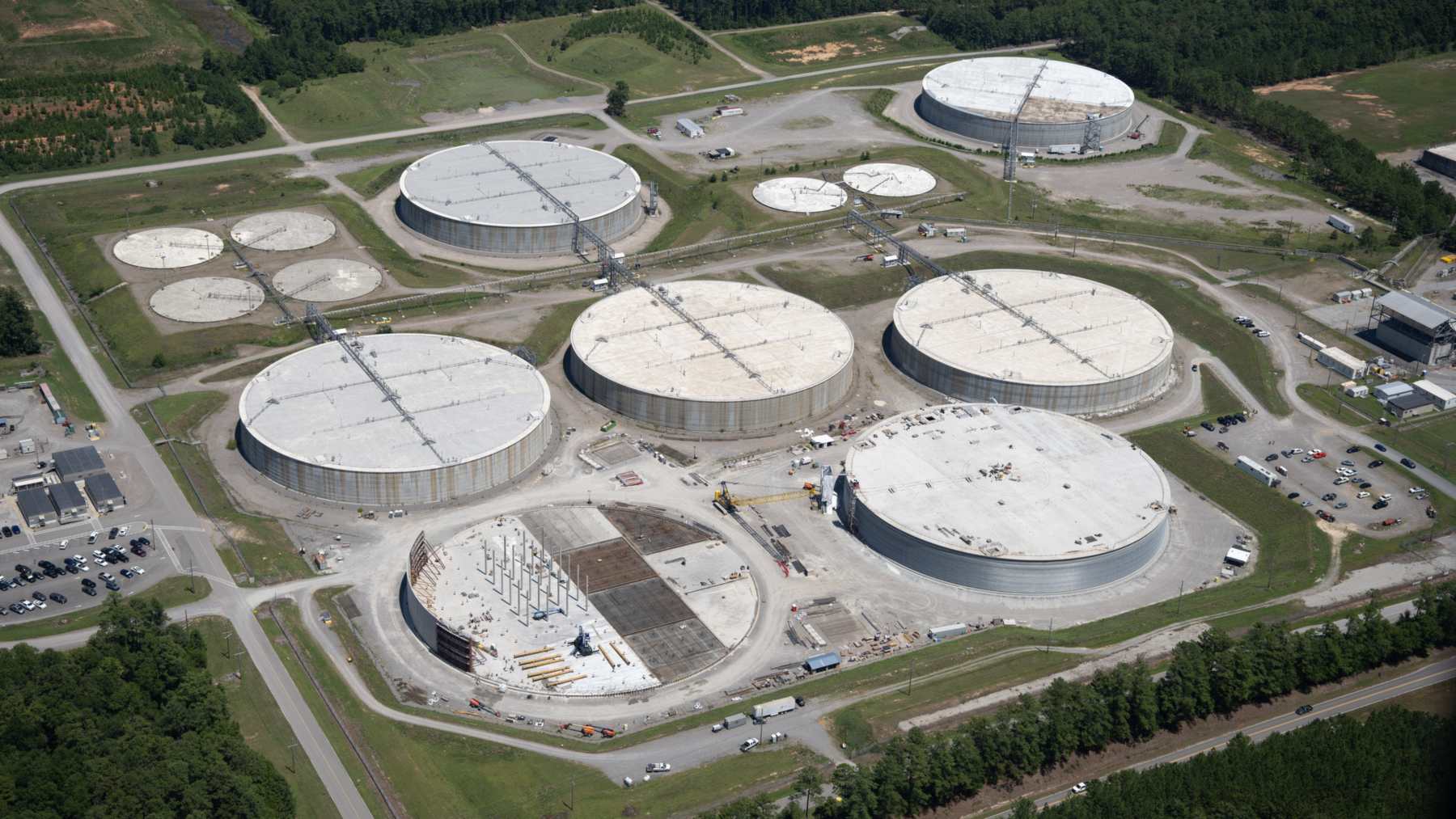
SDU 6 is 375 feet across and 43 feet tall. DOE rates it at 32.8 million gallons, which it usually rounds up to about 33 million.
The six disposal units Savannah River built before it held roughly 3 million gallons apiece. Sticking with that older design would have meant building 80 of them, according to DOE. The mega-size layout gets the same job done with seven. SDU 6 alone covers about 2-1/2 acres and took more than 13,000 cubic yards of concrete to build.
Its walls are wrapped in 289 miles of pre-tensioned wire strand, and each strand is 3/8 of an inch thick. That sounds like overkill until you think about what happens during a pour. Fresh grout behaves like a liquid, so it shoves outward on the walls the same way a full kiddie pool bulges at the sides. DOE says the wire keeps the walls intact as the tank fills up and they try to expand. Picture the steel bands holding an old wooden water tower together and you’re in the right ballpark.
Inside, more than 7,000 pieces of rubber about an eighth of an inch thick are bonded to the floor and walls. DOE says that makes SDU 6 the largest rubber-lined tank in the world, which is a pretty niche title, but I’m not going to argue with it.
It also came in cheap, at least by government standards. SDU 6 cost about $118 million against a $143.2 million budget, and it was finished 16 months ahead of schedule. I don’t know about you, but a federal construction project beating its deadline by more than a year is a pretty rare sight.
The mixing plant finally ran all day
Filling the tank wasn’t the only first. On the way to topping it off, the Saltstone Production Facility kept going for a full day without stopping, which it had never managed before. The plant has typically run for 14 to 18 hours at a stretch, and DOE credits upgrades at the facility plus a bigger supply of salt solution for making a full day possible. In that one run, just over 112,000 gallons of salt solution went into SDU 6.
Those 112,000 gallons are the liquid going in, before the fly ash and slag get mixed in, so the grout that actually lands in the tank takes up more room than that.
Which raises a fair question. Isn’t treatment supposed to make the waste pile smaller?
Not in this case. DOE says about 32 million gallons of tank waste is still sitting at the site, and the cleanup waters it down, runs it through chemical treatment and then bulks it up with dry ingredients. So the total volume that ends up in the disposal units will be a lot bigger than what’s in the tanks today. You’re basically trading a smaller amount of liquid in aging underground tanks for a much bigger amount of solid that stays put, and frankly that seems like a pretty reasonable trade.
SDU 6 actually started taking grout two years before the Salt Waste Processing Facility came online, using salt solution from smaller interim cleanup processes. DOE says that facility is now running faster than it ever has, which is a big reason the disposal units matter so much.
SDU 6 hasn’t had a totally smooth ride
Early last year, a control room operator watching SDU 6 on camera spotted light coming through the joint where the roof meets the tank wall. According to a Defense Nuclear Facilities Safety Board site report, follow-up inspections found degraded gasket material and several openings to the outside air. Processing into SDU 6 was put on hold while engineers evaluated it, radiological protection staff set up air monitoring, and SDUs 7, 8 and 9, which share a similar design, didn’t show the same problem. A follow-up engineering analysis found very little settling.
I couldn’t find a public write-up spelling out exactly how that joint was dealt with. What DOE does say is that crews filled SDU 6 under strict operating procedures, keeping an eye on grout height and using ventilation features built into the unit’s design, and that the liquid waste team will keep monitoring the filled tank over the long term.
There are six more of these
SDU 6 is one of seven aboveground mega-size units that will hold the final form of Savannah River’s salt waste. Four more have been built since, and DOE says two of those are taking grout right now. One of the newer ones is SDU 10, the 375-foot unit wrapped in 341 miles of cable that got cleared to receive material a couple of months ago. Construction is underway on the final two.
Chuck Comeau, federal project director at DOE’s Savannah River Operations Office, called the fill “an important step in reducing the risk of waste at SRS.” It’s safe to assume SDU 6 won’t be the last of these we hear about getting full.
DOE announced the SDU 6 fill on October 13, and Savannah River Mission Completion, the contractor that runs the disposal units, will keep the tank under long-term surveillance from here on out.