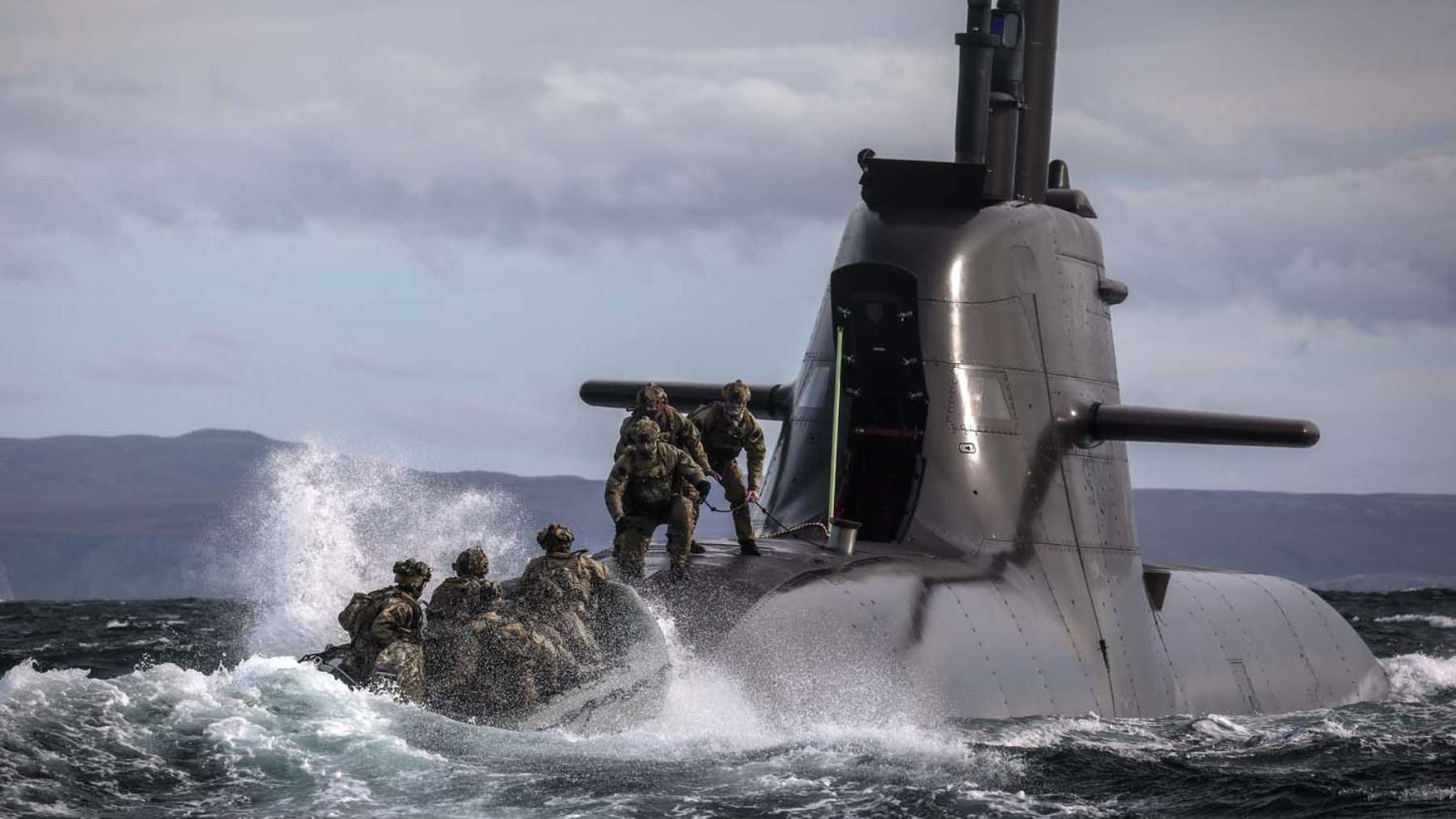

If you know one thing about submarines, it’s that they’re built to stay out of sight. They lurk, they listen, and if everything goes to plan, nobody ever knows they were there.
So it’s a little unusual for one to come up on purpose off the coast of Scotland with British commandos on board. That’s exactly what happened during Exercise Strike Warrior, though. And the submarine was German.
According to the Royal Navy, the boat surfaced off Cape Wrath, the far northwestern tip of mainland Britain. Commandos from 148 Battery left it in inflatable raiding boats, set up an observation post on top of the cliffs and used it to aim the guns of the Portuguese frigate NRP Dom Francisco de Almeida at “enemy” positions.
The phrase “German U-boat surfaces off Scotland” would’ve meant something very different 80-odd years ago. Now it’s a pretty neat bit of NATO choreography. The Navy says the German boat was responsible for picking out the targets. The commandos slipped ashore, and the Portuguese frigate handled the firepower.
The battery seems pretty pleased with how it went, too. Its operations officer, whose name the Navy is keeping back for operational reasons, said the unit hadn’t pulled off “this level of complexity and coordination of live assets” in nearly 30 years.
So why go to all that trouble for one observation post?
Warships need someone on the ground to aim for them
A frigate’s gun can hit targets miles inland, behind hills and ridgelines, but the crew firing it can’t actually see what they’re shooting at. Someone has to be close enough to watch where the rounds land and radio corrections back to the ship. That’s basically what 148 Battery is for. The Navy describes it as a specialist unit of Navy and Army commandos trained to sneak in behind enemy lines, scout targets and call in fire from warships. Getting those spotters into place without anyone noticing is where it gets tricky, and a submarine is about as quiet a taxi as you’ll find.
In this case, the gun belonged to a 401-foot frigate that carries a 76mm OTO Melara cannon as its main weapon, according to the Portuguese Navy. The Royal Navy’s account doesn’t say whether it fired live rounds or how far away its targets were.
Cape Wrath would be a sensible spot for the real thing. The UK government says the training area there covers about 25,000 acres of moorland, and it’s the one place in Europe where ground troops, warships and aircraft can all train together at once. The RAF even trains there with live 1,000-pound bombs.
If you ever plan a hike out there, check the firing times first. The range flies red flags by day and shows red lights at night when live firing is on, and nobody’s allowed in.
Germany has six of these submarines
The Navy didn’t name the boat, and I couldn’t find which one it was. Narrowing it down isn’t hard, though. The Bundeswehr runs six Type 212A submarines, U 31 through U 36, and as far as I can tell, those six are Germany’s entire submarine fleet.
Each one is 184 feet long and goes to sea with a crew of 28. It displaces 1,598 tons on the surface and 2,017 tons once it dives.
The 212A’s real party trick is staying under. Most non-nuclear submarines have to come up near the surface every so often to run their diesel engines and recharge their batteries, and that’s when they’re easiest to spot. The 212A carries a fuel cell plant alongside its diesel, which the Bundeswehr says lets it stay submerged for up to two weeks. Which means if you’re trying to get a handful of commandos close to someone else’s coastline without being noticed, it’s a pretty good fit.
Here’s how the two ships at either end of that chain compare:
The Navy doesn’t say why it used a German submarine instead of a British one. Britain does have attack submarines of its own, and its newest, HMS Agamemnon, only left the shipyard in Barrow for sea trials on September 24. But the Navy frames the whole raid as allies working together, and for an exercise this NATO-heavy, that’s probably the honest answer.
The frigate is a bit of an international mutt itself. The Portuguese Navy says the Dom Francisco de Almeida was built in the Netherlands as a Karel Doorman-class ship for the Dutch Navy before Portugal took it over. It’s the sister ship of the NRP Bartolomeu Dias, which spent part of a recent exercise off Portugal playing target for more than 60 drone boats and aircraft.
It wasn’t the only frigate 148 Battery worked with, either. Earlier in Strike Warrior, the commandos called in gunfire from two ships in Standing NATO Maritime Group One, the Dutch Navy’s HNLMS Van Amstel and Canada’s HMCS St. John’s. Van Amstel is one of the Dutch Navy’s M-class multipurpose frigates, so the battery ended up working with two ships of the same Dutch design in one exercise.
Strike Warrior is the biggest commando test in 15 years
The submarine raid is one piece of a much bigger exercise. The Royal Navy calls Strike Warrior the largest test of the UK Commando Force’s full range of units in 15 years. It’s also the first time since Afghanistan that every one of those specialist units has worked together, according to the Navy.
More than 2,000 people from six countries are spread across Scotland for it, from the Western Isles to the North Sea. The Navy lists those countries as the UK, the Netherlands, Canada, Germany, Norway and the US. Portugal isn’t on that list. That seems a little harsh, given its frigate was the one with the gun.
The whole exercise pulls in 19 aircraft and eight warships. Alongside the gunnery work, the commandos have run amphibious landings, boarding operations and anti-submarine warfare, and they’ve flown drones both to hit targets and to carry supplies to troops in the field. They’ve also built underground medical facilities, which I can’t imagine is a fun job in Scotland in October.
If you were hoping for a play-by-play, the Navy has kept a few details of the submarine run to itself. It hasn’t said which day the raid happened, how many commandos went ashore, or how long the boat sat on the surface. I’d guess the answer to that last one is “as little as possible.”
Strike Warrior kicked off on September 28, and the Royal Navy says it wraps up this Friday, October 9.