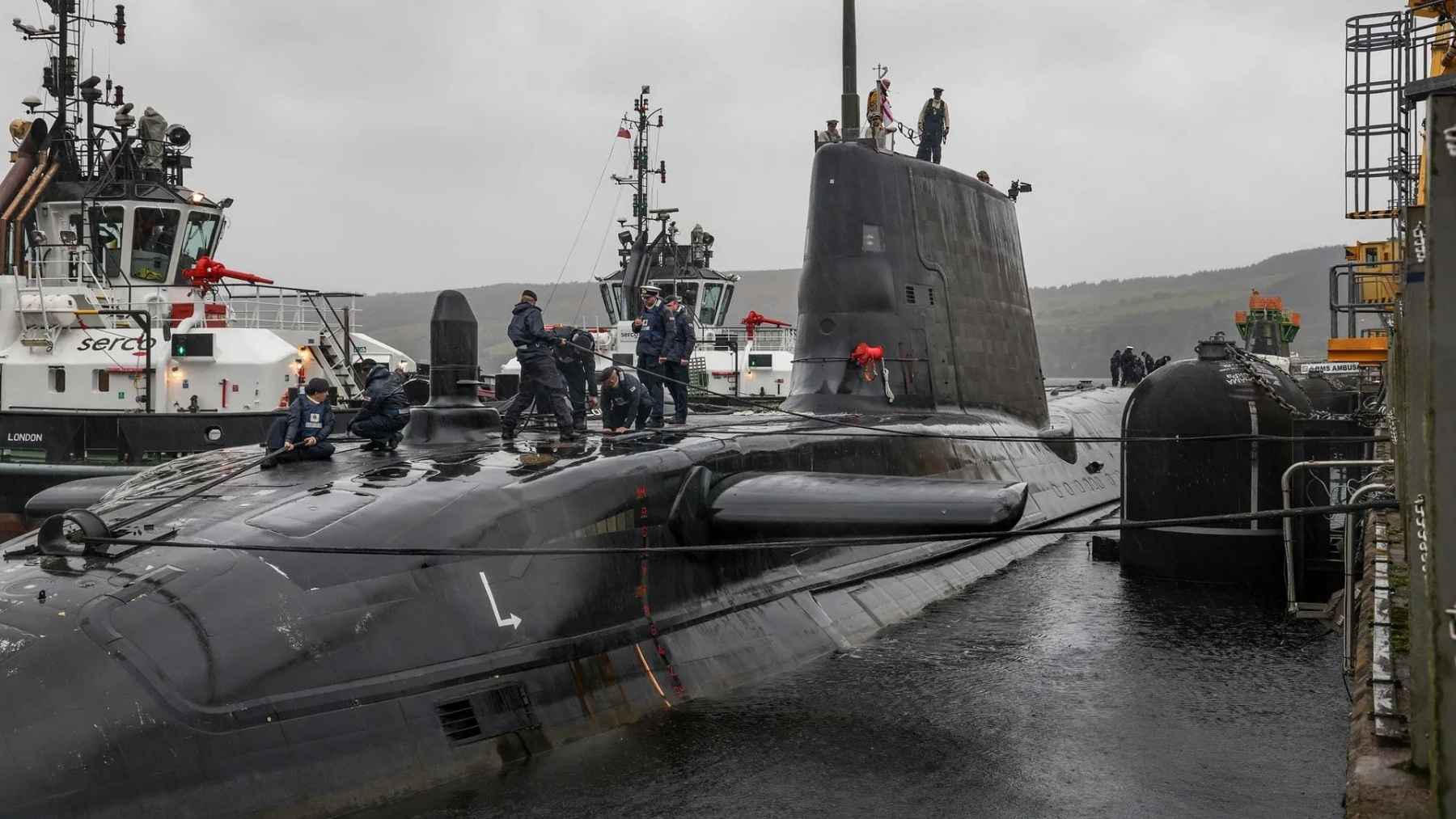

If you’d started building a house in the summer of 2013 and your contractor was still on site today, you’d have lawyers involved. So spare a thought for the British taxpayer. On September 24, HMS Agamemnon, a nuclear-powered attack submarine, finally left BAE Systems’ shipyard in Barrow-in-Furness, England, on her first voyage. Her keel was laid in that yard on July 18, 2013, which puts 13 years and two months between the formal start of construction and the day she sailed.
She didn’t exactly roar out of there, either. Getting the 318-foot (97-meter) boat clear of the yard meant lashing her between four tugboats, sent up by the contractor Serco from naval bases in Portsmouth and Faslane. The convoy threaded the confined Devonshire and Buccleuch docks, made a sharp turn toward Ramsden Dock, then eased down the Walney Channel toward the Irish Sea, with the tugs sticking close until the water got deep enough for the submarine to look after herself. Navy Lookout, which covered the departure, rates that exit as one of the trickier parts of the whole trip.
Why does a nuclear submarine need four tugboats?
Because a submarine on the surface is frankly a pretty terrible boat. The hull’s shaped to run deep and quiet, not to maneuver in a dock, and at 8,157 short tons (7,400 metric tons) nothing about her stops or turns in a hurry. So the tugs did the steering, and a boat built to vanish under the ocean got walked out of her own shipyard holding four hands.
Tugboats do this kind of babysitting all the time. Last month they pushed a 45,000-ton battleship four feet off her pier in Norfolk so a museum could swap two rubber fenders. The difference is that the Wisconsin hadn’t moved in 26 years, and Agamemnon is brand new. Sort of.
So what took 13 years?
Nobody’s published an itemized answer, so I’ll stick to what the record shows, which is a schedule that kept sliding. When the submarine’s name was announced in 2013, the UK’s Ministry of Defence expected her to enter service in 2022, per Navy Lookout. She rolled out of Barrow’s giant assembly hall in October 2024. King Charles III commissioned her into the Royal Navy on September 22, 2025.
And if you figure a commissioned warship is a finished warship, this boat would like a word. A commissioning is the ceremony where a vessel formally joins the fleet, with the flag, the crew and in this case the King. It doesn’t mean the builders are done. Agamemnon spent another year in the shipyard after her own party, finishing the test program on her reactor plant and taking her first trim dive, basically a controlled sink in calm water to confirm the boat sits level, in October 2025. Her departure came one year and two days after the ceremony.
What the Royal Navy is getting
Agamemnon is the sixth boat of the Astute class, Britain’s current line of hunter-killer submarines. Steve Timms, who runs BAE’s submarines business, called her “the sixth of seven such submarines that we are building here in Barrow” in the company’s announcement. She carries Spearfish heavyweight torpedoes for ships and other submarines, plus Tomahawk cruise missiles for targets ashore, the same missile family American destroyers and subs have fired for decades.
An attack submarine is the underwater world’s general-purpose tool. It hunts surface ships, trails other submarines and throws cruise missiles inland, all while staying hidden, and navies build specialized one-offs for the stranger jobs; the US ran its entire seabed-warfare mission through one stretched 453-foot submarine for 21 years. What makes Agamemnon matter right now is simpler. The fleet she’s joining badly needs a boat that moves.
By Navy Lookout’s count, 120 days had passed at her departure since an operational British attack submarine was last known to be underway, with HMS Anson, the fifth Astute, alongside in Devonport since May 27 after an Indo-Pacific deployment. Agamemnon isn’t operational yet. She’s still the first Royal Navy attack submarine to put to sea in four months.
When does she actually start working?
Not for a while. The boat is headed for HM Naval Base Clyde on Scotland’s west coast, her permanent home, where a long run of sea trials, weapons testing and crew training starts. The Ministry of Defence doesn’t publish planned in-service dates for individual submarines, so the best guide we’ve got is her sister. HMS Anson left Barrow on February 19, 2023, ran trials in UK waters and at the US Navy’s AUTEC range in the Bahamas, and became fully operational around June 2024, per Navy Lookout. The same roughly 15-month path would make Agamemnon a working warship in the back half of 2027, a little over 14 years after her keel went down. That’s Navy Lookout’s math, not an official promise, and I’d treat it as the optimistic case.
Barrow already has five more submarines in build
The seventh and final Astute, Achilles, is at an advanced stage of construction, according to BAE, and all four of the Dreadnought-class boats that will replace Britain’s current nuclear-deterrent submarines are under way in the same yard, which King Charles granted Royal Port status last year. Early design work has started on SSN-AUKUS, the class that will eventually replace the Astutes themselves. And every reactor in that pipeline comes from a single Rolls-Royce site in Derby that’s doubling in size to keep up.
As for Agamemnon herself, General Sir Gwyn Jenkins, the Royal Navy’s First Sea Lord, says the submarine has now begun sea trials and will soon arrive at the Clyde to join the fleet. Those trials started with her departure from Barrow on September 24, 2026, and if HMS Anson’s timeline holds, they’ll keep her busy until late 2027.