
Most of us don’t give magnets much thought. There’s one holding a takeout menu to the fridge, a couple more tucked inside your car’s speakers, and that’s pretty much it. According to the National MagLab in Florida, a strong fridge magnet puts out about a hundredth of a tesla, which is plenty for a menu.
Fusion engineers think about magnets all day long, because a lot of fusion machines are basically giant magnets wrapped around a gas (technically a plasma) that’s far too hot for any wall to touch. And in one corner of fusion research, building those magnets has been a real headache.
A New Jersey startup called Thea Energy thinks it’s found a way around that. Its idea is to make the magnets flat, make every one of them identical, and hand the difficult part to software.
Stellarator magnets are notoriously hard to build
There are two main ways to hold a fusion plasma in place with magnets. A tokamak, the classic donut you’ve probably seen in pictures, drives a strong electric current through the plasma to help twist the magnetic field into shape. A stellarator gets its twist from the shape of the coils instead, so it can run continuously, but those coils end up bent into some pretty wild 3D forms.
The best-known stellarator is Wendelstein 7-X in Germany. Its main field comes from 50 twisted superconducting coils in five different shapes. According to the engineers who built them, those coils measure up to about 11.5 feet at their largest and weigh around 12,000 pounds each.
Every one of them also had to match its intended shape very precisely, because a coil that’s slightly off bends the field in ways the physicists didn’t plan for. It’s a frankly incredible piece of engineering. You probably wouldn’t want to build it over and over for a fleet of power plants, though.
Thea’s coil is flat, round and apparently pretty strong
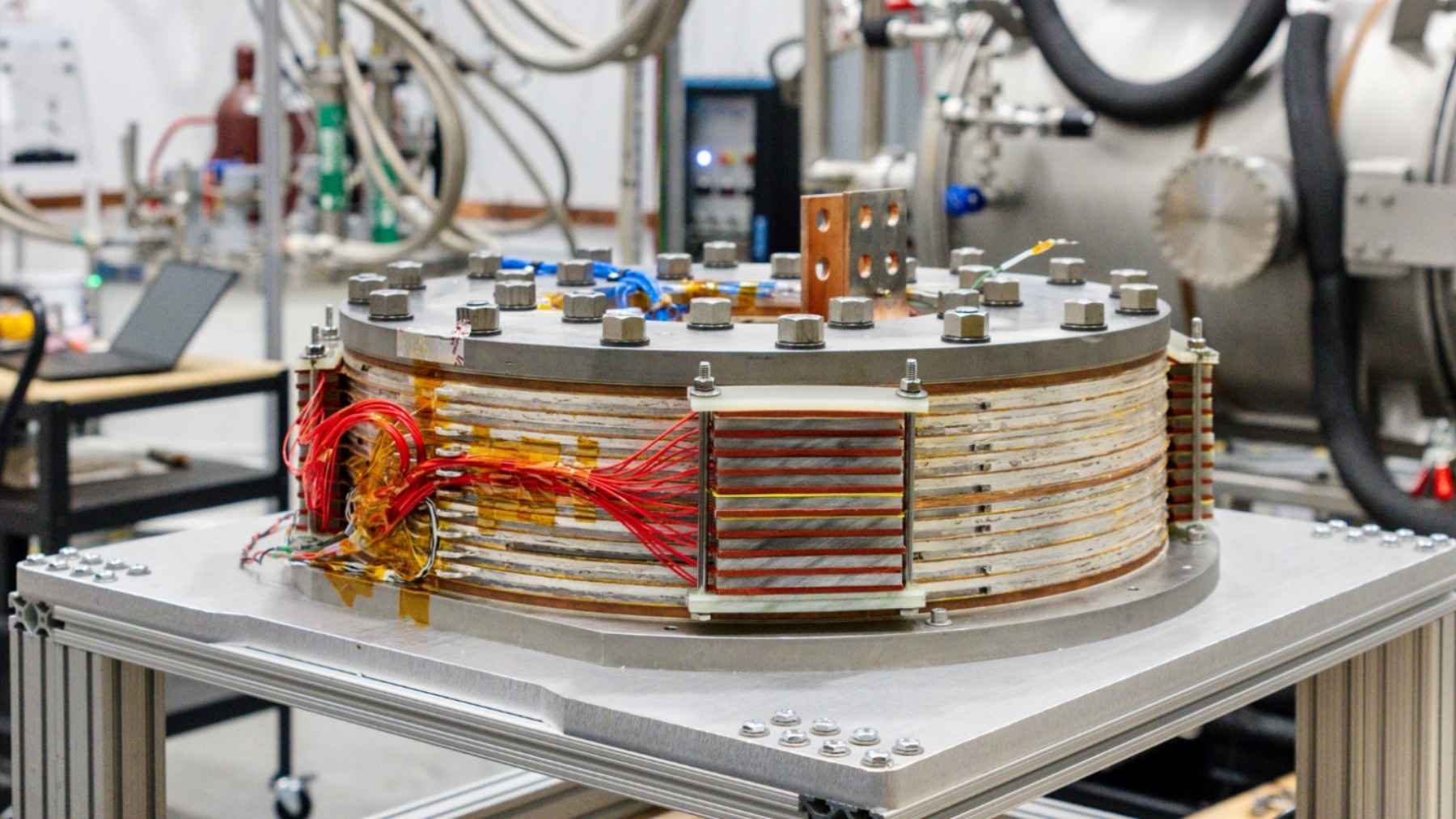
Thea swaps the twisted coils for flat, circular ones laid out in an array. Each coil gets its own current, and software adjusts those currents so the whole array adds up to the twisted field a stellarator needs. It’s a bit like a stadium screen, where thousands of plain little lights add up to one big picture.
In Thea’s May 13 announcement, the company said it had run the first full-size version of that coil at the current and field strength Eos will need. Eos is the first large stellarator Thea plans to build, and this coil was made to its spec. Thea says the coil produced a field of more than 6 tesla at 20 kelvin, and that’s about 424 degrees below zero Fahrenheit.
So how strong is 6 tesla?
The MagLab says the kind of junkyard magnet that hauls cars around is about 1 tesla, and it puts an ordinary MRI scanner at 1.5 to 3. These aren’t perfect comparisons, since where you measure a field matters a lot. But they give you a rough idea of the league this coil plays in.
The coil is wound from high-temperature superconducting tape. A superconductor carries electricity with zero resistance once it’s cold enough. That’s how you can push huge currents through a magnet without it cooking itself. And yes, “high temperature” here means 424 degrees below zero. It’s only warm next to older superconductors. Those need liquid helium, which gets them even closer to absolute zero.
The coil was designed and made in-house in Kearny, New Jersey, where Thea is based. Co-founder and CTO David Gates said the company’s magnets are “overwhelmingly easier to build” than the complex coils of earlier stellarators. That’s a bold thing to say about your own hardware, but it’s also sort of the entire pitch.
There are a few things we don’t know yet. All of the test figures come from Thea, and I haven’t found an independent measurement of the coil published anywhere. The company also hasn’t given the coil’s actual dimensions beyond calling it full-size.
Thea did say its next test campaigns would look at quench survivability. A quench is when part of a superconducting magnet suddenly stops superconducting and all that current starts turning into heat in one spot. It’s pretty much the failure every superconducting magnet designer has to plan around, so those results will arguably matter as much as the 6-tesla figure.
Then Thea started talking about copies
On July 27, Thea put out a manufacturing update. CEO Brian Berzin said the team had iterated the coil more than a hundred times in about two years and finalized the design. Back in May, the company’s count was more than 50 generations in about a year and a half.
Thea doesn’t say how many of those versions came after the May test, and the two releases use different time windows, so I wouldn’t read too much into the jump.
Berzin also gave a target. He said Eos will use about 300 of the shaping coils, and Thea’s May release says every shaping coil in the design is one identical part. That 300 is a plan for a machine that hasn’t been built yet, and Thea hasn’t said how many full-size coils it’s made so far.
The July news came with a $20 million award from ARPA-E, the Energy Department’s advanced research agency, under its SCALEUP Ready program. Thea says the money goes toward manufacturing and testing for a production line of these magnets. The agency’s SCALEUP lead, Dave Nye, is quoted in Thea’s July release saying the company has validated its magnets. Still, a federal manufacturing award is a bet on a production plan, and an outside lab publishing its own measurement of the coil would be a separate thing.
So are 300 identical coils actually easier than 50 weird ones?
Probably, at least on the factory floor. Winding the same flat circle 300 times is the kind of job you can build a production line around, with one set of tooling and one set of checks. Thea’s own Eos page makes the comparison and tells you to “think automotive assembly lines,” which is an analogy I’m more or less contractually obligated to enjoy.
Most of the fusion magnets that make headlines go the other way. The 1,000-ton central solenoid built in California for ITER took roughly 15 years to make.
But the flat shaping coils don’t do all the work. At least in a design paper on Eos posted to arXiv, 12 bigger flat coils ring the plasma and supply most of the field that holds it in place, and the small shaping coils handle the corrections. Thea’s Eos page also lists a maximum field of about 16 tesla at the coils, compared with the 6-plus tesla the shaping coil ran at in May. So Thea’s production line is aimed at the simplest magnets in the machine. That makes sense to me, but Eos still needs its bigger coils too.
Then there’s control. Thea’s Eos page says the machine has more than 450 independent variables it can keep re-tuning. The company’s argument is that software can make up for a coil that came out slightly wrong or wears over time, where a twisted coil is stuck with the shape it was built in. I think that’s a pretty convincing argument on paper. I’d still like to see it hold up with a few hundred coils running at once, and that can’t happen until Eos exists.
In its most recent update, on August 18, Thea said it had looked at several possible locations for Eos, and it’s planning a second plant in northern New Jersey to make more of its magnets.