
Almost every picture you have ever seen of a fusion reactor shows the same shape. A metal donut, plasma running around the inside of it, magnets wrapped tidily around the outside. That machine is a tokamak, and it is the design most fusion experiments have been built to for decades, largely because it is the easier one to build and by far the better understood.
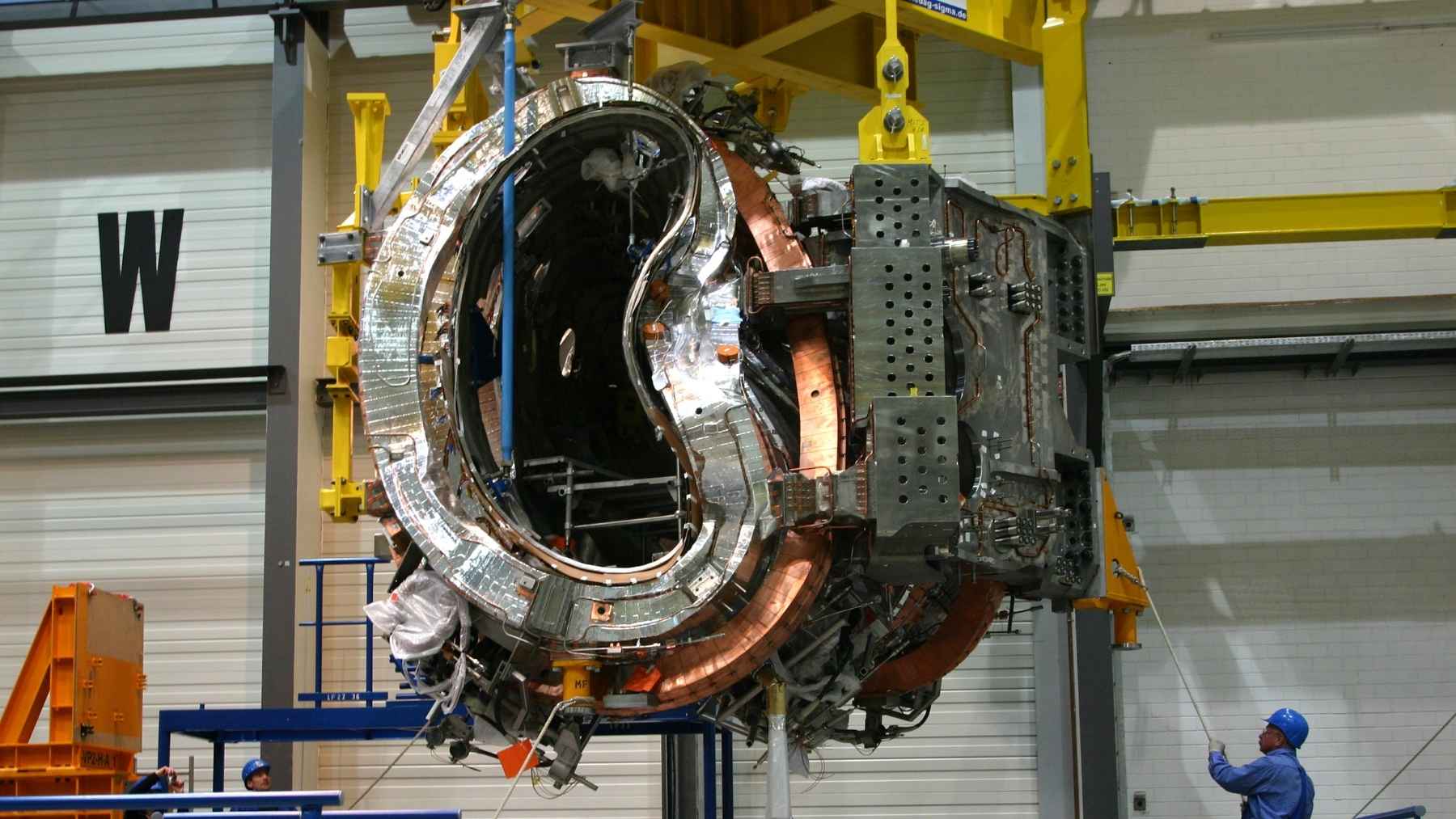
Then there is the thing sitting in Greifswald, on Germany’s Baltic coast. Wendelstein 7-X runs on 50 superconducting coils, each roughly 3.5 metres tall, chilled to about minus 270 degrees Celsius, and not one of them is a shape a person could have drawn. According to the Max Planck Institute for Plasma Physics, working those shapes out was only possible with supercomputers.
On July 27 the same institute announced it is spending 6 million euros to rip out the machine’s microwave heating and build something far stronger. The money comes from Germany’s federal research ministry. The machine itself is switched off as you read this, halfway through a maintenance shutdown, and it does not restart until September.
The record lasted four weeks before the tokamak people called
On May 22, 2025, the last day of its OP 2.3 campaign, Wendelstein 7-X held a high-performance plasma for 43 seconds and hit a peak value of the triple product, the density-times-temperature-times-confinement-time number that decides whether a fusion machine is going anywhere.
The press release said it had passed the best tokamak results for long pulses. That went round the world. Fusion record, German stellarator, tokamaks beaten.
Four weeks later the institute added an update to the bottom of its own announcement. People from the JET tokamak in Britain had been in touch with results nobody had published yet. In its final months of operation, JET had run long pulses of its own, and the best of them held comparable triple products for up to 60 seconds.
So the stellarator had not beaten the tokamaks. It had drawn with them. The IPP said so itself, redrew the graph to show JET’s numbers in green, and today its official milestones page describes the May 2025 result as being “on a par with tokamak records” rather than ahead of them.
Institutions do not usually rewrite their own good news. This one did, and the corrected version is arguably the better story, because JET had three times the plasma volume of Wendelstein 7-X and size is the single biggest advantage you can have in this business.
JET’s side of it is now in print. The paper on those long pulses describes two scenarios developed in December 2023: a 30-second H-mode running 12 to 14 megawatts of neutral beam heating, and a 60-second pulse on 4 to 5 megawatts. The machine that produced them was shut down and is now being taken apart.
Forty-three seconds is a much harder problem than four
The obvious question is why anyone cares about 43 seconds when tokamaks have posted higher triple products in short bursts. The answer is in the numbers themselves.
Work published alongside the JET results notes that across a multi-machine database, triple products drop by at least two orders of magnitude as you stretch plasma duration from under a second to 100 seconds. Everything that makes a plasma good at one second starts falling apart by ten.
That collapse is the whole problem with fusion as a power source. A grid does not want a machine that is brilliant for four seconds. It wants one that runs on Tuesday.
Stellarators are supposed to be better at exactly this. A tokamak needs a large electrical current driven through the plasma to help confine it, which is what makes it a pulsed device by nature. A stellarator does the confinement entirely with the coils outside, so in principle it can just keep going.
The catch is that you pay for that in geometry, which is why the coils look the way they do, and why nobody built a serious one until the supercomputers were good enough to design it.
Eleven microwave guns and only twelve holes to put them in
Wendelstein 7-X is heated mainly by microwaves. Electron cyclotron resonance heating, if you want the full name, and the device that generates it is a gyrotron. There are eleven of them installed, and the spread is wide: the oldest prototypes date from 1999 and manage about 0.6 megawatts, while the current record holder does 1.3.
That is not enough. To prove the point the machine was built to prove, the plasma has to hold a pressure of 4 to 5 percent of the magnetic pressure squeezing it, which is the condition for trapping the fast helium nuclei a real reactor would produce. The IPP estimates that needs up to 30 megawatts of heating power, most of it from microwaves.
Here is where the building starts dictating the physics. Wendelstein 7-X has exactly twelve gyrotron positions. Adding a thirteenth would cost around ten million euros regardless of how powerful the tube going into it is, because it means a new building, new transmission tunnels and a much bigger high-voltage supply.
Which is how you end up with the project announced on July 27. HiPMiB, short for High Power Microwave Beams, started in January 2026 and pairs the IPP with the Karlsruhe Institute of Technology, the University of Stuttgart and Thales. The goal is a 2-megawatt gyrotron, which would be a world record for the type. The institute reckons that is roughly the output of 2,000 kitchen microwaves, at about fifty times the frequency.
Karlsruhe gets the hardest bit. The walls of the resonator where the microwaves are generated take something like 20 megawatts per square metre, which is past what water cooling of copper comfortably handles, so the team is working on microchannel cooling instead. Thales then has to build a demonstrator that survives half an hour of that.
The transmission side is almost more revealing. Microwaves travel from the gyrotrons into the vacuum vessel by bouncing off mirrors, and in past long pulses beyond five minutes that path has produced overheated components and scorched sealing rings on vacuum valves. The fix involves widening the beams with longer focal lengths, blowing dry cold air through the lines and building a diagnostic that can spot arcing fast. A billion-euro fusion machine, held up by cooked rubber.
“A three-year timeframe is planned for this complex project, which is very ambitious,” said Dr. Heinrich Laqua, the HiPMiB project manager at IPP, in the institute’s announcement. Gyrotrons are becoming a business in their own right, incidentally, and at least one Japanese company has built a company around selling them rather than building reactors.
The machine is switched off right now
None of this is happening with the plasma running. Wendelstein 7-X finished OP 2.3 in May 2025 and went into a maintenance phase that the IPP has said runs about a year, with experimental operation resuming in September 2026.
The campaign it just finished was a serious piece of work regardless of who holds what record. Peer-reviewed results published in May put it at 80 to 100 discharges a day across two back-to-back campaigns, with a new steady-state pellet injector built at Oak Ridge National Laboratory feeding it roughly 90 frozen hydrogen pellets over the 43-second run, each about a millimetre across and fired in at 300 to 800 metres per second.
The American involvement is not incidental and it just got locked down. In April, PPPL announced a 10-year project agreement between the Department of Energy and the IPP covering W7-X, the first partnership set up under a new model framework between the U.S. and the European Commission. Jean Paul Allain, who runs DOE’s fusion office, called the collaboration “extraordinarily productive for more than 20 years already.”
Princeton supplies the X-ray spectrometer that measures ion temperature at Greifswald, which means an American instrument produced one of the three numbers in the record everyone argued about.
411 million euros says the shape is right
The most interesting vote of confidence in this geometry did not come from a lab. On July 8, Proxima Fusion, the first company to spin out of the IPP, closed a funding round of 411 million euros at a valuation above 2.4 billion, making it the best-funded fusion company in Europe.
The money is for Alpha, a demonstration stellarator planned next door to the IPP in Garching under a memorandum signed in February with Bavaria, RWE and the institute. Where Wendelstein 7-X is chasing continuous operation, Alpha is meant to show that energy confinement and heat removal scale to something commercial. Further down the road sits Stellaris, a pilot plant the partners have floated building on the site of the old Gundremmingen nuclear station.
IPP scientific director Sibylle Günter called the round “an important step toward making Alpha a reality.” The unglamorous part is in the same release: Alpha also needs 1.2 billion euros from the federal government, and that has not been committed.
So the scoreboard reads like this. A machine whose coils were computed rather than designed matched the best tokamak on Earth for long-pulse performance, then had its own institute walk the claim back to a tie. It is currently dark, being worked on, with its microwave heating due for replacement over three years it may well overrun. And a startup built on its physics is worth more than 2.4 billion euros before Alpha has a foundation poured.
The 30-minute pulse is the number that settles it. Wendelstein 7-X has managed eight minutes. ITER, the tokamak being assembled in France, is a far bigger and far more expensive bet on the other shape. Both are chasing the same thing, which is a plasma that does not care what time it is.