
Submarines don’t tend to travel light. Even the US Navy’s big drone sub, the 85-foot Orca, leaves from a pier because it’s too heavy for a ship’s crane and too big to ride inside another submarine. If you want one on the far side of an ocean, you pretty much have to let it sail there by itself, which is exactly what it did across the Pacific when we covered it in October.
France wants a big underwater drone that gets around a little faster than that.
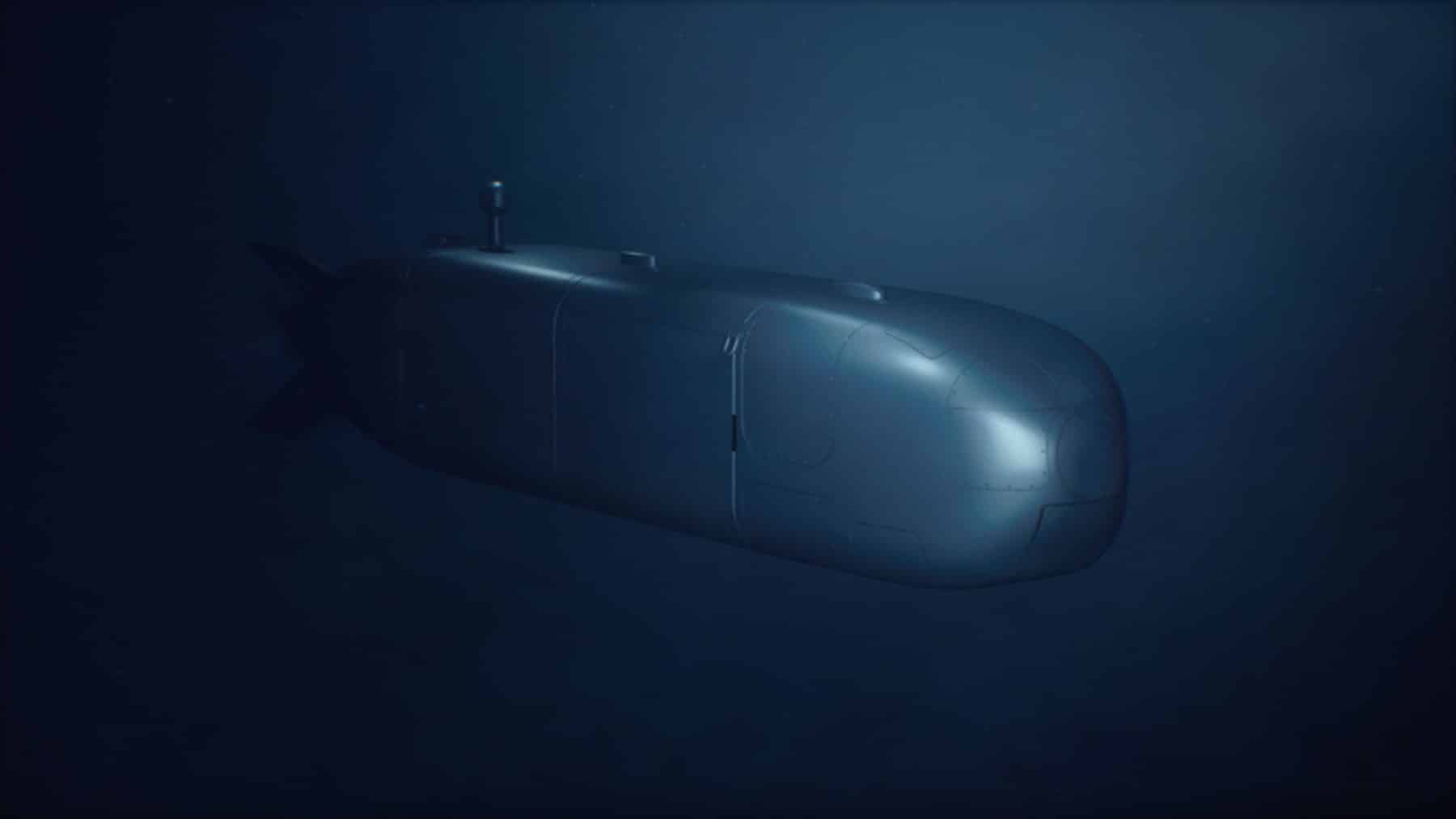
On November 3, at the Euronaval trade show, the French defense ministry’s innovation agency (AID) signed a contract with Naval Group to build an operational demonstrator of its Unmanned Combat Underwater Vehicle, or UCUV, for the French Navy. The agency announced the deal the next day. It says the drone has to be air-transportable, has to go into the water from a quay or a surface ship, and has to make a lot of its own decisions once it’s down there.
It’s a demonstrator, though. That means one vehicle, built to prove the idea works, with sea trials planned for 2028. Any fleet would come later, and as you’ll see, even the money for this first one is still being sorted out.
So how big is an XL underwater drone?
Naval Group files the project under XL-UUV, which stands for extra-large unmanned underwater vehicle. Basically, it’s a drone submarine too big to be fired out of a torpedo tube or lowered over the side by a couple of sailors. The AID says this deal puts France in a fairly small club of countries developing that kind of capability.
A Naval Group representative told Naval News the UCUV will be more than 30 feet long, and that it’ll look a bit different from the company’s current demonstrator. Naval Group hasn’t published a weight for the new vehicle. But I went back through the defense ministry’s original framework announcement, and it called for a long-endurance demonstrator more than 30 feet long and heavier than 11 tons, or more than 22,000 pounds. Neither the AID nor Naval Group repeated that figure this month, so I’d treat it as the starting spec rather than the final number.
The Orca weighs 80 tons, according to the US Navy, while the French spec starts at more than 11 tons. I’d argue that gap is pretty much the point. A drone that size has a realistic shot at riding in a plane.
This didn’t come out of nowhere, either. Naval Group built its own company-funded XL-UUV, which finished sea qualification at the end of summer 2023. The DGA, France’s defense procurement agency, then notified Naval Group of a framework agreement on December 28, 2023, to study and develop the combat version. According to the AID, the French Navy, the DGA and Naval Group have spent nearly three years learning from that first demonstrator at sea.
How does a drone sub get on a plane?
According to Naval News, the UCUV is being designed for air transport on aircraft such as the A400M. If you haven’t run into one, the A400M is Airbus’ four-engine military turboprop, which is kind of what you’d get if you put a C-130 on a serious protein diet. Airbus lists its maximum payload at 81,600 pounds. Its cargo hold is about 13 feet wide and 13 feet tall.
So could a 30-foot-plus drone sub fit?
On paper, it looks pretty plausible. The plane can carry several times the ministry’s minimum weight. But Naval Group hasn’t released the vehicle’s diameter or final weight, so I can’t tell you how snugly it’ll sit in there.
Once it lands, the AID wants it launched from a quay or from a surface ship. That’s a bigger deal than it sounds like it should be. A drone that has to sail from its home port could spend weeks getting to a trouble spot. One that rides in on a plane and gets lifted off a dock at a friendly port can start working a lot sooner. It’s also a pretty different philosophy from the Orca’s. The American boat leaves from a pier and sails, and the French one is supposed to hitch a ride.
Who’s driving?
Mostly the drone. Naval Group says the UCUV will run its Steeris OnBoard software to make decisions during long missions, including when communications are limited or cut off. It’s designed to rework its own mission plan based on its surroundings, the tactical situation, and whether any of its equipment has failed.
If you’re wondering why it can’t just be remote-controlled, it’s because radio and seawater don’t get along. Radio signals fade out fast underwater, so a sub that wants to stay hidden can’t count on a steady link back to base. An underwater drone basically has to be its own captain for long stretches.
Still, there’s a person in the loop. Naval Group describes the autonomy as working under human supervision, and the AID calls it controlled. In plain terms, a human sets the mission and the rules, and the drone handles the moment-to-moment calls in between. Since the AID’s mission list goes all the way up to neutralization, I’d say that supervision is a pretty important detail.
So what will it actually do?
The AID’s list starts with intelligence, surveillance and reconnaissance (ISR, which is the watching-and-listening stuff) and runs up to more offensive neutralization missions. Naval News describes it as intelligence gathering plus defensive and offensive work.
What it’ll carry is still undecided. Naval Group and the AID told Naval News the weapons haven’t been chosen, and a Naval Group representative said that choice will affect how long the drone can stay out. So there’s no endurance figure yet, for the fairly sensible reason that nobody knows what it’ll be hauling.
France’s reasoning is easier to pin down. The AID points to growing competition under the sea and to threats against critical infrastructure, a category that usually covers the cables and pipelines running along the seabed. The agency’s director also told Naval News that several countries are building seabed capabilities and that France needs to be able to counter them.
The money is still a work in progress
Signing a contract and paying to build a submarine aren’t quite the same thing. Naval News understands that most of the funding needed to physically build the demonstrator hasn’t been secured yet. It reports that a final budget allocation is expected in 2027, and that it depends on the outcome of France’s presidential election.
That’s a fairly big variable to hang a drone sub on. Then again, the French Navy, the DGA and Naval Group have been working toward this for nearly three years, which arguably makes it harder for whoever wins to walk away. I wouldn’t bet the farm either way.
The AID still has the UCUV demonstrator starting sea trials in 2028, and Naval News reports the final decision on the money to build it is expected in 2027.