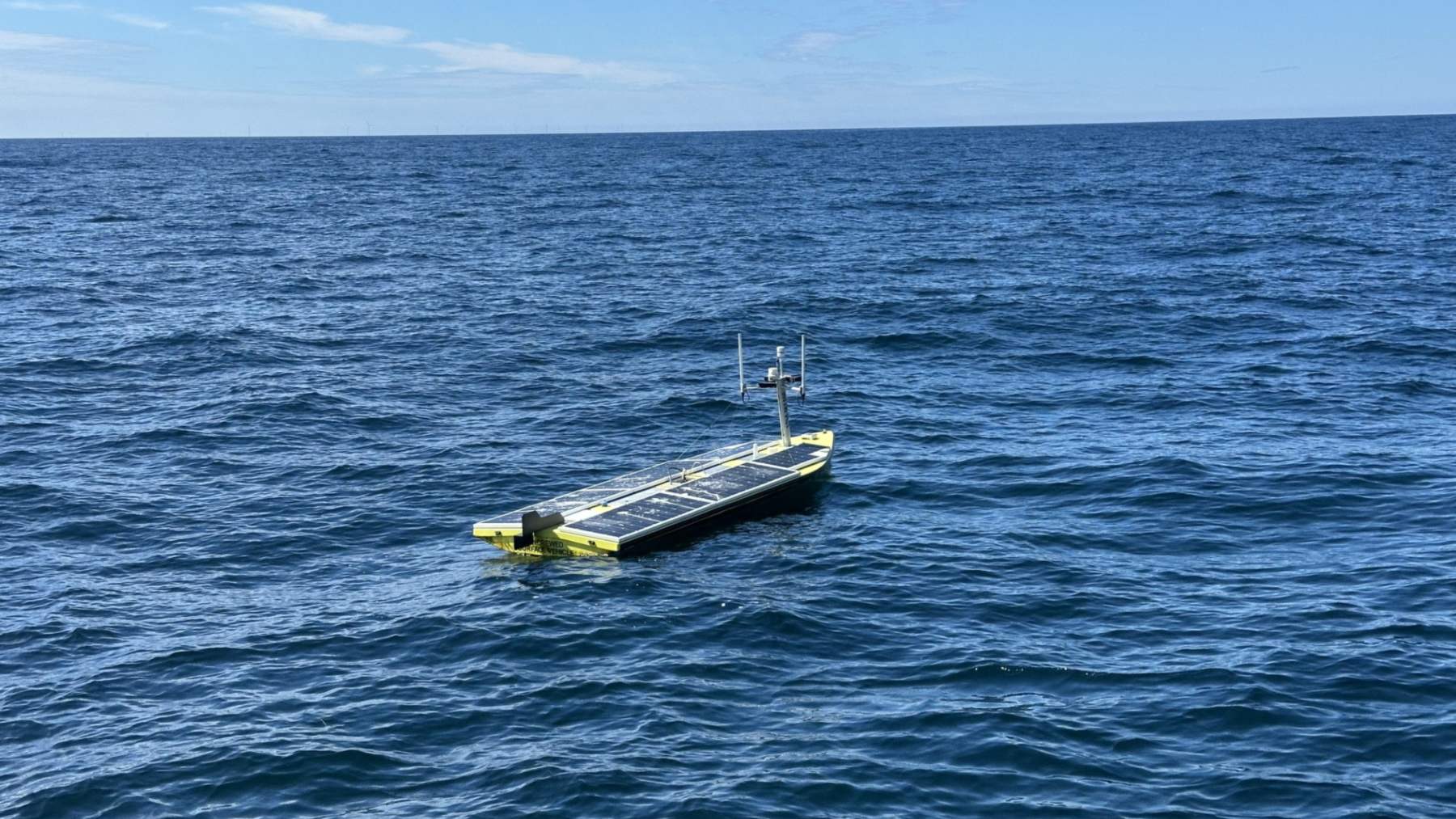

Lost-pet posters usually go up on a telephone pole. This one went out to Maine’s lobstermen, and the pet was a 16-foot yellow drone boat with a $5,000 reward on its head.
The boat belongs to a team from the Woods Hole Oceanographic Institution in Massachusetts and NERACOOS, the regional ocean-observing outfit based in Portsmouth, New Hampshire, and its job this fall was to sit out in the Gulf of Maine sampling the water for an algae bloom. On the night of Monday, October 12, it stopped talking.
The last position anyone had for it was about 30 nautical miles southeast of Frenchman Bay, the water in front of Bar Harbor, where it was parked to recharge its batteries. A boat went out later that week to look and found nothing where the drone was supposed to be.
So the team did what you’d do with a lost dog. It put out a notice with a photo, a description, a map and a reward, and the Maine Lobstermen’s Association pushed it to the people most likely to see a yellow boat on the water. Eleven days later, on Friday, October 23, the team re-established contact with it about 90 miles off Gloucester, Massachusetts, which is a whole state away from where it went quiet.
So how do you lose a boat that’s built to phone home? The short answer is that nobody’s said yet.
The longer answer is more interesting, because this isn’t a buoy with a motor. It’s a fairly serious piece of hardware, and the way it’s built explains both why it couldn’t sink and why it was out there alone in the first place.
So what kind of boat is this?
NERACOOS calls it a SeaTrac USV, which stands for uncrewed surface vehicle, and the maker is SeaTrac Systems, a small company in Marblehead, Massachusetts, started in 2017 by two MIT-trained naval architects. SeaTrac really only sells one boat, the SP-48, and the beam NERACOOS lists for the missing one, 139 centimeters, matches SeaTrac’s own spec page to the centimeter. Neither SeaTrac nor NERACOOS has named the model, so I’m reading it off the dimensions, but I’d be surprised if it’s anything else.
By the company’s numbers, the SP-48 is 15.7 feet long and 4.6 feet wide, draws 1.4 feet of water, and weighs 606 pounds empty with room for 154 pounds of instruments. Six solar panels cover the deck, rated at 750 watts in full sun, and they feed a 6.75-kilowatt-hour battery that turns a single propeller through an electric motor.
Cruise is about 3 knots. Top speed is 5. SeaTrac says it keeps working in weather up to Beaufort force 7, which is a near gale, and survives force 11, which is the step below a hurricane.
That spec sheet also explains the “holding position to recharge” line in the notice. A solar boat doesn’t carry fuel, so when the battery runs low it doesn’t head for a dock. It stops, points into the weather, and sits there making power until it can afford to move again.
SeaTrac says the boat can hold a spot to within about 33 feet, and that’s what the WHOI boat was doing 30 miles out when it went quiet. It was basically parked in the ocean, charging.
WHOI has been putting instruments on SeaTrac hulls since 2018, when a biologist there named Mike Brosnahan bolted an Imaging FlowCytobot to the company’s prototype and ran it down Harpswell Sound. The FlowCytobot is a sensor that pulls in seawater and photographs the individual plankton cells in it, and a computer sorts the pictures by species in near real time, so you can see a harmful bloom building instead of waiting for the clams to die.
“As sensors go, the IFCB is pretty large and power hungry,” Brosnahan said back then, and the whole attraction of a solar boat was that it could feed the thing without anyone swapping batteries. Whether this particular boat had one on board this fall, I can’t confirm. Fox Weather says only that it carried specialized sensors sampling for phytoplankton, and Brosnahan is the name on the reward notice.
Why it was never going to sink
The notice makes a point of saying the boat probably hadn’t gone down, because it carries float bags, and I think that’s the most reassuring sentence in it. The hull is fiberglass over a foam core, it’s got a weighted keel that rolls it back upright if a wave flips it, and the float bags are presumably the backup for the day something actually breaks and lets water in. So the worst realistic scenario was a 600-pound yellow boat drifting around the Gulf of Maine with a dead radio, not a boat on the bottom.
NERACOOS hasn’t said why the radio died, and I’m not going to guess at a dead battery or a boat strike or a storm, because none of the sources do either. What I can tell you is that these boats carry a lot of ways to call home.
SeaTrac’s spec sheet lists a line-of-sight radio for close range, cellular links, and an Iridium satellite link for everything beyond cell range. The company has also said its boats carry a separate battery-powered GPS tracker that keeps pinging a position if the main systems stop and every other link drops.
If that tracker was on this boat, it’s safe to assume it’s how the team found it off Gloucester. NERACOOS hasn’t said that, though, so file it under educated guess.
Eleven days later, a call from off Massachusetts
The update went out Friday night, October 23: the research team had “re-established communication” with the missing boat roughly 90 miles off the coast of Gloucester, and would go get it on Sunday, October 25. Ninety miles is NERACOOS’s number, and the notice doesn’t say nautical or statute, so I’ll leave it at about 90. No drift distance has been published, and working one out from the two positions would mean inventing a path that isn’t on anyone’s map, so I’m not doing that either.
There are two things the sources don’t say. There’s no report of a lobsterman or anyone else spotting the boat, so there’s no word on whether anyone collects the $5,000, and the notice gives WHOI and NERACOOS the final say on that anyway.
And the alert the lobstermen’s association is running still ends with the Sunday plan. As of Monday morning, neither that page nor the Portland Press Herald, which has already updated its story once, had said whether the boat came out of the water.
The bloom it was out there to watch
You may be thinking “toxic algae,” and that’s the one thing this isn’t. The bloom is a plankton called Karenia mikimotoi, and the Maine Department of Marine Resources has said in every update since September 8 that it isn’t toxic to people and that Maine shellfish and fish are safe to eat. It turns the water rusty brown, it smells, and it kills things by a different route.
The cells drift down at night and breathe, and when a dense bloom dies off, the rot pulls the oxygen out of the water. Soft-shell clams and marine worms can’t move away from that. Fish and lobsters usually can, unless they’re sitting in a trap.
The counts got big fast. The state’s first sample in Portland Harbor on September 8 came back at 2 million cells per liter. By October 2, a sample at Port Clyde was over 50 million, which is more than the 44 million the state recorded at the peak of the last bloom like this, nine years ago.
In Brunswick’s Maquoit Bay, the town’s coastal office measured dissolved oxygen at 3.11 milligrams per liter, or 37 percent of saturation, when 50 percent is the level tied to serious shellfish die-offs, according to Fox Weather. The state closed Maquoit Bay and part of Middle Bay to shellfish harvesting on September 19 so digging wouldn’t stress the clams further, and reopened Maquoit on October 8 once the worst of it had passed.
And offshore is where our boat comes in. DMR’s October 2 update said the bloom out past the coast had actually gotten stronger after a rain, with discolored water reported from half a mile to five miles out between Portland and Penobscot Bay, and satellite images showing the densest patches offshore.
A boat that can sit 30 miles out for weeks photographing plankton is pretty much the only practical way to watch that part of it, and you can’t do it from a dock. By October 9, DMR said the bloom was fading in most places, with elevated counts hanging on in Muscongus and Penobscot bays. Three days later, the boat went quiet.
Solar drone boats have had a decent year on this site, between a 23-foot drone sailboat circling Antarctica on sun and wind and two 24-foot drone boats that spent a month watching shipping lanes off Fiji without burning a drop of fuel. This one’s the humbler cousin, a 16-foot plankton camera that cost its owners a week and a half of nerves and a reward poster.
Frankly, I find it the more relatable story. Anyone who’s lost a drone in a tree knows the feeling, and this one was 30 miles out in October water.
NERACOOS posted its update on October 23 and said the team would go after the boat on Sunday, October 25. Mike Brosnahan at WHOI is coordinating the pickup, and by that Sunday the boat had been on its own in the Gulf of Maine for 13 days.