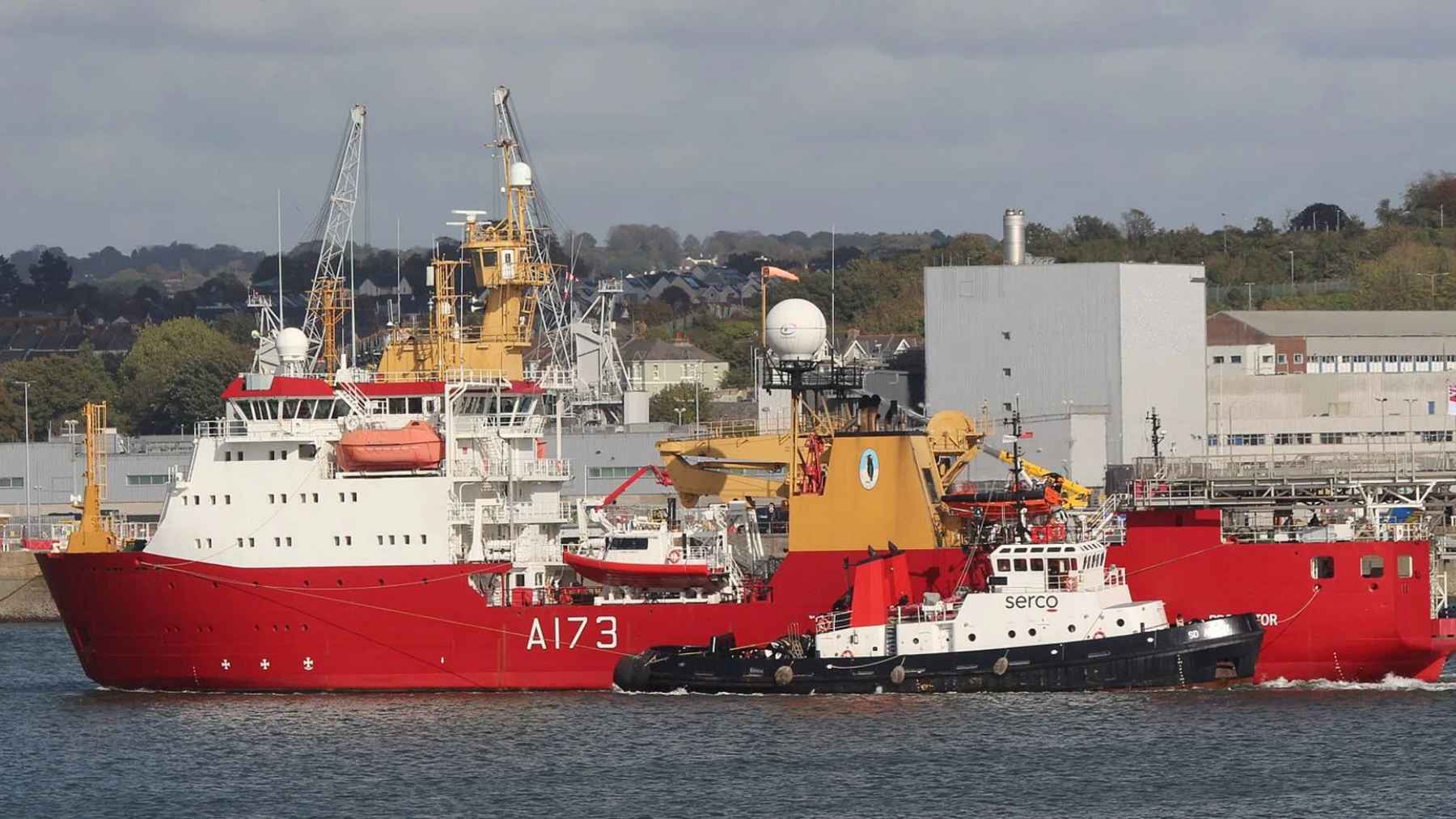

If you’ve followed the US Coast Guard’s icebreaker problem at all, you know the shape of it. One heavy icebreaker, the Polar Star, commissioned in 1976, and every time something on her breaks, somebody in Washington discovers there’s no spare. Britain runs the same one-ship model for its polar work, and on October 13 that ship came back into her home port in Plymouth, England, behind a tugboat.
HMS Protector is the Royal Navy’s only ice patrol ship, and the Navy’s official line is that she’s in Devonport “while investigations into a defect take place.” That’s pretty much the whole statement, plus a sentence about replacing her at some point. The Telegraph reported a “double engine defect.” I’d call that a fairly polite way of describing a 292-foot ship that can’t move on her own.
So what actually broke? Officially, nobody’s saying.
And I’ll be honest, the reporting on how she got there is a little tangled. The Telegraph’s version, as relayed by GB News and the Portsmouth paper, is that both engines failed on the morning of October 13 as she was trying to leave UK waters. Navy Lookout, which ran a reader’s photo of the tow coming in, says she never left the shipyard on the River Tees under her own power and was towed the entire way down the English coast. gCaptain’s industry sources back that up: commercial tugs did the long haul and Serco tugs took over near the port. Two accounts that watched the tow beat one that didn’t, so I’m going with the long tow.
So what is HMS Protector, exactly?
She wasn’t built for the Navy at all. She was finished in October 2001 as the MV Polarbjørn, Norwegian for polar bear, a research and subsea support ship for a shipping company in Bergen. The hull was welded in Lithuania and the ship was fitted out in Norway. She’s 292 feet long and displaces about 5,000 tons, which puts her somewhere between a big offshore supply ship and a small frigate. Two Bergen diesels push her along at 15 knots. There’s a helicopter deck but no hangar, which has annoyed the Royal Navy’s critics for years.
The Royal Navy chartered her in April 2011 as a three-year stopgap after its previous ice ship, HMS Endurance, nearly sank. The charter cost £8.7 million a year, and in September 2013 the Ministry of Defence bought her outright for around £51 million. The stopgap is now in year 15.
Now, you’ll see her called an icebreaker, including by the Royal Navy itself, and that’s a bit generous. Her ice class is DNV ICE-05, which means she’s rated to push through first-year ice up to about 20 inches thick. The Polar Star, for comparison, is built to break ice 21 feet thick. That’s not a typo. Protector is an ice-strengthened patrol ship that can nose into the pack and get back out again, which is a different job from smashing a channel open for other ships.
She’s been broken before
Protector’s record isn’t all breakdowns, and I’d argue the 2015 to 2019 stretch is about the best thing a Royal Navy ship did that decade without firing anything. She was based in the southern hemisphere for those four years, maintained in South Africa, with crews rotating through so she stayed deployed around 330 days a year. She ran the first Royal Navy patrol of the Ross Sea in 80 years and joined the search for the Argentine submarine ARA San Juan in November 2017.
Then a propulsion defect in the Caribbean in 2019 sent her home for a £14 million, ten-month refit on Teesside, and she missed the 2020-21 Antarctic season entirely.
She came back strong, to be fair. In June 2021 she pushed up the Greenland Sea to 80°41.5′ North, about 650 miles from the North Pole, which the Royal Navy says is farther north than any of its surface ships has ever been. Two Royal Navy officers had spent the previous winter riding along on the Polar Star in the Alaskan Arctic to learn the trade, and a Coast Guard ice expert, a lieutenant, helped out on the record run. So there’s an American fingerprint on the high point of her career.
In 2024 she worked through the Hudson Strait into Hudson Bay with a Canadian Coast Guard ice adviser aboard, went through the Panama Canal, and finished the 2024-25 Antarctic season at Punta Arenas, Chile, in February 2025.
And that, as far as I can tell, is the last time she did the job she was bought for.
In May 2025 she went into dry dock at UK Docks on the Tees for her five-yearly docking. The whole yard period ran seven months: she came off the blocks in August but didn’t sail until December, and she tied up in Devonport on December 12 for trials ahead of deploying south. The deployment never happened. She sat out the entire 2025-26 Antarctic summer in Britain, went back up to the same Teesside yard for most of this year, and came home on October 13 at the end of a tow line.
Is she done?
The Navy says she’s still part of the fleet. Navy Lookout, which covers this stuff closer than anyone, thinks she’s probably beyond economical repair, and its reasoning is pretty hard to argue with. The yard that’s been fixing her is on the Tees. If she were going to be fixed, why tow her the length of England to Devonport? Unless you’re getting her ready for disposal, the site can’t see what Plymouth offers that Middlesbrough doesn’t.
Devonport, for what it’s worth, isn’t the busy base it was. Navy Lookout counts seven Royal Navy vessels homeported there now: five frigates, Protector and a survey ship, plus a small inshore boat. It’s been a rough year for Royal Navy availability in general. The service’s newest attack submarine needed four tugboats just to get out of the yard that built her, at a point when the fleet hadn’t put a boat to sea in four months.
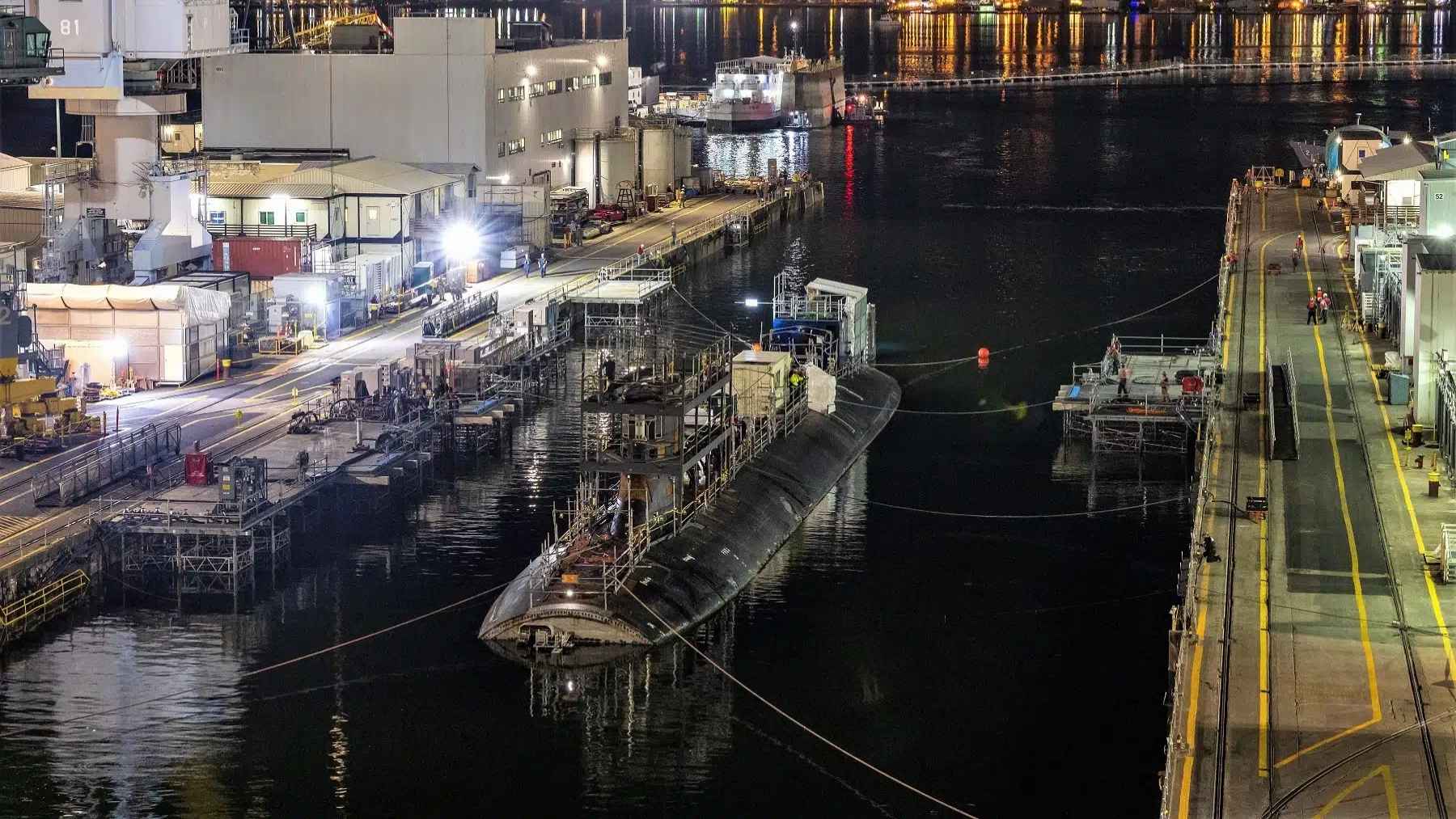
Britain’s been here before, and not that long ago. HMS Endurance, Protector’s predecessor, was put out of action by accidental flooding off Chile in December 2008. No ice ship went south for the next two seasons, it took until 2013 for the Ministry of Defence to accept she was beyond economical repair, and she lay at Portsmouth until June 2016, when a tug took her to Turkey for scrap. If you want a template for what happens next, that’s the one I’d bet on, though I’d be happy to be wrong. The US Navy knows the feeling: the submarine USS Connecticut has been sitting in a Washington dry dock waiting for a new bow for years.
As for a replacement, the Defence Investment Plan published in June commits to replacing Protector with what ministers call “a more modern variant,” meant to cover the Arctic as well as the Antarctic. In July the Defence Readiness Minister, Luke Pollard, told Parliament money had been set aside but the timeline depended on a procurement route nobody had picked yet. Asked again in September when that would be decided, his written answer said only that decisions on the method and the timeline would come in due course. Pollard, by the way, is the member of Parliament for the Plymouth district that includes Devonport, so the ship in question is tied up in his own backyard. Telegraph sources figure a successor might not enter service until the 2030s if she can’t be saved.
Does any of this matter to anyone outside Britain? Somewhat. Protector’s actual job down south was the government-ship stuff: carrying Antarctic Treaty inspectors onto other countries’ research stations, running fisheries inspections in the Southern Ocean, and surveying waters that now see a lot of cruise ship traffic. The British Antarctic Survey has its own ship, the RRS Sir David Attenborough, for resupply, so the science doesn’t stop. The Ministry of Defence’s position, in a January blog post Navy Lookout dug up, is that the treaty obligations can be covered by Royal Air Force flights out of the Falkland Islands. Argentina and Chile, whose Antarctic claims overlap Britain’s, both send naval icebreakers south every season, so you can imagine how that argument lands in Buenos Aires.
The ship is tied up at Weston Mill in Devonport, and the only hard date anyone in government has put on a replacement is Pollard’s written answer of September 15, 2026, four weeks before the tugs brought her in.