- 3 MONTHS AGO · MILITARYA 38-foot drone boat that once spent 192 hours alone at sea came up behind a float towed by a Navy ship off Virginia, pushed a fuel probe into it, took on 400 gallons over dozens of hookups and let go each time, and somebody was steering the probe on every one
- 2 MONTHS AGO · MILITARYA German drone submarine 13.8 feet long and 882 pounds is built to fit a standard torpedo tube, swim four days on a 42-kWh battery and sit on the seabed listening for weeks, rated for the same 19,685 feet as the three-ton American one Iran hauled in
- 2 MONTHS AGO · MILITARYA 453-foot submarine stretched by a 100-foot section spliced into its middle has worked as the US Navy’s only special warfare support boat for 21 years, carrying divers, robots and cable-handling gear, and its replacement just surfaced in a shipyard job listing
- 2 MONTHS AGO · MILITARYA 39.4-foot drone submarine turned up at a NATO exercise in Portugal carrying a rig whose only job is rehearsing a payload drop, with nothing live leaving the hull while engineers read the telemetry, and the US Navy has already taken delivery of the same long version
- TODAY · THIS ARTICLEA 15,800-ton, 453-foot French submarine pushed a ballistic missile weighing more than 110,000 pounds out of one of its 16 tubes from under the Atlantic off Brittany after 18 months in dry dock, and the only other flight of this version took off from a pad on land
Ballistic missile submarines are built to be the thing nobody sees. That’s pretty much the whole job description: they slip out of port, vanish for weeks, and the less anyone knows about where they are, the better they’re doing.
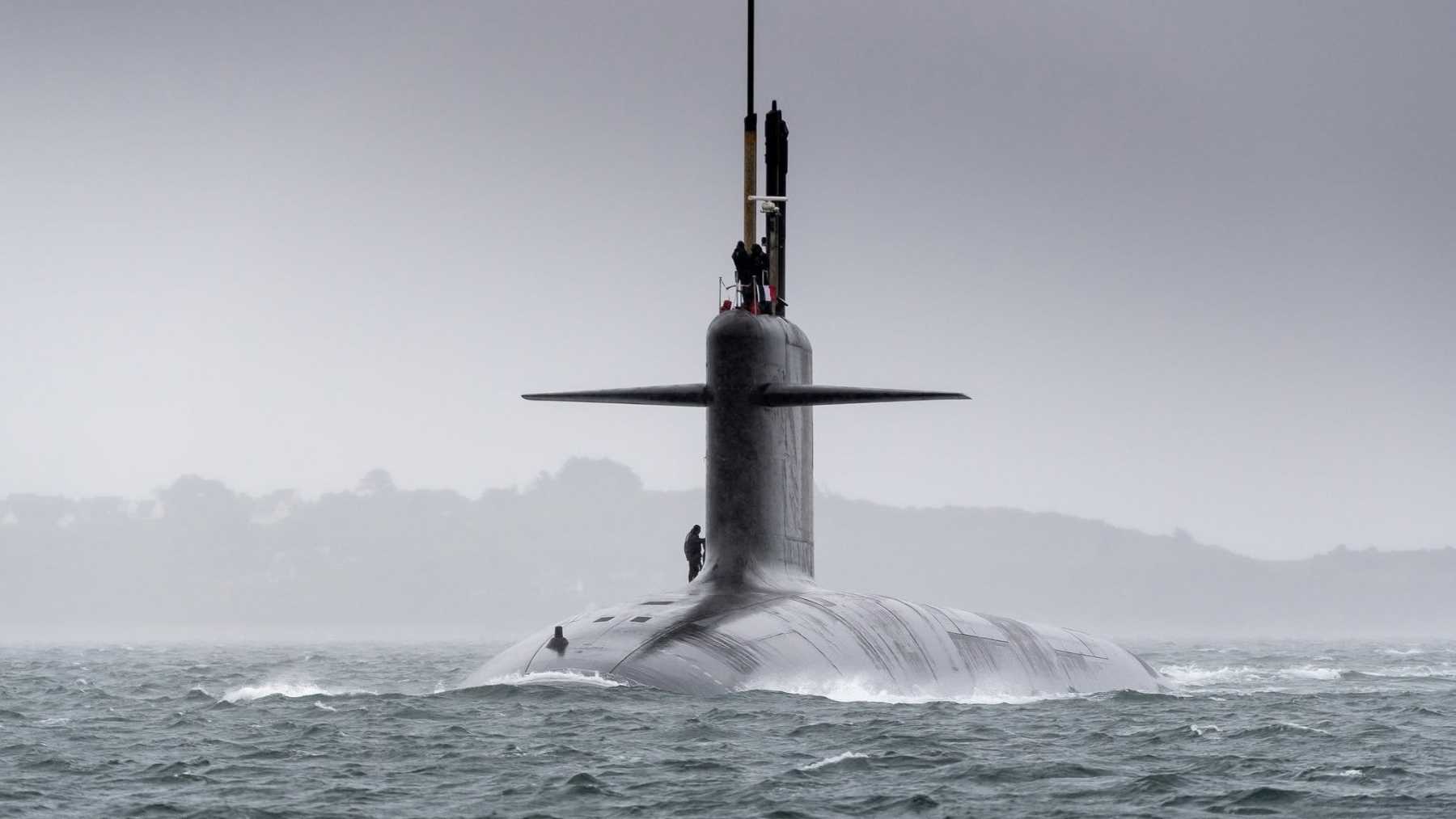
So it’s a little unusual when a country parks one off its own coast and has it put on a show. On Tuesday, France’s Le Vigilant fired a ballistic missile from under the Atlantic off Brittany, and President Emmanuel Macron watched it go from aboard a nearby frigate, the Auvergne.
The missile was an M51.3, the newest version of France’s submarine-launched missile, and it didn’t have a nuclear warhead on it. According to France’s Ministry of the Armed Forces, Le Vigilant launched it off Finistère, the far western tip of Brittany, and it came down in the North Atlantic more than a hundred miles from any coastline. The DGA, France’s defense procurement agency, tracked it the whole way, partly from the Monge, a ship that’s built to watch missiles fly.
Macron’s post on X afterward described it as the new M51.3’s first launch from Le Vigilant. The ministry’s own write-up doesn’t use the word “first.” But the only other M51.3 flight France has announced took off from a land launch pad in southwest France back in 2023, so as far as I can tell, Tuesday’s shot is the first time this version has left a submarine.
Which is, after all, where it’s supposed to live.
So why fire a missile at nothing?
The ministry calls this an acceptance firing, and the idea’s simple enough. Le Vigilant just came out of the overhaul that French ballistic missile submarines undergo about once a decade, and before it goes back on patrol, France wants proof that the boat can still launch its payload.
Basically, it’s a test drive. You wouldn’t pick your car up after a full engine rebuild and point it straight at a cross-country road trip without taking it around the block first. Well, you might… But you shouldn’t. France’s block just happens to end in the North Atlantic.
Naval Group, which did the work, says it began about three years ago at Île Longue, the submarine base across the harbor from Brest. That’s where the weapons and the reactor fuel were removed. Then Le Vigilant spent 18 months in a dry dock at the Brest naval base, where crews worked through 45,000 lines of preventive maintenance and hundreds of upgrades to the boat’s systems. The whole job added up to 4 million hours of work. That’s the kind of figure that makes your last visit to the dealership’s service bay look pretty quick. The boat returned to Île Longue more than a year ago for the final stretch, and Tuesday’s launch marked the end of that period, per the ministry.
Is a live missile shot really necessary after all that?
France apparently thinks so, and I’d say there’s a decent reason. Le Terrible, another of the four boats, went through the same ritual after its own overhaul. And Le Vigilant has seen one of these go wrong before: back in 2013, an M51 it fired off, Brittany blew itself up less than a minute into the flight, France’s first failure of that kind in nearly two decades. So you can see why nobody wants to skip the test drive.
Le Vigilant is 453 feet of submarine
If you’ve never seen one up close, the Triomphant-class boats are big. Le Vigilant runs 453 feet long and 41 feet wide, and it displaces about 15,800 tons submerged. For scale, the Navy lists its Ohio-class boomers at 560 feet, so the French boat’s quite a bit shorter, and it carries 16 missile tubes to the Ohio’s 20.
France has four of these submarines, all based at Île Longue, and it keeps at least one out on patrol at all times. Funnily enough, 453 feet is also exactly the length of the stretched one-off submarine the US Navy has relied on for seabed missions. It’s just a coincidence, but it’s a fun one.
The M51.3 is the third version of the missile
The missile itself is 39 feet long and weighs more than 110,000 pounds, according to ArianeGroup, which builds it. Open-source figures usually put it at about 114,600 pounds and about 7.5 feet across, though France hasn’t confirmed either figure. It’s basically a three-stage solid-fuel rocket that lives in a tube, and ArianeGroup doesn’t hide that it shares much of its engineering with the company’s Ariane space launchers.
Getting a rocket out of an underwater tube takes some doing. Submarine-launched missiles are generally shoved out by gas pressure and up through the water, and the first-stage motor lights once the missile’s clear of the surface. From there, ArianeGroup says the M51 climbs more than 1,240 miles up, well past the roughly 250 miles at which the International Space Station orbits, then comes back into the atmosphere at Mach 20. That’s about 12,400 mph, if you’re wondering.
I should be clear about those numbers, though. They’re ArianeGroup’s figures for the M51 family in general, and France hasn’t released any flight data for Tuesday’s shot. The missile’s actual range is classified. Published estimates run from roughly 5,000 to 6,200 miles, and France won’t confirm any of them.
What the ministry does say is that the M51.3 entered service about a year ago with more range, better accuracy, and a better shot at getting through missile defenses than the versions before it, along with a new warhead called the TNO-2. France hasn’t said which of its submarines already carry the M51.3 on patrol, and honestly, I wouldn’t expect it to.
France builds every piece of this itself
Macron’s thank-you list after the launch ran through Naval Group, ArianeGroup, the DGA, France’s atomic energy commission and the French Navy, which is the whole deterrent in one list, more or less. The warheads, the missile, and the submarine are all French. That’s a pretty rare setup. Britain builds its own submarines (its newest attack boat only left the yard in Barrow last month, after 13 years), but the Royal Navy’s Trident II D5 missiles come out of a shared stockpile at Kings Bay, Georgia, according to UK Defense Journal. They’re the same missiles the US Navy’s Ohio-class boats carry.
Macron didn’t bother being subtle about why France goes to all this trouble. “To be free, you have to be feared,” he wrote. It’s a pretty blunt way to sum up a nuclear deterrent, but a blunt message is sort of the point when you’re posting video of your own missile launch.
France isn’t stopping here. Macron says the next generation of French ballistic missile submarines is already under construction, and ArianeGroup’s under contract to develop the M51.4, the version that follows this one.
As for Le Vigilant, the ministry has signed off on its October 6 shot as a success, meaning the 453-foot boat has demonstrated it can use its weapon system again after a 4-million-hour overhaul.
 A 1,123-foot aircraft carrier with eight defueled reactors is under tow from Newport News to Mobile, where a scrapyard will cut the hulk apart around those reactors over the next four years while a 100-yard safety zone moves with herMilitary · 2 weeks ago
 A 13-foot-wide US Navy nuclear mini-sub rolled across the seabed off Scotland on wheels, found an F-14 upside down in fishing nets nearly 1,900 feet down and brought its secret Phoenix missile up with a Soviet spy trawler watching, after a month of sonar ships had come up emptyMilitary · 2 weeks ago
 Drone boats that ride almost awash like a drug smuggler’s semi-submersible just went to three American companies to prototype, and the Pentagon’s spec asks each one to haul 18,000 pounds of Marine supplies up to 2,000 nautical miles alone and sink itself on commandMilitary · 2 weeks ago
 @shermanabbott ROOKIE1 month ago