
Big water projects usually die in court before anybody pours concrete. The lawsuit lands at the permit stage, the schedule slips a decade, and the whole thing either shrinks or quietly goes away. Gross Dam, in the foothills southwest of Boulder, Colorado, did it in the wrong order. Denver Water spent four years on a roughly $600 million project to raise the dam 131 feet while the legal fight over whether it could ever use the extra space wasn’t finished.
The concrete work wrapped up in June. The permission arrived September 15, when the 10th Circuit Court of Appeals ruled the project’s federal permit was lawfully issued and threw out the lower-court order that had barred Denver Water from filling the expanded reservoir. So the utility now has a 471-foot dam and, for the first time in almost two years, the legal right to put water behind all of it.
Quick catch-up if you haven’t followed this one. Denver Water started the permitting process in 2003 and got its permit from the Army Corps of Engineers in 2017. An environmental group called Save The Colorado sued, arguing the Corps hadn’t properly weighed climate change and cheaper alternatives to a bigger dam, and in October 2024 a federal district judge agreed and blocked the utility from filling the enlarged reservoir. She let dam construction itself continue for safety reasons, so Colorado ended up with a nearly finished dam that wasn’t legally allowed to do its job. The three judges who heard the appeal reversed that, finding the Corps’ calls on cost and climate change were reasonable and supported by the record. According to Inside Climate News, Save The Colorado won’t appeal.
So Denver got its dam, pretty much by outlasting everybody.
So how do you top out a dam with a 160-foot hole in it?
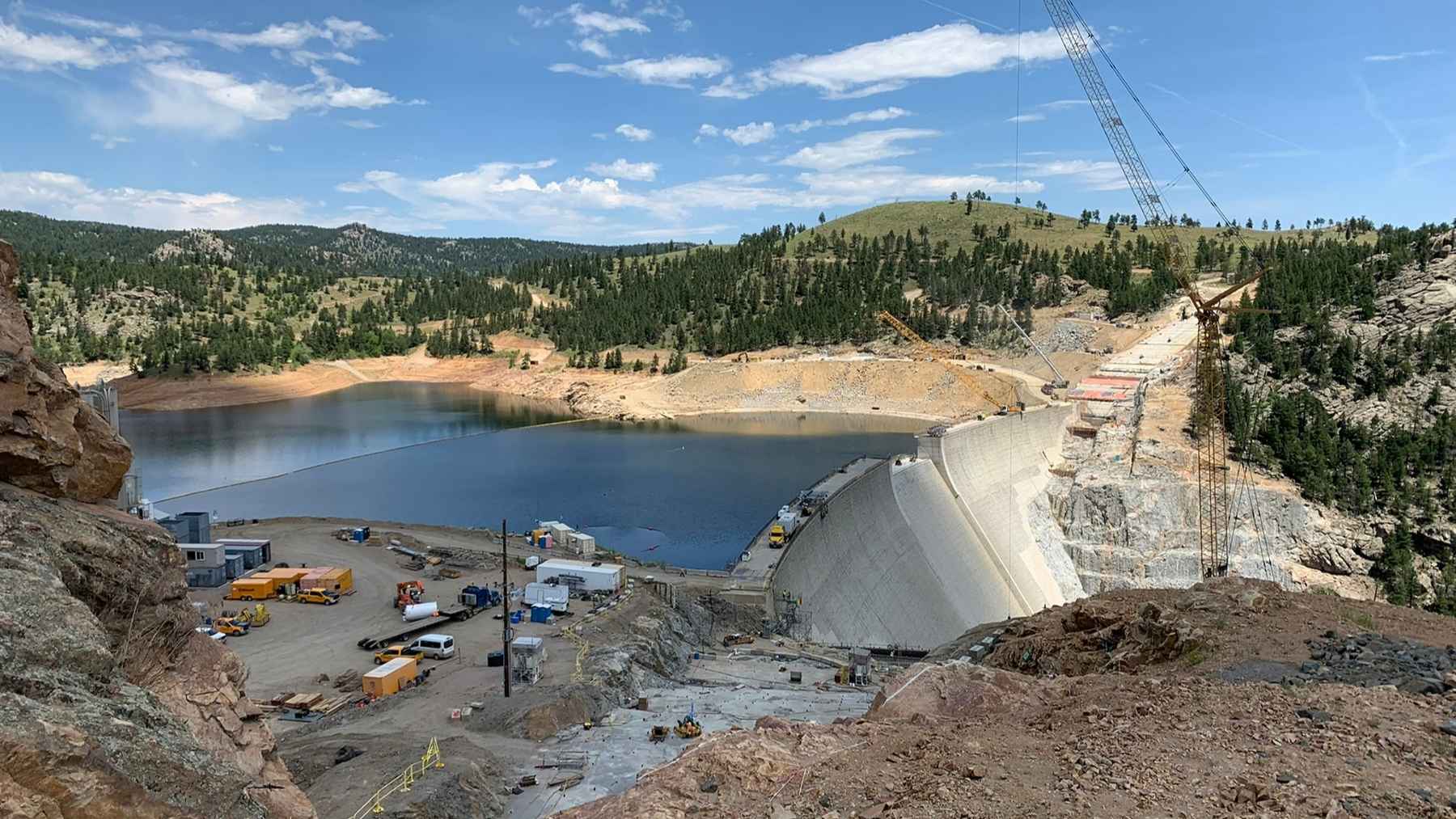
The courtroom isn’t even the interesting half of this story, frankly. The construction is. Gross Dam got taller with roller-compacted concrete, which is about as glamorous as it sounds: a stiff, nearly dry mix that gets spread in layers and flattened with rollers, closer to paving a road than pouring a foundation. The layers stack into big steps, and step by step the old 340-foot dam climbed toward its new height of 471 feet above the streambed.
The final 22 feet were the tricky part. Denver Water had to build the top in two separate halves, because a 160-foot slot down the center has to stay open for the new spillway, the escape channel that lets floodwater out of a reservoir before it can go over the crest. On the lower, continuous portion of the dam, trucks and equipment had simply moved concrete from one side to the other. With a giant gap in the middle, that wasn’t an option anymore, so crews parked a chain of conveyors in the opening and tilted them steeper as the first half rose, carrying concrete from the batch plant across the gap to the far side.
It worked. Crews finished the left half on May 12, cranes lifted the rollers and excavators off the top, and the machines drove about 4.5 miles around on an access road to start the right half, since you can’t exactly hop the gap in a compactor. The last roller-compacted concrete went down on June 2, and one more foot of conventional concrete goes on in the coming months to bring the crest to its full height.
So where does the extra water come from?
The reservoir grows from 42,000 acre-feet to about 120,000, which isn’t quite triple but it’s close enough that Denver Water rounds it that way. An acre-foot is enough water to cover an acre of ground a foot deep. The roughly 77,000 acre-feet of new space would supply about 150,000 homes, by Inside Climate News’ math, and the expansion adds about 11 percent to the total supply for the 1.5 million people Denver Water serves.
Now, if you’re new to Rocky Mountain plumbing, the reservoir sits on the east side of the Continental Divide while most of its new water starts on the west side. Streams like the Fraser and Williams Fork feed the headwaters of the Colorado River, and Denver Water diverts a share of that flow through the Moffat Tunnel, which runs under the Divide, into South Boulder Creek and down into Gross Reservoir. The utility wanted the extra storage here partly because its big reservoirs sit south of the metro area, and it says a full-size Gross gives it a lot more flexibility to move water where it’s needed.
The timing is a little awkward
Because you may have noticed the Colorado River isn’t exactly flush right now. Lake Powell broke its record low in August and Lake Mead did the same, and we’ve spent September watching Glen Canyon Dam and Hoover Dam creep toward the elevations where their turbines can’t safely run. Against that backdrop, a court clearing one more diversion from the river’s headwaters wasn’t ever going to land quietly.
“It’s nonsensical to be putting more straws in, and further draining, the Colorado River at this point in history,” said Gary Wockner, director of Save The Colorado, in a statement after the ruling. Denver Water’s answer, boiled down, is that it plans to treat the new space as a bucket for the good years: the utility says it’ll fill the reservoir in stages, pulling from the river only in wet years, and that the extra flexibility lets it leave more water in the headwater streams when conditions turn bad.
Which side of that you land on probably depends on where your tap connects. I’ll note the court didn’t crown a winner on the science; it decided the Corps had done its homework properly under the law, which is a narrower thing. And I can’t tell you how fast the new space actually fills. Nobody can. Denver Water says filling could begin as early as 2028, with the pace depending entirely on snowpack, and snowpack in this basin has had a rough couple of years.
There’s still about two years of work in the way regardless. The remaining jobs on the dam itself, finishing the crest, building the actual spillway, a bridge over it and the stilling basin at the bottom, should wrap up in the summer of 2027, with tree clearing around the bigger reservoir running into 2028. “We’re going to finish strong and look forward to putting an expanded Gross Reservoir to work for our customers and for the environment,” said Jeff Martin, Denver Water’s program manager for the expansion, after the September 15 ruling. If the snow cooperates, water starts backing up behind those new 131 feet in 2028.