
- 1 MONTH AGO · MILITARYA 45,000-ton battleship was pushed four feet off her pier in Norfolk by tugboats without starting an engine, her first move in 26 years, so crews could swap two rubber fenders, and the second one came out with the ship’s paint stuck to it after a year of planning
- 4 WEEKS AGO · MILITARYA 340-pound drone boat covered in solar panels was launched off the Texas coast into the Gulf to park itself for six months and watch for drug boats at 2 knots, after 10 of them anchored on the Rio Grande helped agents catch 350 people a month since January
- 2 WEEKS AGO · MILITARYA 27,000-ton battleship that fought in both world wars has spent four years in a Galveston shipyard taking 700 tons of new steel into her hull, fired her 14-inch guns again, and now points her bow at the pier across the channel where she’s supposed to tie up next
- 5 HOURS AGO · MILITARYA 30-foot underwater drone, a compact experimental hull much smaller than the fiber-optic boat from the same yard, went into the water for the first time at a Taiwanese harbor on Wednesday, with no prior official announcement, to test autonomous navigation and modular payloads
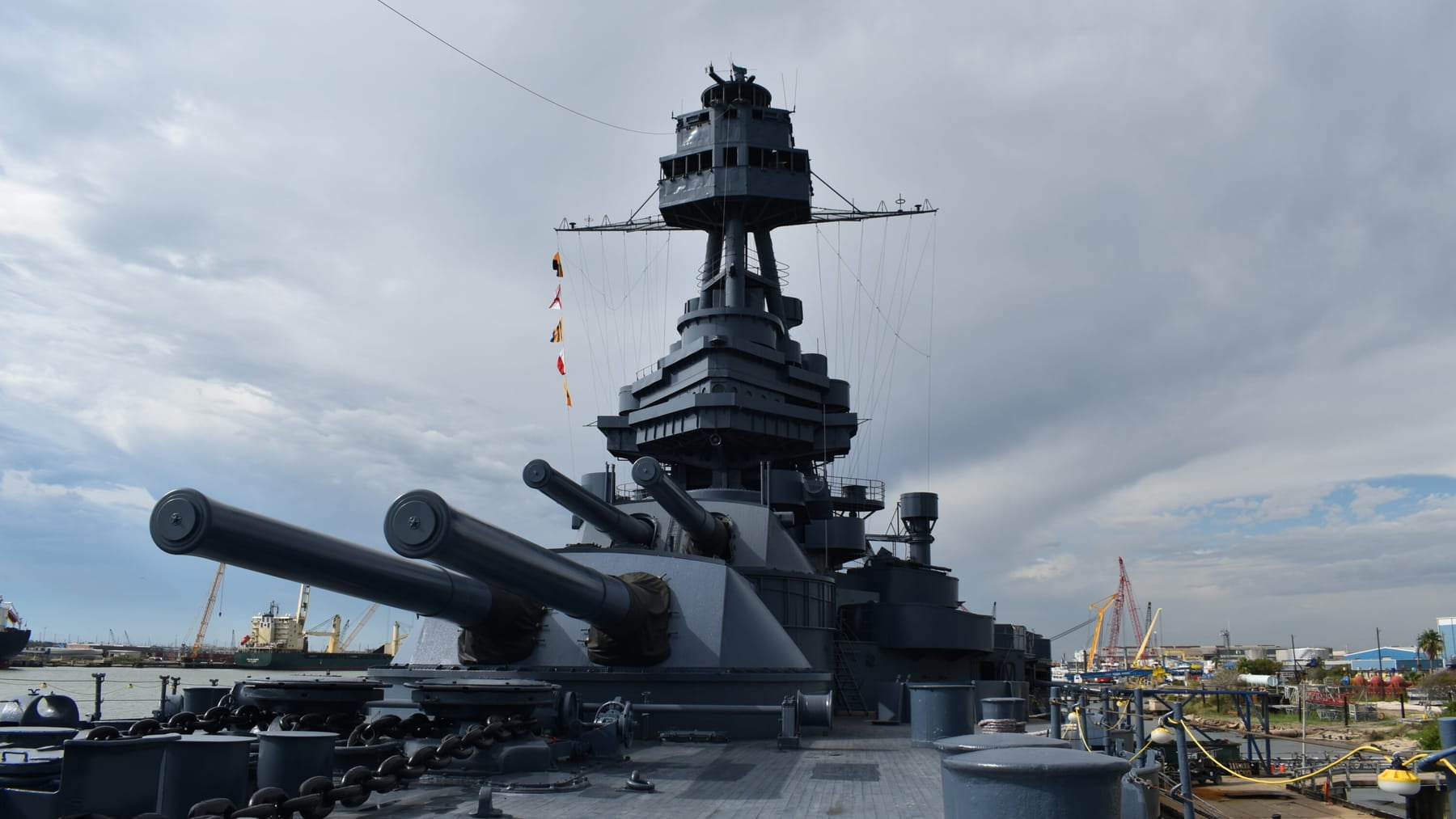
- TODAY · THIS ARTICLEA 27,000-ton battleship that once had 45 pumps taking thousands of tons of water out of her hull is having a 32,000-square-foot wood deck finished at a Texas yard she has occupied since 2022, and she’ll move about a mile to a pier where officials hope to open her by the end of 2027
Most of what you’ve read about the Battleship Texas over the last few years has been about the bottom of the ship. That makes sense. Her hull leaked so badly at her old berth that keeping her afloat turned into a daily chore, and fixing it took a dry dock, a lot of new steel and a lot of money, which we went through in our October look at the restoration.
But this week the news moved up a level. Julianna Washburn, who covers Galveston County for Houston Public Media (HPM), was aboard on Tuesday, Nov. 10, at Gulf Copper’s shipyard in Galveston. According to her report, the ship’s 32,000-square-foot wood deck is in its final stretch, with crews finishing it now. Once that’s done, they’ll move inside and start painting the interior so visitors can come back aboard.
Frankly, the deck is what most of those visitors are going to notice first. Almost nobody walks off a museum ship talking about hull plating.
The rest of the to-do list, per HPM, covers major structural repairs, period-correct antennas and lights, and restoring the ship’s watertight integrity. That last one basically means making sure water that gets into one compartment stays in that compartment. Warships are designed around that idea, because a hole in one spot isn’t supposed to sink the whole thing.
So why does a steel battleship have a wood deck?
It’s a fair question. The Texas is steel from the keel up, and the wood isn’t holding any of that together. The planks sit on top of a steel deck. Wood gave sailors better footing than bare metal, especially when it was wet, and it helped keep the compartments underneath a little cooler in the sun. As far as I can tell, battleships of her generation went to sea with wood laid over steel, so a restoration that’s aiming for the way she looked in service pretty much has to put one back.
HPM didn’t say how much of the deck is left to lay, and I haven’t seen a percentage anywhere else.
She used to need 45 pumps
So how bad was it at San Jacinto?
Thomas Perich, a Navy veteran and Galveston native who chairs the Battleship Texas Foundation’s board, gave HPM a pretty vivid answer. Back when she sat at San Jacinto Battleground in La Porte, he said, she’d gone decades without real work. The foundation was running 45 pumps every day to keep water off her. And he was specific about the unit. He wasn’t talking about gallons. He meant tons, thousands of them.
“It was leaking like a sieve,” Perich told HPM.
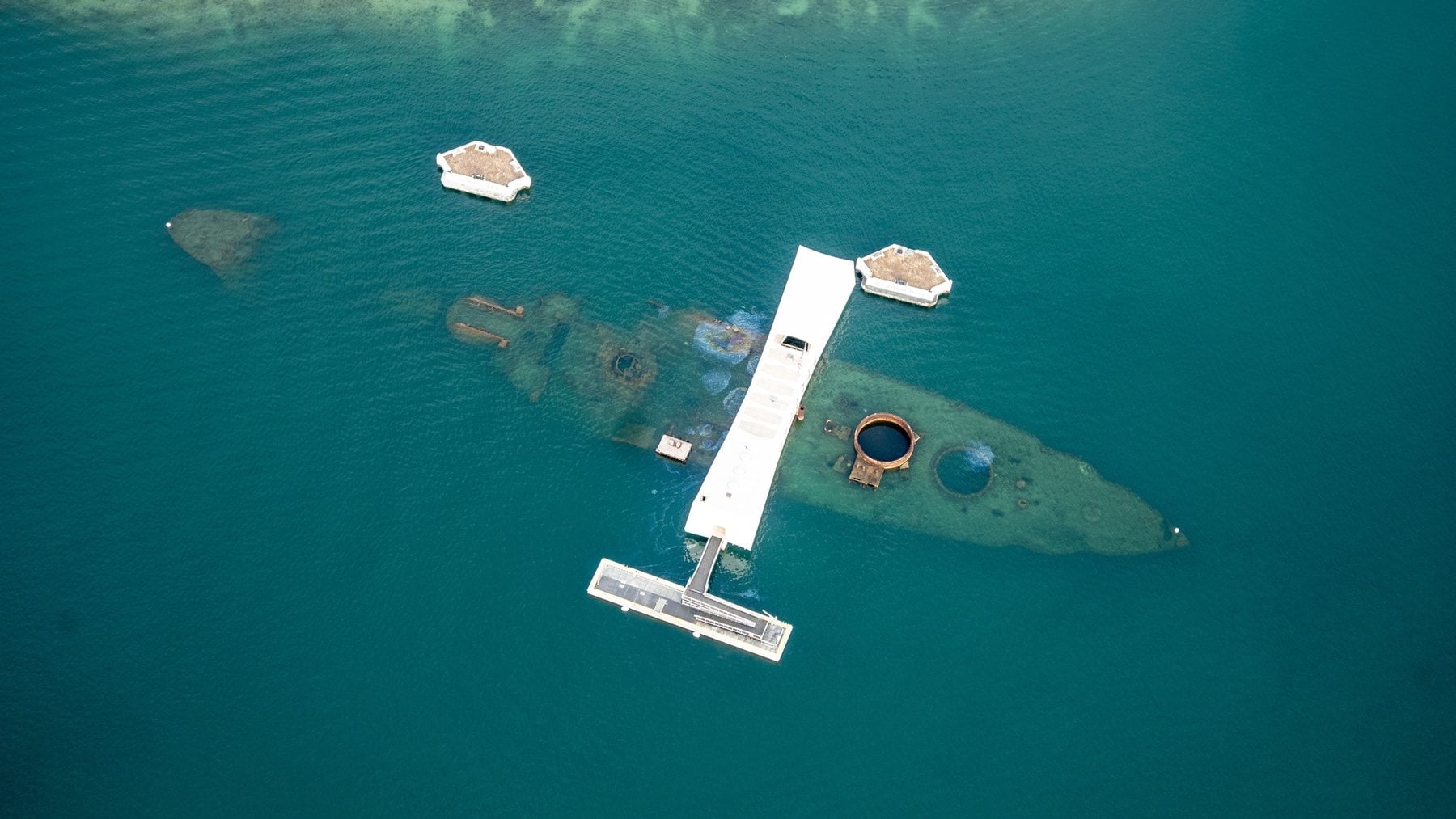
That’s Perich’s account from memory, not a reading off a flow meter, and I haven’t found a published measurement of how much water those pumps actually moved. Still, you don’t run 45 pumps every single day on a ship that’s only a little damp. Old battleships and water have a complicated relationship in general. Last week we wrote about a battleship at Pearl Harbor that scientists estimate is still losing a gallon or two of fuel oil a day through her deck.
Perich also told HPM that, inside and out, the ship is barely recognizable compared with her San Jacinto days.
So how heavy is she, anyway?
I went back to the Navy’s own paperwork for this one. The Naval History and Heritage Command, which is the Navy’s official history office, lists the Texas at 27,000 tons displacement and 573 feet long. An archived entry in the Naval Vessel Register, the Navy’s official list of its ships, gives two numbers instead: 27,000 tons light and 34,000 tons full. That same entry has her at 573 feet overall, 106 feet across at her widest and 32 feet of maximum draft. The command’s photo archive calls her a 27,000-ton battleship of the New York class, too.
If you’re wondering why there are two weights, light displacement is basically the ship with nothing loaded aboard: no fuel, ammunition, food or crew. Full displacement is the ship ready to go to war, and the register puts the gap between the two at 7,000 tons of deadweight.
So what does she displace today? I honestly don’t know, and I haven’t seen anyone publish a current figure. She isn’t loaded for war anymore, but she has picked up new steel in her hull and is about to have a fresh deck on top. I wouldn’t add any of that to the 27,000 tons, and I’d be a bit suspicious of anyone who did.
The last trip is about a mile
The ship has been at the Gulf Copper yard since 2022. Her next stop is Pier 15 in Galveston, which HPM puts at about one mile from where she’s sitting now. Once she’s moored there, the plan is to run her as a floating museum you can actually tour.
A mile doesn’t sound like much, and for a ship that’s already been towed down the Houston Ship Channel, it pretty much isn’t. Still, nothing about moving a battleship is casual. When tugboats pushed the Wisconsin four feet off her pier in Norfolk so crews could swap two fenders, that took a year of planning.
The foundation hopes to have her welcoming visitors again by the end of 2027. According to HPM, that’d be the first time the public has been let aboard since 2019. HPM doesn’t give a date for the move to Pier 15 itself, though, and I wouldn’t treat 2027 as anything firmer than a goal. Restorations like this one have a habit of turning up one more problem once the old paint comes off.
Then there’s the money, and frankly the figures don’t line up. HPM puts the restoration at $85 million. When we covered the ship in October, the foundation’s FAQ listed a projected $75 million, with $60 million of that coming from the Texas Legislature, and Travis Davis, the foundation’s vice president of ship operations, had told the Houston Chronicle the total would land around $82 million. I can’t tell you which of those is the current number, so I’m not going to pick one.
Davis did give HPM a nice bit of history to go with all of this. The ship first came to Galveston 112 years ago, when she went there to pick up her ceremonial silver service, and he described ending up there for good as a full-circle moment. If you’ve never heard of a silver service, it’s a set of silverware and serving pieces that a state or city traditionally presents to the warship named after it.
As of HPM’s report, last updated on Nov. 12, the ship is still at Gulf Copper’s Galveston yard, and the Battleship Texas Foundation is hoping to open her to the public at Pier 15 by the end of 2027.
Credit: houstonpublicmedia.org
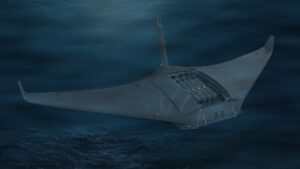 A 22-foot underwater drone shaped like a stingray glides by sinking and rising, its American builder says tests have kept its drones submerged for up to 70 days, and the next version it wants is over 100 feet long, built to carry up to 96 smaller drones and stay out for yearsMilitary · 2 hours ago
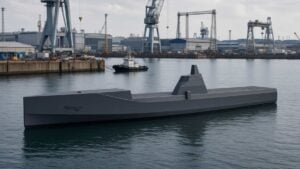 A 600-ton drone warship slid into the water at a Korean shipyard on Thursday, built to scout and watch at sea, and after trials in local waters it is due in the United States early next year for more testing aimed at the Navy’s growing unmanned fleetMilitary · 21 hours ago
 A 243-foot missile corvette armed with eight vertical launch cells for cruise missiles was struck by drones in the Gulf of Finland, Ukraine’s security service said, as the same overnight raid set oil tanks on fire at a Baltic export portMilitary · 1 day ago