
- 4 MONTHS AGO · ENERGYLondon just unveiled plans to bore two 8-foot tunnels for 12 miles under the city carrying nothing but hot water, piping the heat a garbage incinerator vents into the sky today into 300,000 homes that burn gas to make the same heat again
- 4 MONTHS AGO · ENERGYThe world’s first plant making electricity from salt water meeting fresh sits in a small blue building on a Dutch dike, switched on by a king in 2014, and hitting its own 50-kilowatt label would take 37 football fields of membrane
- 3 MONTHS AGO · ENERGYA terminal being finished at JFK has 13,000 solar panels across six and a half football fields of its own roof, and not one of them would keep a light on in a blackout at 2am, because what carries the building in the dark is 3.84 megawatts of fuel cells burning gas
- 2 MONTHS AGO · ENERGYA 24-foot tunnel borer chewed 2.7 miles under Lake Mead against water pressure of up to 218 psi, with a car tire carrying 33, to plant a drinking straw near the lake bottom, and the lake just hit its lowest level since Hoover Dam first filled it
- TODAY · THIS ARTICLEA dike of packed soil that keeps a 56,000-acre lake out of Clemson’s football stadium is seeping, the water is carrying the wall’s own grains out with it, and the whole lake will now be held 4 feet lower, possibly for a decade, because a shallower lake pushes with less force
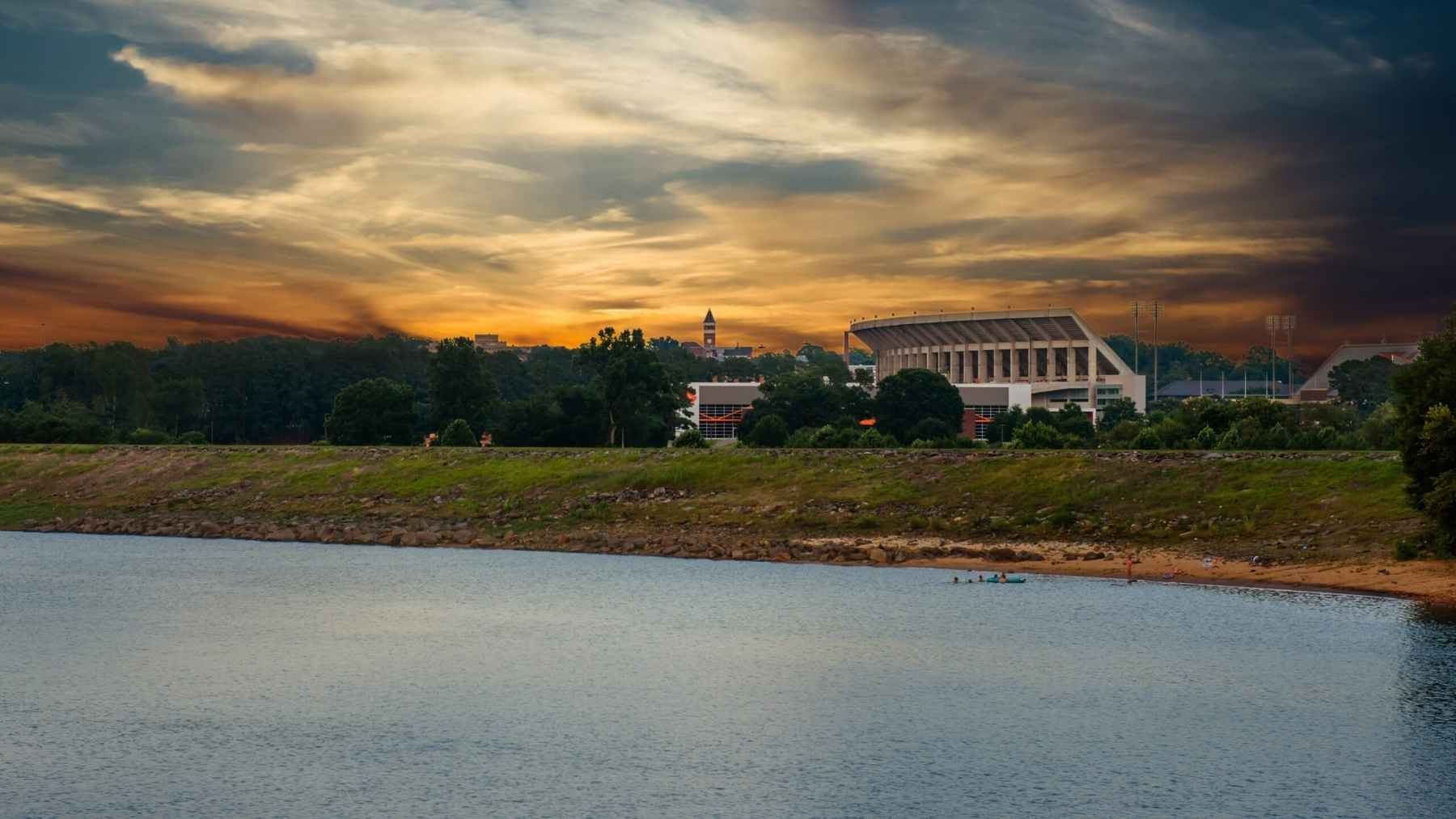
Clemson’s Memorial Stadium goes by Death Valley, and on a fall Saturday it’s one of the loudest places in American sports. Lake Hartwell sits right up against the campus. And by the university’s own telling, the two nearly ended up on top of each other: when the Army Corps of Engineers drew up the lake in the 1950s, the water at its highest design level would have reached the 26th row of the stadium.
Clemson fought the project until the government agreed to bend the Seneca River around campus with a set of earthworks: two diversion dams, a pumping station and an earthen saddle dike. That dike is the reason the stadium hosts football instead of bass. It’s also the reason the Corps announced on August 26 that the whole 56,000-acre lake will now be held 4 feet lower than normal, possibly for a decade, because water is seeping through and under the dike and slowly carrying its soil away.
So if you boat, fish or keep a dock on Hartwell, this is about your next decade on the water.
So what’s actually wrong with the dike?
The Clemson Lower Diversion Dam Saddle Dike is exactly what it sounds like: a wall of compacted natural soil, built before the lake ever filled, plugging a low spot so the water can’t spill toward campus. Structures like this always pass a little water, because soil has gaps between its grains and water finds them. That’s normal, and engineers plan for it.
Water becomes a problem when it moves fast enough to take soil with it. Every grain that washes out leaves a slightly bigger opening for the next one, and over the years that can hollow out narrow channels through and under the structure. Engineers call it piping, and it’s the classic way an earthen dam fails.
The Corps first spotted seepage at the saddle dike in 2015, then reclassified the structure to a higher risk level in 2018. Then it looked at how the dike handled severe conditions, including Hurricane Helene, and the erosion came out worse. “The higher the water level, the greater the pressure,” Justin Nixon, dam and levee safety program manager for the Corps’ Savannah District, told FOX 5 Atlanta. A fuller lake pushes harder on the dike, water moves faster through it, and more soil goes along for the ride. Hold the lake down and everything slows.
The Corps says the public isn’t in any immediate danger, and I’d take that at face value, since this is the same agency that just voluntarily kneecapped its own reservoir out of caution. Its assessment is still blunt, though: by the Corps’ own risk standards, the dike’s current condition doesn’t pass.
The lake was already low before anyone restricted it
Hartwell is currently sitting around 650 feet above sea level, which is already below the new 656-foot cap, and that confuses people. The Corps isn’t draining the lake. Nixon has been unusually direct about this: the low water you see today comes entirely from a regional drought that’s been running for over a year, with the basin now in the Corps’ Level 2 drought category.
The restriction changes the ceiling. Hartwell’s guide curve (the target level the Corps manages the lake toward) used to reach 660 feet in summer and drop to 656 in winter. Now 656 is the target year-round, with 662 as a hard maximum during heavy rain so the dam still has somewhere to put a flood. When the drought finally breaks, the lake gets to come back up. It just can’t come all the way back.
So what do those 4 feet actually cost you?
More than you’d think for such a small number. The Corps says designated swim beaches generally stop working once the lake drops below 657 feet, so under a 656-foot cap the roped-off swim areas stay closed or dry even in a wet year. Most boat ramps should still work at the new level, though some shallow ones may close. If your dock sits in a shallow cove, expect it to spend more time in the mud than it used to. And reservoirs are a bit of a theme this year: out west, Lake Mead just hit its lowest level since Hoover Dam first filled it, and that one is pure drought.
So why does the fix take up to 10 years?
Fair question. A decade to repair what’s basically an engineered pile of dirt sounds absurd, and it’s frankly less absurd once you remember the dirt has to keep holding back a lake the entire time anyone works on it.
The Corps is starting a formal Dam Safety Modification Study, which is the process that decides what the permanent fix actually is. That means exploratory borings, new instruments in and around the dike, soil testing and modeling of how the water moves, and the Corps says these studies typically take up to two years. Design, funding approval and construction come after that, which is where the five-to-10-years-or-more estimate comes from. Nobody has priced the job yet, and I couldn’t find even a rough figure, because the study is what produces the cost estimate.
If you want a preview of what the fix could look like, the Corps has been here before. At Wolf Creek Dam in Kentucky, seepage through the earthen embankment eventually got answered with a concrete cutoff wall built down through the dam into bedrock. And this isn’t even the Savannah River basin’s first piping scare: back in 1991, the Department of Energy drained most of a plutonium-cooling lake at the Savannah River Site over a suspected pipe forming in its own earth dam.
As for the stakes, the Corps spells them out. If the saddle dike failed, water could pour into the low-lying areas behind it, including parts of Clemson University’s infrastructure and its sewage treatment plant, and the emergency response would mean drawing Hartwell down far more drastically than 4 feet. Clemson, for its part, says campus operations aren’t affected and its lakeside facilities, including the Snow Family outdoor fitness complex, remain open.
Corps officials have spent the past month answering questions about the dike, and there’s a bigger session on the calendar. The Lake Hartwell Association holds its annual meeting on October 15 at 6 p.m. at the Anderson Civic Center, with a Corps representative scheduled to answer questions about the dike repairs. If your summers run through that lake, I’d be in the room.
 A reactor built from 664 two-inch uranium cubes hung on wires in heavy water under a German castle was Heisenberg’s last shot at a chain reaction, and two of the surviving cubes now show it needed about twice the uranium and heavy water it held, more of both than Nazi Germany hadEnergy · 7 days ago
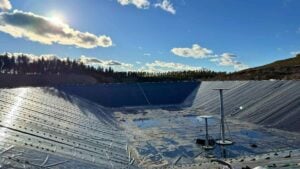 A 66-foot-deep gravel pit in Finland just started taking in about 100 million gallons of tap water, and once a nine-acre lid goes on top, it’s meant to hold enough summer heat at up to 194°F to cover as much as nearly a quarter of the town’s yearly heat demandEnergy · 7 days ago
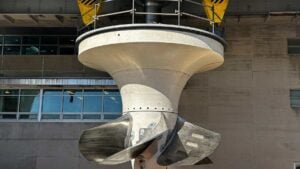 A 375,000-pound turbine now spins inside a Tennessee dam in place of one that ran for more than 80 years, and a federal watchdog just found that 196 of the 240 welds on the ring guiding water out of it failed on a job where some welders weren’t qualifiedEnergy · 7 days ago