
Every so often a utility crew turns up on your street, opens a trench down the middle of it, and vanishes for a month. It is loud and inconvenient, and it is still the standard way to get a power cable from one end of a road to the other.
That method runs out of road the second it meets something you are not allowed to cut. In south London, a crew working for UK Power Networks hit exactly that on Avenue Road, where a railway and a tram line cross the street they had been trenching along.
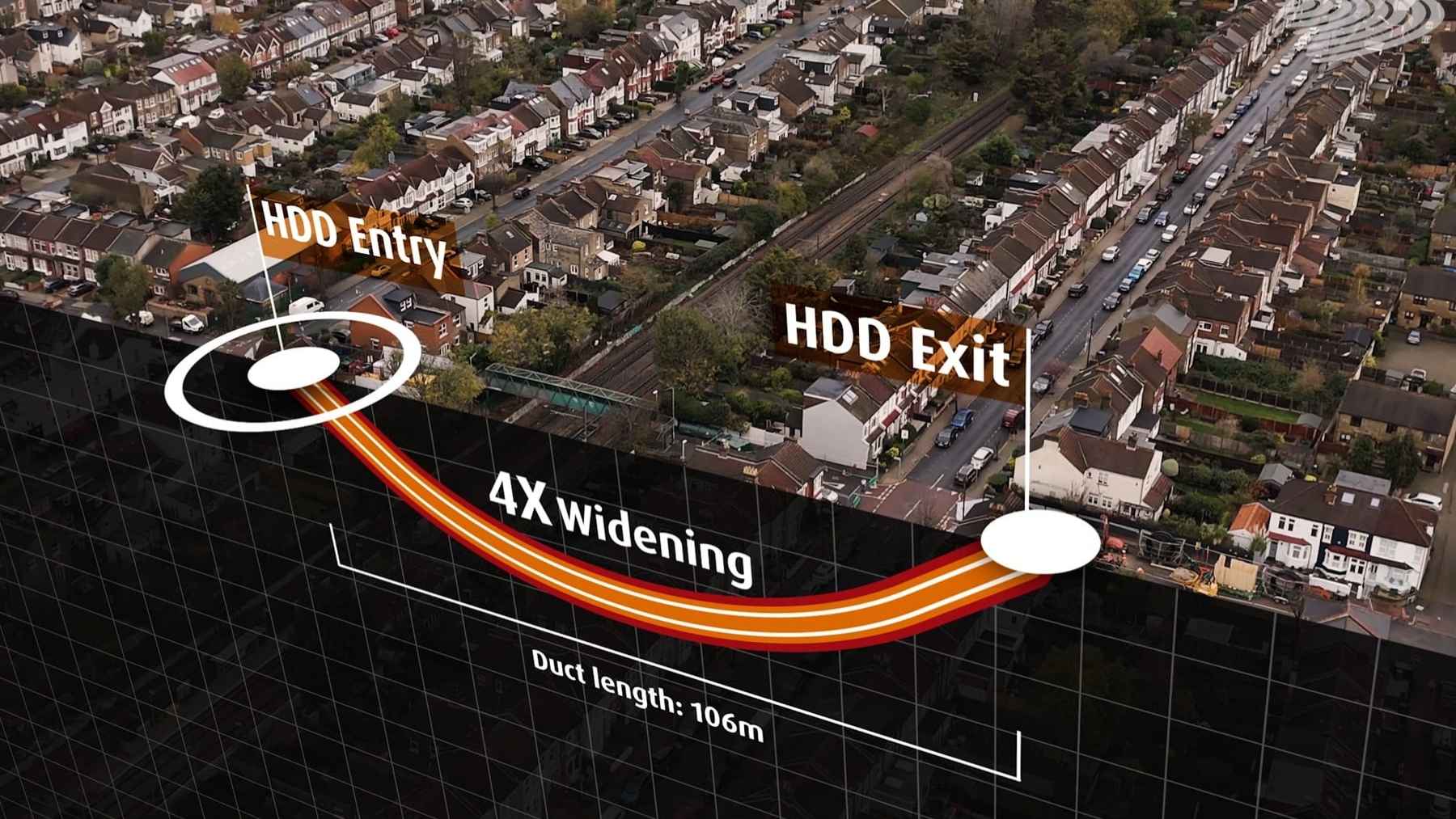
The usual fix is to lift the track, dig underneath, and put the railway back. Instead they set up a drill rig, aimed it sideways, and bored a hole just over 330 feet long and about 20 inches across underneath the whole corridor. Trams kept running every ten minutes. Trains kept running. Nothing above ground came out of service, and ianVisits, which reported the job in detail, put the finished bore at just over 100 meters.
The railway was the one thing they could not touch
At Avenue Road the corridor is tighter than it looks. The tram stop sits on a short passing loop, so there are two tram tracks there, and Southern’s single-track Crystal Palace to Beckenham Junction line runs alongside them behind the northern platform, without a platform of its own.
The heavy rail service is not exactly relentless. Southern runs it hourly, Monday to Saturday. The trams are the busy part, every ten minutes toward Beckenham Junction and Wimbledon via Croydon.
But it is single track. Closing it does not thin out a timetable, it severs Beckenham Junction from Crystal Palace outright. The line also sits on 750-volt DC third rail, which is not something you want a trenching crew working next to for weeks.
Add a residential street on either side and a tangle of other buried utilities, and the lift-the-track option stops looking cheap.
One pilot hole, then four passes to make it bigger
Horizontal directional drilling starts small on purpose. The rig launches from the surface at a shallow angle, steers a narrow pilot bore along a planned curve, surfaces on the far side, and only then begins opening the hole out.
Claire Sheridan, a portfolio manager at UK Power Networks, laid out the sequence: drill the pilot hole, then widen it four separate times until the ducts will fit. The operation, she said, “keeps the trains running and the streets open while the works take place.”
Five passes in total to reach 20 inches. Ducts went in, cable got pulled through afterward, and spare ducts went in alongside so the next upgrade does not need a second hole.
The drilling was done by McCormack Drilling, formally Peter McCormack & Sons, a Northern Ireland contractor that has been doing this since the early 1970s and was bought by OCU Group in October 2024.
The technique is American and it is 55 years old
Some of the write-ups around the job called the method novel. It is not, and the people who do it for a living would tell you so first. UK Power Networks itself stuck to the more accurate word: specialist.
HDD goes back to 1971, when Martin Cherrington was in Watsonville, California, boring gas lines for Pacific Gas & Electric. PG&E asked whether he could get a 4-inch gas line about 500 feet across the Pajaro River without open-cutting it.
Nobody had tried. According to Trenchless Technology, Cherrington’s crew spent roughly a month failing in assorted ways with oilfield tools before they broke through on the far bank. He finished his career with 27 US patents on directional drilling and the nickname Father of HDD. Asked about the milestone decades later, he said: “Time flies when you’re having fun!”
That history is the whole reason Avenue Road worked. It was not a breakthrough. It was a 55-year-old tool pointed at a corridor with room for nothing else.
Compare it with the hardware at the other end of the tunneling scale, like the 4,700-ton German machine that had to be turned around at the bottom of a pit under Hampton Roads, or the 3,500-ton borer in Poland that needed a purpose-poured concrete cradle before its first few feet. Those move mountains. This one made a 20-inch hole and went home.
The cables coming out were full of fluid
Here is the part that did not make the press release. UK Power Networks’ own works update for the scheme, filed with Bromley Council, describes Sydenham to Churchfields as a 33kV FFC replacement scheme. FFC stands for fluid-filled cable.
Older high-voltage circuits used paper insulation kept saturated with insulating fluid under pressure. They work, and plenty are still in service. They also leak as they age, which is why networks across Europe have spent years pulling them out.
What goes in instead is cross-linked polyethylene, XLPE, a solid insulation with no fluid to lose. Jason Callaghan, a project manager on the scheme, framed the swap around future-proofing and a more resilient supply rather than groundwater, with local network reliability as the stated driver.
That same document is useful for a second reason. It puts the route at 2.8 miles (4.5 km) from Sydenham Grid to Churchfields Substation, while the completion figures describe 5.6 miles (9 km) of cable installed. Those are two different measurements, one being how far the job runs and the other how much cable ended up in the ground.
It also lists two small HDDs on the route, one under the Network Rail asset and one under a brook. The 330-foot bore that made the news is the small one.
EV chargers are why the cable is going in at all
When UK Power Networks announced the £7 million scheme, it did not lead with reliability. It led with heat pumps and EV chargers, citing Department for Transport figures showing EV registrations across Lewisham and Bromley rising 80% year on year since 2018.
The utility also said it would share 1.4 miles (2.2 km) of trench with a second project rather than dig the same streets twice, and coordinated separately with the gas network on two Bromley roads.
That is a distribution-level squeeze, and you have a version of it. 33,000 volts sits right at the top of what American linemen call primary distribution, which runs up to 34,500 volts. Same tier, same job, same headache when a few hundred houses on one street all plug in after dinner.
Engie noticed. The French utility agreed in February 2026 to buy UK Power Networks from CK Infrastructure for £10.5 billion, about $14.2 billion, and named demand from electric vehicles and data centers as the draw.
Burying cable in America costs a lot more than this
The US is midway through its own undergrounding push, for a different reason. PG&E announced a 10,000-mile program in 2021 after its equipment was tied to a string of catastrophic wildfires, and it has since energized more than 1,300 miles of it.
The cost has come down from roughly $4 million a mile at the start of the program to $3.1 million a mile in 2025, which PG&E credits to local contractors, shallower and narrower trenches, and reusing spoil on site.
Do not line those numbers up against the London ones. PG&E is converting rural overhead lines through fire country. UK Power Networks was swapping existing buried circuits under a dense suburb. The trench is about the only thing the two jobs share.
What they do share is the reason for the hurry. Both networks are being rebuilt ahead of load that has not fully turned up yet, which is a bet with its own failure mode. Ask Hartford, where a 41.5-million-gallon tank sat empty for years because the hole got finished and the pumps did not.
The best part is how unremarkable it is
No machine with a name. No tonnage figure worth a headline. No six-month maneuver at the bottom of a shaft. A rig on a compound, one pilot bore, four reams, and a 20-inch hole under a railway that carried on running its hourly service the entire time.
That is what the technique has been for since a guy in Watsonville spent a month arguing with a riverbed. If your local utility ever gets a cable across a road without closing the road, this is probably how it happened.
 @marktownend ROOKIE1 month ago