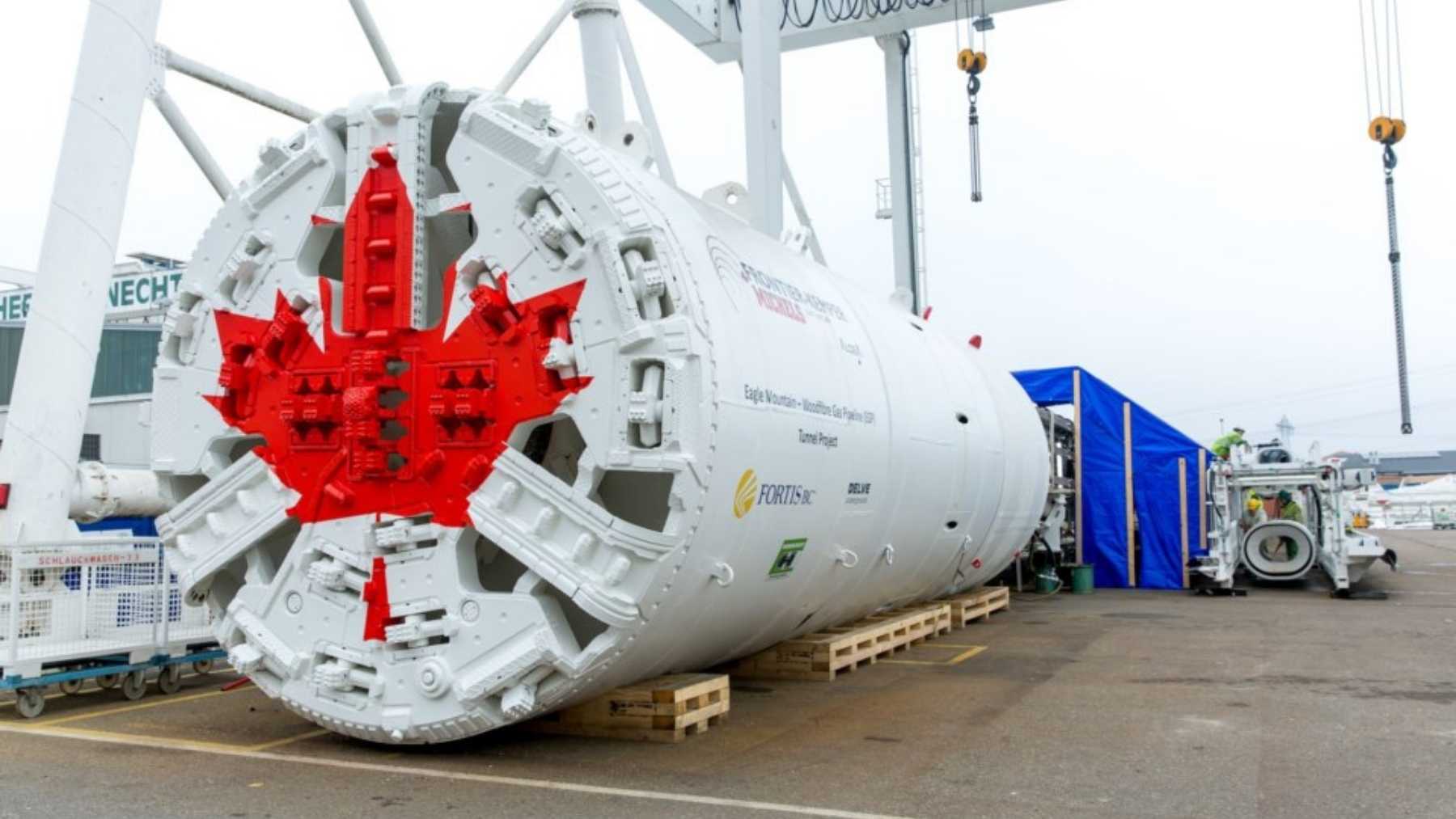

Back on September 10, we told you about two boring machines closing in on each other under a British Columbia mountain, digging a gas pipeline tunnel that gets sealed and flooded on purpose once the pipes are in. At the time, the hard-rock machine still had a stretch of granite between itself and the finished section of the tunnel, and FortisBC was talking about wrapping up excavation sometime this fall.
Well, they’ve met.
FortisBC announced the breakthrough on September 18, and Tunnelling Journal filled in the engineering details on September 21. The hard-rock machine, a gripper TBM with a 14.9-foot (4.53-meter) cutting diameter, chewed through the last of the rock and broke into the soft-ground section its partner finished back in April. There’s now one continuous tunnel running about 5.5 miles (8.86 kilometers) from the old BC Rail yard in Squamish to the Woodfibre LNG site.
FortisBC rounds that to an even 9 kilometers in its update, while the trade press logs 8.86. I’ll take the engineers’ number.
So what exactly broke through?
A gripper TBM is the machine you send in when the rock is strong enough to hold itself up. It doesn’t line the walls with concrete rings as it goes. Instead, it braces pads against the bare rock, shoves the cutting head forward off that grip, then resets and does it all again. You need genuinely solid ground for that to work, and this drive mostly had it: granite, granodiorite and quartz diorite under Monmouth Mountain.
The machine started from the Woodfibre end, where crews first blasted an 82-foot (25-meter) starter tunnel just to give it somewhere to stand. From there it ground through about 3.1 miles (5 kilometers) of rock, passing under as much as 1,378 feet (420 meters) of mountain at Monmouth Ridge. That’s a quarter mile of rock overhead, give or take.
The tunnel isn’t flat, either. It starts around 164 feet (50 meters) above sea level and bottoms out about 82 feet (25 meters) below it. So parts of two future gas lines will sit below sea level, inside a mountain, on purpose.
You may be wondering why one side of the mountain wrapped up in April while the other didn’t finish until September. The short answer is that the gripper simply had more tunnel to cut, roughly 3.1 miles against the slurry machine’s 2.4, through harder material. As far as I can tell, nobody treated it as a race.
The breakthrough itself happened at the underground chamber where the two drives were always meant to meet, so the machines didn’t have to test whose cutting head was harder. If you want the version of this where the aim gets genuinely nerve-wracking, the two machines boring toward each other under Lesotho’s Maluti mountains are doing the same thing across 24 miles.
EGP tunnel senior project manager Ignacio Calvo González said in the announcement that “seeing the two tunnel sections connect is incredibly rewarding.” After roughly two and a half years of tunneling, I’d say he’s earned that.
I can’t give you the exact day the cutter head came through, because FortisBC hasn’t published one. Its update only says the machine broke through earlier this month, so September 18 is the day everyone was told, not necessarily the day it happened.
The machine has to come out before the pipes go in
First, the gripper has to come back out of the tunnel it just finished. Once it’s gone, crews will get the bore ready for its real cargo: two 24-inch (610-millimeter) high-pressure gas lines running side by side, with the rock the machines pulled out of the mountain packed back around them as protective backfill. Reusing your own spoil to protect the pipes strikes me as fairly tidy housekeeping.
The tunnel is also just one piece of a much longer pipeline. The wider Eagle Mountain-Woodfibre project adds about 31 miles (50 kilometers) of new gas line between Coquitlam and Squamish, feeding the Woodfibre LNG export facility, and most of that gets built with ordinary trench and road work rather than boring machines. The mountain section went underground to keep construction off the surface of a 1,663-acre (673-hectare) estuary wildlife management area.
Tunneling started in spring 2024, which puts the underground portion at about two and a half years of cutting through two completely different kinds of ground. FortisBC announced the breakthrough on September 18, and the overall project it’s part of is scheduled to wrap up in 2027, pipes, water and all.