
Blueberries might be the lowest-drama crop in farming. You stick the bushes in the ground, you wait a couple of years, you fight off the birds, and you pick. At no point does the standard playbook involve calling in a bomb squad.
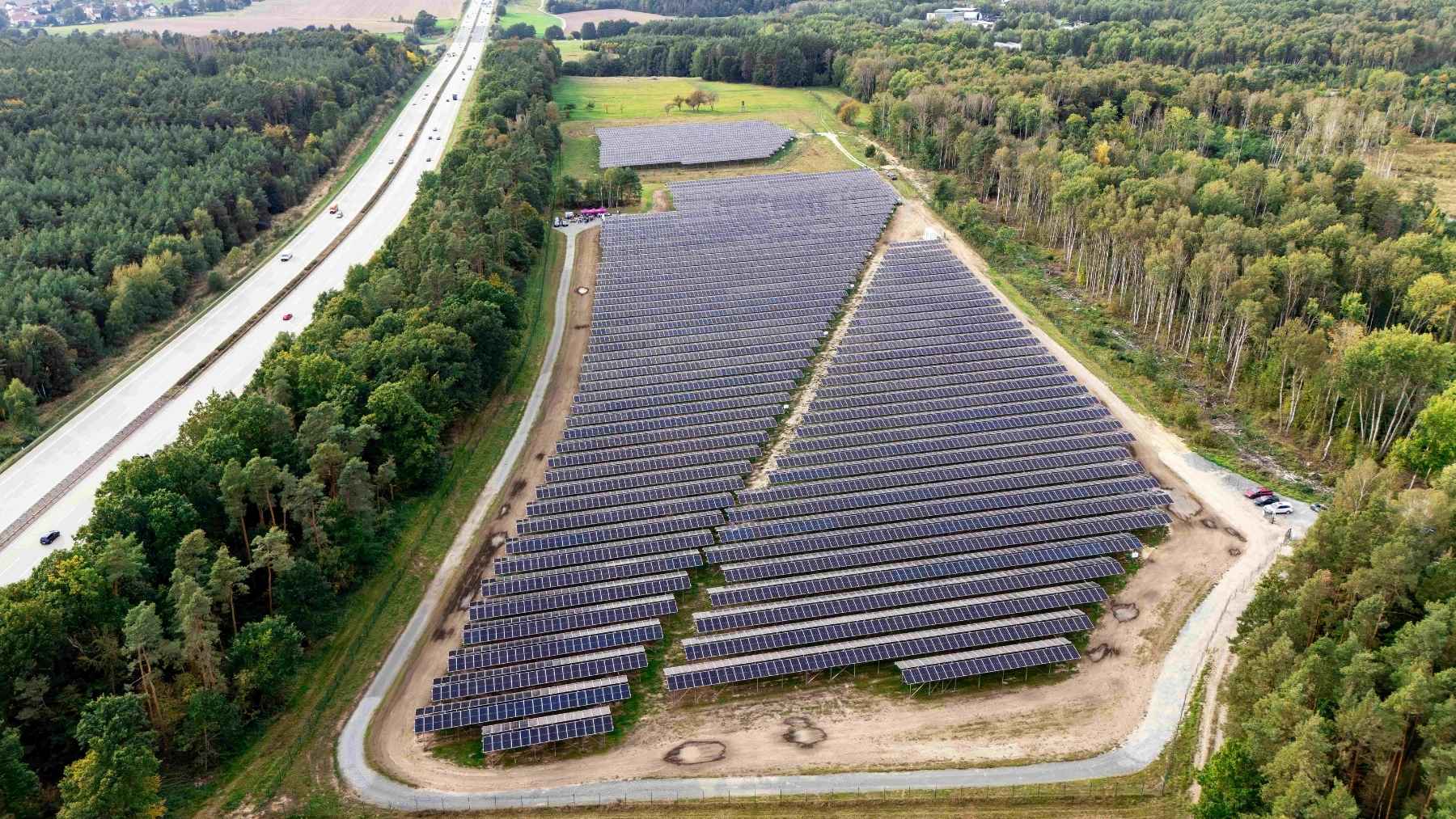
In the eastern German state of Thuringia, it did. On October 1, the solar arm of the state’s biggest utility switched on an array of nearly 12,000 solar panels standing 10 to 13 feet over a field next to the A4 autobahn. And before a single steel post went into that field, ordnance-disposal crews had to pull hand grenades and leftover ammunition out of the soil, because the land used to belong to the military. Now it belongs to berry bushes.
The plant is run by TEAG Solar, and according to the Thuringian energy ministry, it’s the state’s first large agri-PV project and the biggest solar installation on working farmland Thuringia has built so far. Crews have been mounting modules since March across roughly 15.8 acres (6.4 hectares) near the town of Bad Klosterlausnitz. The Germans call this kind of setup Agri-PV. Over here it usually goes by agrivoltaics, and the concept is exactly what it sounds like: raise the panels high enough that farming carries on underneath, and pull two products off one field.
So what was wrong with the field?
It sat there as a former military site, and in Germany that label comes with homework. The country runs public ordnance-clearance services, the Kampfmittelräumdienst, whose whole job is digging old munitions out of the ground before anybody builds on it, and they’re never short of work. At Bad Klosterlausnitz, the clearance teams went in ahead of the construction crews and removed hand grenades and assorted ammunition remnants, per the ministry. Neither the ministry nor TEAG has said whose grenades those were or how long they’d been down there, and I couldn’t pin it down either, so I won’t guess.
Solar keeps landing on exactly this kind of ground in eastern Germany, and it’s not a coincidence. We covered the biggest example a few weeks back: 700,000 panels sitting on a former Soviet firing range southeast of Berlin, where the developer’s rent effectively paid for hauling the shells out. A photovoltaic array barely touches the dirt. The posts go in at surveyed points, each one checked first, and whatever sits deeper stays where it is. Try doing that with a housing development.
What’s actually growing under 12,000 panels?
Mostly blueberries, which is why the state’s energy minister and the utility’s CEO spent part of the opening ceremony planting seedlings for the cameras. A newly founded organic grower called Rüdersdorfer Bio will farm the biggest share of the ground under the modules, and the planting list TEAG published runs well past blueberries: raspberries, blackberries, currants in white, red and black, plus aronia berries, tayberries, boysenberries, sour cherries, small apple trees and something called a haskap.
I’ll admit I had to look that last one up.
It’s a honeysuckle berry that supposedly tastes like a blueberry crossed with a raspberry. And the berries aren’t the whole operation. A smaller slice of the site goes to a regional tree nursery, which will raise seed stock from native shrubs there, and TEAG says the fruit harvest is headed for organic grocery shelves in the nearby towns of Hermsdorf and Bad Klosterlausnitz and in Erfurt, the state capital. “Now two harvests can be brought in,” TEAG chief executive Stefan Reindl said at the switch-on, meaning the electricity and the fruit. The company adds that livestock could graze under the modules down the line.
Berries are frankly a smart match for this kind of structure. The bushes stay low, you’d never need a combine in the rows, and soft fruit generally doesn’t mind some cover against hail and brutal July afternoons. The 10-to-13-foot clearance isn’t there for the plants at all. It’s there for the people and machinery working under the glass, which is the same logic that shaped a Spanish olive grove we wrote about, where 5,150 panels went up 13 feet so the straddle harvester could pass over the trees. The height of an agrivoltaic array gets set by the tallest machine that has to fit underneath it, not by the crop.
The village gets a cut of every kilowatt-hour
TEAG expects the array to feed just under 7 million kilowatt-hours into the grid each year, enough to cover about 2,300 households, and by the company’s math that avoids almost 2,900 short tons (2,600 metric tons) of CO2 annually. For every one of those kilowatt-hours, Bad Klosterlausnitz collects a voluntary payment of 0.2 euro cents from the operator. That sounds like nothing. Run it across the plant’s minimum 20-year life and the ministry puts the total at 280,000 euros, a bit north of $300,000, flowing into the budget of a small spa town, and TEAG says the neighboring village of Olberndorf is in on the arrangement as well.
Nobody forced the utility to pay that. TEAG is owned by Thuringia’s municipalities in the first place, and if you’ve watched how many German renewable projects get ground down in local opposition, you can probably see why a developer would volunteer. Keeping a village of neighbors on your side for 0.2 cents a kilowatt-hour is, frankly, cheap.
For scale, this is Thuringia’s debut in large agri-PV, not Germany’s. The state’s track record before this amounted to strawberry growing at Gebesee and a handful of test rigs, according to dpa, while Germany’s largest agri-PV array went online outside Berlin just a month earlier with about 74,000 modules across roughly 173 acres (70 hectares), which puts the berry field’s 12,000 at about a sixth of the count. Every state gets a first one, though, and this is Thuringia’s.
The blueberry bushes themselves have barely met the soil. Thuringia’s energy minister, Tilo Kummer, and Reindl planted the first seedlings under the panels at the October 1 opening, and TEAG Solar stays on as operator for the plant’s run of at least 20 years.