
Pretty much every strong metal part you own got that way by being beaten up. Blacksmiths hammered steel into shape on anvils, and a modern mill does the same job by squeezing hot slabs between rollers until the crystals inside break down into smaller pieces. Metallurgists call those crystals grains, and smaller grains generally mean a tougher material, because a crack has to fight its way past a lot more internal boundaries before it gets anywhere.
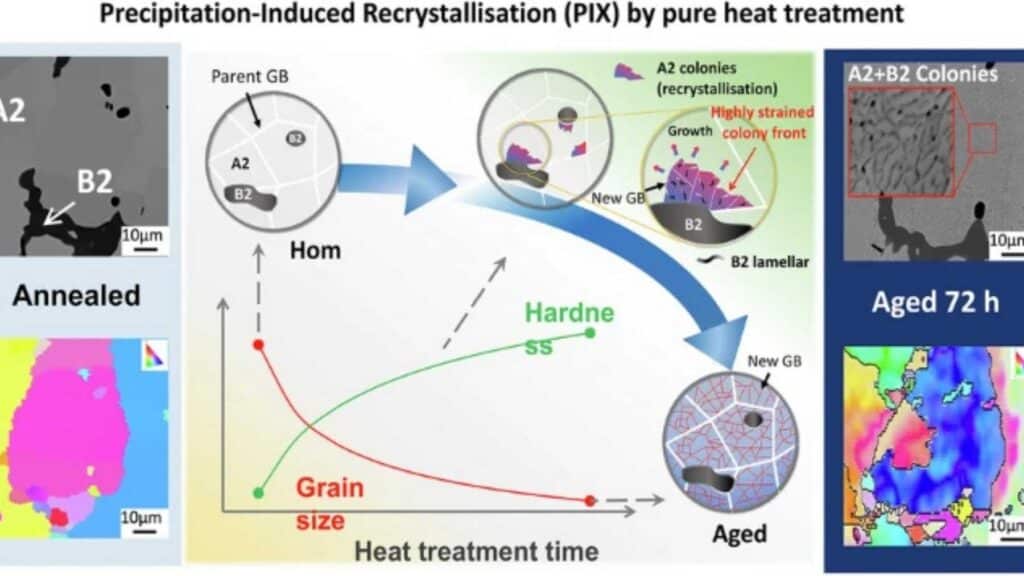
A team at the University of Birmingham has now published a tungsten alloy that skips the beating entirely. Hold it at 2,282°F for 100 hours and the grains inside shrink by about 60% on their own. There’s no rolling or forging step anywhere in it. The metal builds up strain internally and uses it to grow new, smaller grains.
Why should you care about grains in a lab sample?
Because the metal in question is tungsten, which happens to be the leading candidate for the plasma-facing walls of future fusion reactors. It’s also one of the worst materials on Earth to put through a rolling mill. If you can refine it in a furnace instead, you’ve removed a seriously ugly manufacturing step.
So why is tungsten such a pain to work with?
Tungsten melts at 6,192°F, the highest of any metal, and that’s exactly what you want in a wall that sits a few feet from a fusion plasma. The catch is room temperature. Cold tungsten behaves less like a metal and more like a ceramic plate: load it the wrong way and it cracks instead of bending. Engineers call that a high ductile-to-brittle transition temperature, and radiation inside a reactor makes the brittleness worse over time. Fusion labs already spend a surprising amount of effort babysitting this stuff; Princeton researchers recently had to blast a porous tungsten “sponge” with neon plasma inside a reactor just to get it clean.
The classic fixes are rough. You can roll tungsten to refine its grains, but deforming a brittle metal takes enormous force and tends to crack the very thing you’re trying to toughen. You can alloy it with rhenium, which works, but rhenium isn’t cheap, to put it mildly. So a process that refines tungsten’s grains while the metal just sits in a furnace solves a real manufacturing problem.
The alloy does the work during heat treatment
The Birmingham team, working with the UK Atomic Energy Authority, TU Bergakademie Freiberg in Germany and City University of Hong Kong, mixed tungsten with 36.5% chromium by weight. Count atoms instead of weight and chromium actually makes up 67% of the alloy, since a chromium atom weighs less than a third of a tungsten atom. The samples they’re working with are arc-melted cylinders roughly an inch long, so we’re talking about lab samples here, and I’ll come back to that.
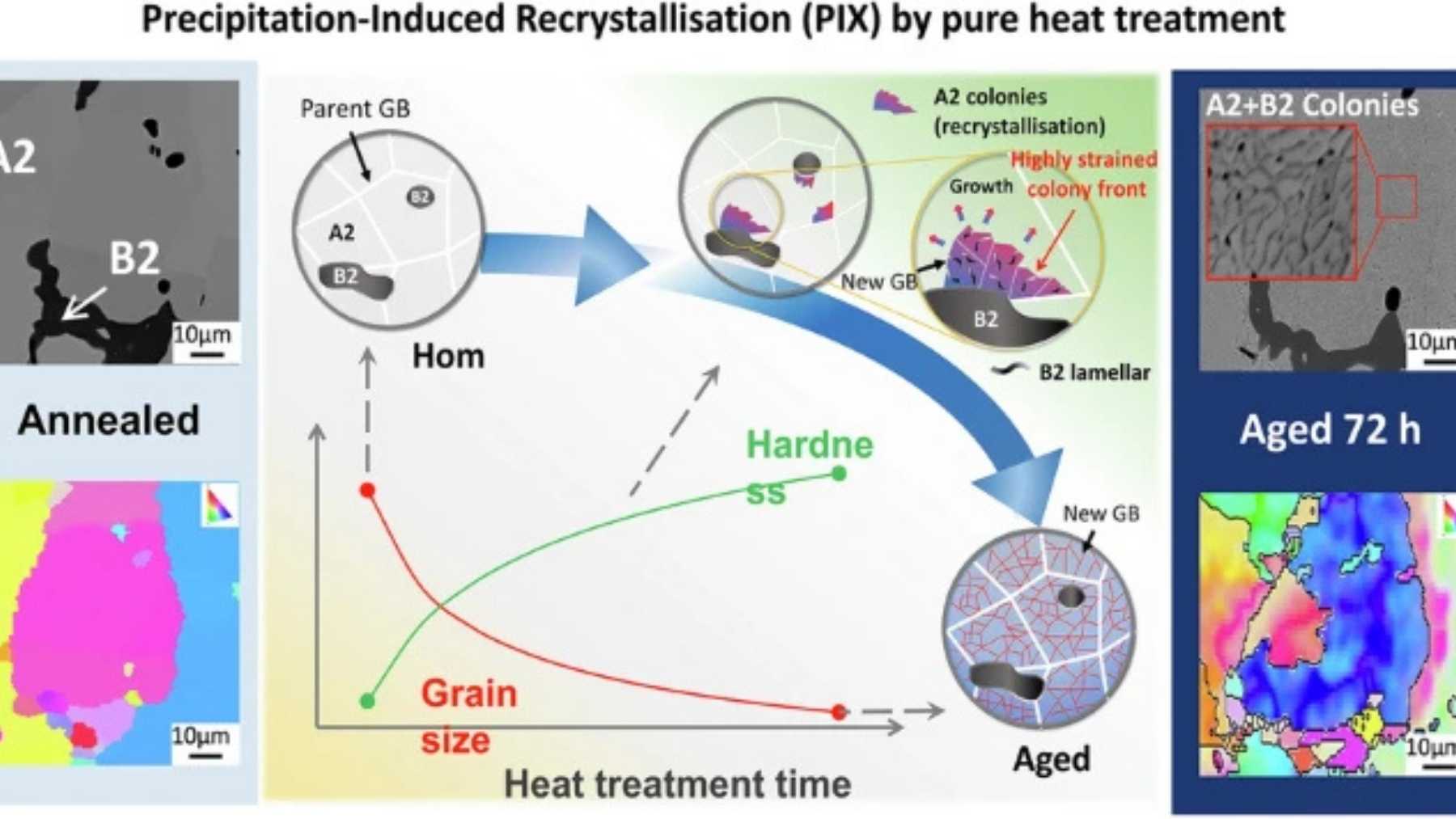
Then comes the step that does all the work, described in Scripta Materialia. Aged at 2,282°F, the alloy splits into two crystal phases, one rich in chromium and one rich in tungsten, stacked in thin alternating layers. Those two lattices don’t fit together cleanly, and X-ray diffraction put the mismatch at 6.4%, give or take 0.2%. That misfit builds elastic strain in the metal, dislocations pile up along the boundaries between the layers, and once enough stored energy accumulates, the material does what strained metal always does when it’s hot: it recrystallizes into new, smaller, strain-free grains. A steel mill reaches that point by crushing the metal from outside. This alloy reaches it by sitting still.
After 100 hours at temperature, the average grain size had dropped from 147 micrometers to 61. For scale, a human hair runs around 70 micrometers across, so the grains went from roughly double the width of a hair to just under one. And in the team’s earlier work on an equivalent alloy, hardness held steady at about 740 Vickers through the same aging window, so the metal didn’t go soft while it was rearranging itself.
Project leader Sandy Knowles, a professor in nuclear materials at Birmingham, said in the university’s announcement that the discovery “challenges conventional understanding that grain refinement typically requires extensive thermomechanical processing.”
The team named the mechanism Precipitation Induced Recrystallisation, PIX for short. And yes, that’s “recrystallisation” with an S, because it’s a British university and they get to spell their own discovery. I’ll stick with the American spelling here.
Don’t expect a PIX reactor wall anytime soon
Everything here happened to inch-long cylinders in a lab furnace, measured with electron microscopes and X-ray diffraction. Nobody’s built a component out of this alloy, let alone bolted one into a fusion machine.
I should also flag what the study didn’t measure. Radiation embrittlement is the motivation for the whole exercise, but the aged alloy hasn’t been through irradiation testing, so whether finer grains buy tungsten real protection against fusion neutrons is still an open question. The university’s release goes no further than saying smaller grains can improve mechanical reliability, and that caution seems about right to me.
The same mechanism showed up in a second alloy, and that one is arguably the more practical story in the near term. A titanium-iron-molybdenum alloy aged at 1,382°F cut its grain size by around 90% and picked up 60 points of Vickers hardness along the way. That one’s aimed at jet-engine compressor blades, and the result is published in Communications Materials.
So who actually needs a furnace-only version of forging? Anyone making parts that can’t survive a rolling mill. Brittle metals are one case, and 3D-printed components are the other big one, because once you’ve printed a part in its final shape, you can’t exactly roll it afterward without wrecking the shape. A strengthening step that’s just holding the finished part in a furnace works on any geometry. The team’s filed a patent on the process, which tells you how they rate it.
The tungsten results have been online in Scripta Materialia since August 19, formally slotted into a January 2027 issue, and the University of Birmingham went public with the PIX mechanism on September 30, 2026.