
Big science machines usually make the news for one of two reasons. They are chasing fusion, or they are smashing particles together looking for something nobody has seen before. Sweden spent the last decade building one that does neither.
The European Spallation Source, on the edge of Lund, exists to manufacture neutrons in bulk so researchers can see inside batteries, engine parts and protein samples. On July 7 the facility announced it had finished a second round of accelerator commissioning, capping four months of pushing a proton beam 1,780 feet down a tunnel.
The beam still has not hit the thing it was built to hit.
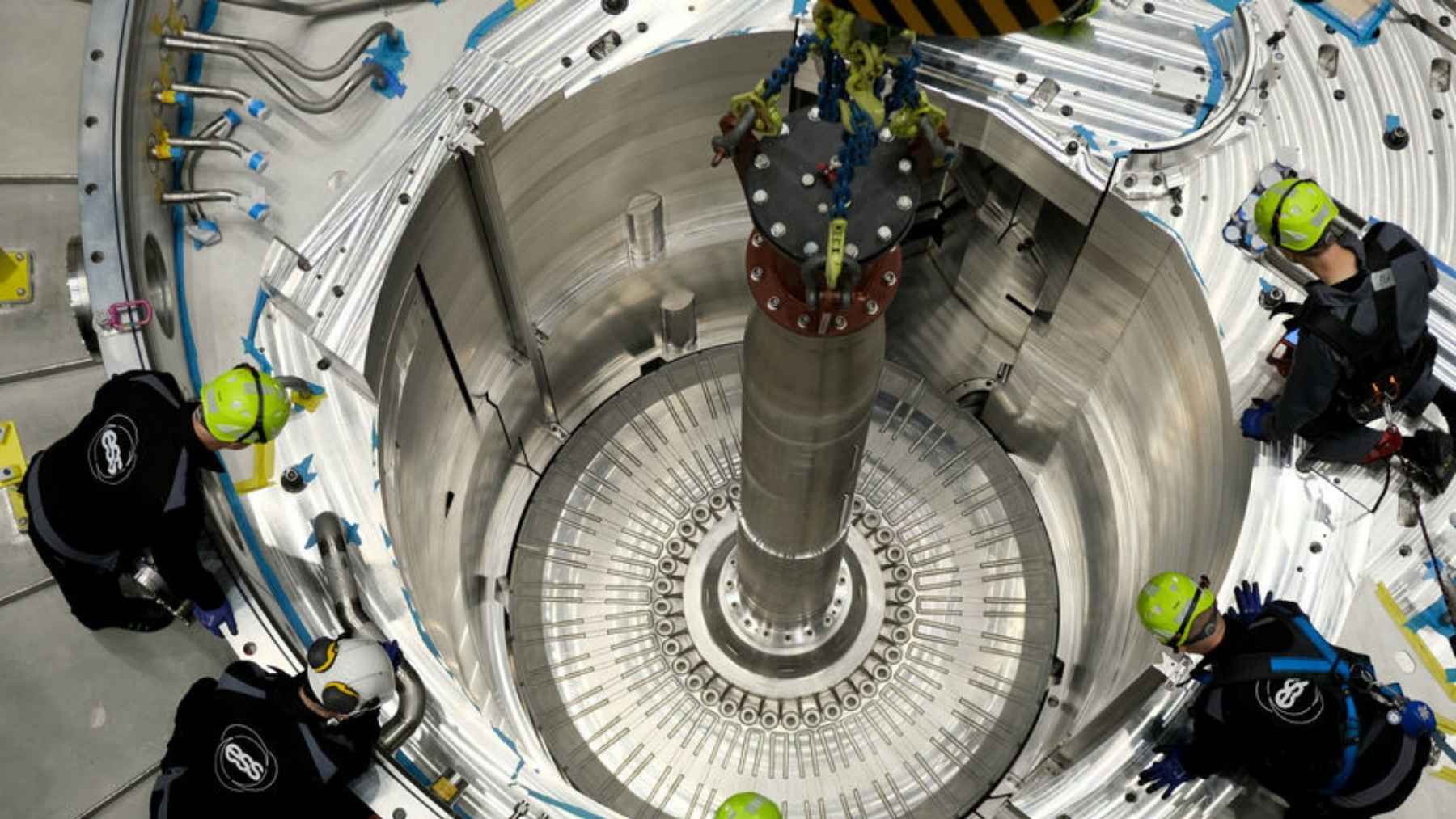
That thing is a stainless steel wheel 8.5 feet across, weighing about five metric tons, packed with roughly 7,000 bricks of tungsten. It turns at 23 and a third revolutions per minute inside 6,000 metric tons of steel and concrete. It has been sealed in there since November 2023, spinning, waiting.
The wheel is the whole trick
Spallation is a blunt idea. Fire protons hard enough at a heavy metal and neutrons come loose from the nuclei. It is the same mechanism a Swiss outfit wants to use to burn nuclear waste, except there the neutrons feed a reactor instead of an instrument hall.
The catch is heat. A proton beam carrying megawatts of power will wreck any stationary lump of metal you put in front of it.
So Sweden made the target move. ESS Bilbao, the Spanish partner that designed and built the wheel, cradled roughly 7,000 tungsten bricks in 36 stainless steel cassettes and sealed the lot in a pressurized vessel. Helium runs through it at 2.85 kilograms a second, down the shaft and back up through a rotary union, with the whole loop engineered to lose less than 0.85 bar of pressure.
The rotation speed is not arbitrary. Thirty-six sectors turning at 23 and a third revolutions per minute means a fresh sector arrives at the beam line 14 times every second, which is exactly the pulse rate the accelerator is built to deliver. Every pulse lands on metal that has had a full turn to cool down.
ESS puts it more memorably in its own documentation: the wheel spins at roughly two thirds the speed of a 33 rpm record.
Tungsten is the material of choice because it is dense, neutron-rich and holds together at absurd temperatures. It is also a metal China mines about 80 percent of, which is a separate headache for anyone building hardware like this outside Asia. ESS is blunt that the wheel was a gamble: none of the established target designs could handle the power level it was aiming for.
Sweden spent four months proving the beam can hold
The July announcement covers a phase ESS calls Beam on Dump 2, which started in February. The beam went through the normal conducting section first, then through the superconducting linac in March. Since early May it has been running steadily into the tuning dump at 800 to 860 million electron-volts.
Getting the beam to the dump was never the hard part this time. That was accomplished in May 2025. The job now is holding a stable beam while the numbers climb.
Pulse length went from 0.005 milliseconds in May 2025 to 1.5 milliseconds. Repetition rate went from 1 Hz to 14 Hz. Beam current is at 62.5 milliamps. On July 3 the first 1.5-millisecond pulse landed on the dump, and the machine was shut down for the summer a few days later.
Every one of those increases makes something else harder. “The 89 RF cavities need to be perfectly aligned,” said Daniel Noll, a physicist in the ESS beam physics group, describing what it takes to reach 800 MeV. More current means the protons repel each other harder and the magnets need retuning. Longer pulses at a faster rate means more heat dumped into the cavities.
Commissioning restarts in the autumn.
A power dip in November broke the part sitting right in front of the wheel
In November 2025 the site took a brief interruption to its incoming power. Almost everything shrugged it off. One component did not.
The casualty was the moderator, and it matters more than its size suggests. Neutrons come off the tungsten at about 10 percent of the speed of light, which is useless for research. The moderator slows them to roughly the speed of sound, using liquid para-hydrogen and water inside a plug lined with beryllium.
“These disruptions are a setback, undoubtedly,” ESS Director General Helmut Schober said in December.
The moderator was never a one-off, though, which is where most of the coverage got it wrong. ESS installed it inside a replaceable plug precisely because these components are meant to be swapped every few years as better versions arrive, and a second unit was already in production at Forschungszentrum Jülich in Germany when the power dipped.
“Designing a second moderator was always part of the plan for the ESS machine,” Kevin Jones, ESS Director for Machine and Operations, said in January. Management decided to stop analyzing the damaged unit and pour everything into getting moderator 2 installed and tested in the last quarter of 2026. It has a different geometry and is expected to push more neutrons at the instruments than the original would have.
The rest of the site kept moving through all of it. Sweden’s radiation regulator granted the permit for neutron production on February 13, valid for five years. BIFROST was declared ready to receive neutrons in February, LoKI in March, the test beamline at the end of March, ODIN in May.
America hit 2 megawatts first, and did it with liquid mercury
If the 2 MW figure sounds familiar, it should. On April 23, 2026, the Spallation Neutron Source at Oak Ridge National Laboratory reached 2 megawatts of beam power, days before its twentieth anniversary of operations.
SNS solved the same heat problem a completely different way. Its target is a steel vessel full of flowing liquid mercury, which cannot be damaged by heat in any meaningful sense because it is already liquid. When it fired its first pulse in April 2006 at 160 kilowatts, it was the first high-power machine to use superconducting cavities to accelerate protons and the first to use a mercury target at all.
The pulse shape is where the two machines genuinely part ways. Oak Ridge accumulates protons in a ring and fires them in bursts lasting microseconds. Sweden skipped the ring entirely and fires pulses thousands of times longer, which is a deliberate bet that long pulses buy better energy resolution for certain experiments.
Sarah Cousineau, who directs the research accelerator division at SNS, has made the point that running at high power is one thing and doing it reliably day after day is another, and that reliability is what twenty years bought Oak Ridge. Sweden has not had a single day of that yet.
Then there is the detail that makes this less of a rivalry than it looks. The Second Target Station planned at Oak Ridge will be fed by a rotating tungsten target, taking every fourth proton pulse from the accelerator. America’s next neutron source is built around the same solid-metal idea Sweden bet the project on.
Three dates, and none of them contradict each other
ESS has published what looks like three different schedules, and readers keep treating them as a walk-back. They are separate milestones.
First neutrons are planned for 2027. Andrew Kimber, the project director, has said the goal is producing neutrons and hosting scientists doing experiments by the end of 2027. The permit announcement in February referred to the facility being in operation in 2028, which is the full user program with the instrument suite filled out.
Beam on Target, the moment the proton beam is finally steered onto the wheel instead of the dump, was described in February as expected next winter. Moderator 2 has to be in and tested first.
One more piece of housekeeping sits in the way. Schober, who pushed the button that shut the beam down in July, hands the director general job to Jane Hvolbæk Nielsen on November 1 after five years in the role. On the current schedule he will be out the door before the beam ever reaches the wheel he spent his tenure aiming it at.
The wheel, for its part, has done everything asked of it. It passed a continuous 1,000-hour spin test on a stand before installation, went into the monolith behind 13 feet of stainless steel shielding in November 2023, and has been turning in a sealed vacuum ever since without a single proton touching it. Whether Sweden’s design was the right call is a question that cannot be answered until something finally does.
 @laurashermanrud ROOKIE1 month ago