
Copper melts at 1,985 degrees Fahrenheit (1,085 degrees Celsius). That number has sat in the engineering handbooks for well over a century, and nobody has ever had much reason to argue with it.
A melting point describes slow, patient heating, though. Hit copper with heat faster than the metal can respond and the physics gets weirder, and until this month the simulations agreed on how that story ends. At 2,595°F, the crystal structure holding the metal together was supposed to fail instantly, everywhere at once, like a controlled demolition.
Then researchers at the Department of Energy’s SLAC National Accelerator Laboratory aimed an electron camera at a copper film, drove it past that temperature, and watched the collapse simply not happen. The results were published in Nature Communications on August 6, and SLAC detailed the experiment on August 13.
The copper did melt. Nobody repealed thermodynamics. What it refused to do was fall apart on schedule, and that refusal matters a lot more than it sounds.
The plasma gets the headlines, the wall gets the abuse
So why is a national lab filming copper in the first place? Fusion. The plasma inside a future fusion power plant will burn at hundreds of millions of degrees, and that is the figure that ends up in every press release.
The metal around that plasma has the less glamorous job. SLAC puts the sudden heat loads on those structural components in the same class as what a spacecraft takes on reentry, and copper and its alloys are the leading candidates for soaking it up. Current models cast them as heat sinks, the materials that pull thermal energy away from whatever sits closest to the reaction.
Real machines are already leaning on that limit. Germany’s Wendelstein 7-X stellarator, the one that runs on 50 computer-designed superconducting coils, is developing microwave heating whose resonator walls take roughly 20 megawatts per square meter, more heat than water-cooled copper can comfortably carry away. And the 1,000-ton American-built magnet at the heart of ITER exists to ignite a plasma that the surrounding hardware then has to survive.
Here’s the catch: nobody picks those materials by trial and error. Simulations do the screening, sorting through candidate after candidate before anything gets built. If the simulation is wrong about how copper dies, it is wrong about everything downstream of that.
You can’t learn much from a puddle
The traditional way to test a candidate material is what researchers call “cook and look.” You blast the sample with extreme heat, let it cool, then inspect the damage.
The problem is what’s left to inspect. However the metal came apart, fast or slow, orderly or catastrophically, the evidence is a small brown puddle. Puddles don’t say much about how they got that way.
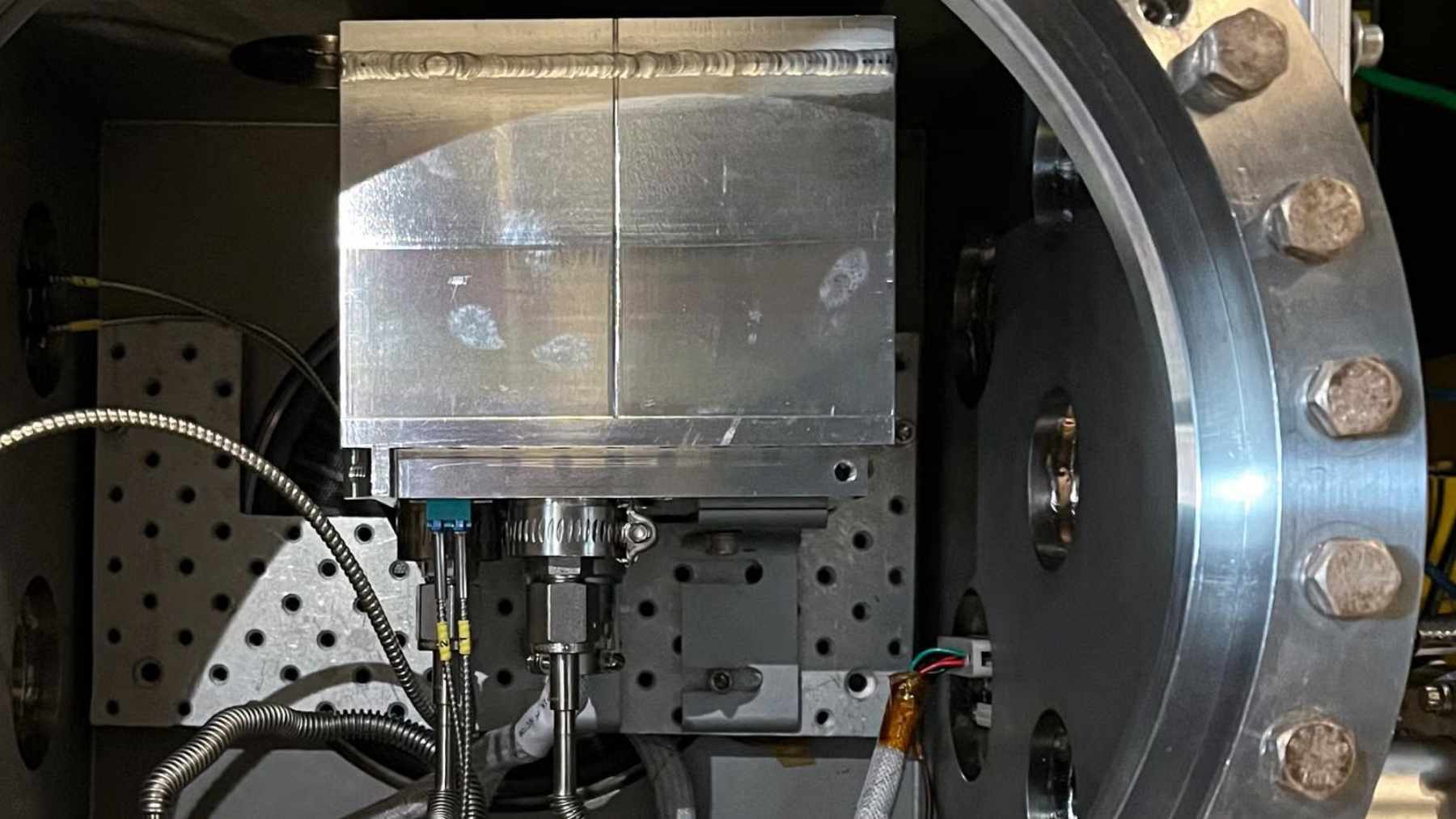
Mianzhen Mo, the SLAC staff scientist who led the study, wanted the middle of the movie instead of the last frame. His team took a thin copper film to MeV-UED, SLAC’s electron camera, which resolves atomic motion down to the femtosecond. That’s one quadrillionth of a second, a timescale where even a shockwave looks parked.
The setup itself is simple to describe. Blast the film with laser heat, fire an electron beam through it while it cooks, and record what the atoms actually do.
The collapse never showed up
The simulations had a detailed script for this experiment. Melting would start along the film’s surfaces at about 1,985°F and creep inward as the temperature climbed, while the center of the sample, squeezed under higher pressure, held its crystal lattice together longer.
Then came the cliff. At roughly 2,595°F (about 1.25 times the melting temperature, a threshold researchers call copper’s superheating limit), whatever crystal remained was supposed to disintegrate instantly into a fully disordered liquid.
That’s not what the camera saw. The lattice kept deteriorating gradually, in order, even as the temperature climbed past the limit. The copper melted the way it wasn’t supposed to be able to.
The footage held a second surprise at the other end of the scale. Under this kind of ultrafast heating, copper showed what’s known as pre-melting, with disorder creeping in along the boundaries of nanosized grains before the metal even reached its standard melting point. So copper starts giving up earlier than the handbook says, and finishes falling apart later than the models claimed. Both ends of the script were off.
One shortcut had been hiding in the models for years
Once the team knew what real copper does, the question became why the simulations kept predicting a collapse that never comes.
The answer turned out to be an assumption. The models treated the melting copper as if it sat under static, perfectly uniform pressure, with every atom pinned in place. The actual experiment is nothing like that. Pressure conditions inside a laser-heated film are dynamic, which gives the atoms room to relax and shift, and shifting atoms can hang on to some order well past the point where pinned ones would have surrendered.
“It’s a straightforward solution, but molecular dynamics simulations had been overlooking it for years,” Mo said in SLAC’s announcement. Once the team fed the real pressure conditions into the code, the simulation reproduced what the camera had recorded.
Mo’s group has been circling this territory for a while. They previously worked on tungsten after it was flagged as a fusion-chamber candidate, and this copper study pulled in collaborators from five German universities plus the University of Warwick in England, with funding from the DOE’s fusion energy sciences program.
Gold already pulled a bigger stunt
If some of this sounds familiar, it’s because SLAC ran a stranger version of the experiment in July 2025, with gold. That team heated a gold film to 19,000 kelvins, which works out to 33,740°F and more than 14 times gold’s melting point, and the metal stayed solid the entire time.
That result, led by Thomas White of the University of Nevada, Reno, blew through a theoretical ceiling called the entropy catastrophe, a 1988 prediction that no solid could survive beyond roughly three times its melting temperature. Gold cleared it more than four times over and kept its crystal structure anyway.
The two results aren’t the same trick. Gold, heated fast enough, refused to melt at all. Copper melted, but calmly, without the predicted collapse. Different metals, different limits, same lesson: when you heat a metal in trillionths of a second, the rulebook written for slow heating stops applying, and two consecutive experiments at the same lab have now caught the models being wrong in two different directions.
There’s a follow-up already planned. The team wants to rerun the copper test under hydrostatic conditions, with pressure equalized inside and out, closing the escape route the atoms used this time. If the crystal finally collapses on cue, the old prediction gets partial credit. After that come copper alloys, the materials actually penciled in for fusion heat-sink duty.
None of this moves a fusion plant’s opening day. What it does is make the software doing the material screening measurably less wrong, and in a field where a computer narrows the shopping list years before anyone cuts metal, less wrong is the whole game. The plasma physics gets the funding rounds and the documentaries. Whether any of it survives contact with reality may come down to how honestly we can predict the behavior of a metal humans have been smelting for 7,000 years.