
Tungsten has a pretty good list of talents for a metal. It’s got the highest melting point of any of them, it’s dense, and it holds together in heat that would turn most of what’s in your garage into a puddle. It’s the same metal that fills the roughly 7,000 bricks inside the five-ton wheel spinning in a vault under Sweden, so it’s no surprise people building fusion machines keep reaching for it.
But tungsten has an annoying habit. It gets dirty while it’s being made, and if you clean it at the factory, it gets dirty again on the way into the machine. A team from Princeton Plasma Physics Laboratory (PPPL), Princeton University and Penn State has a paper out on how to get around that, and their answer was to do the cleaning after the tungsten’s already sealed inside.
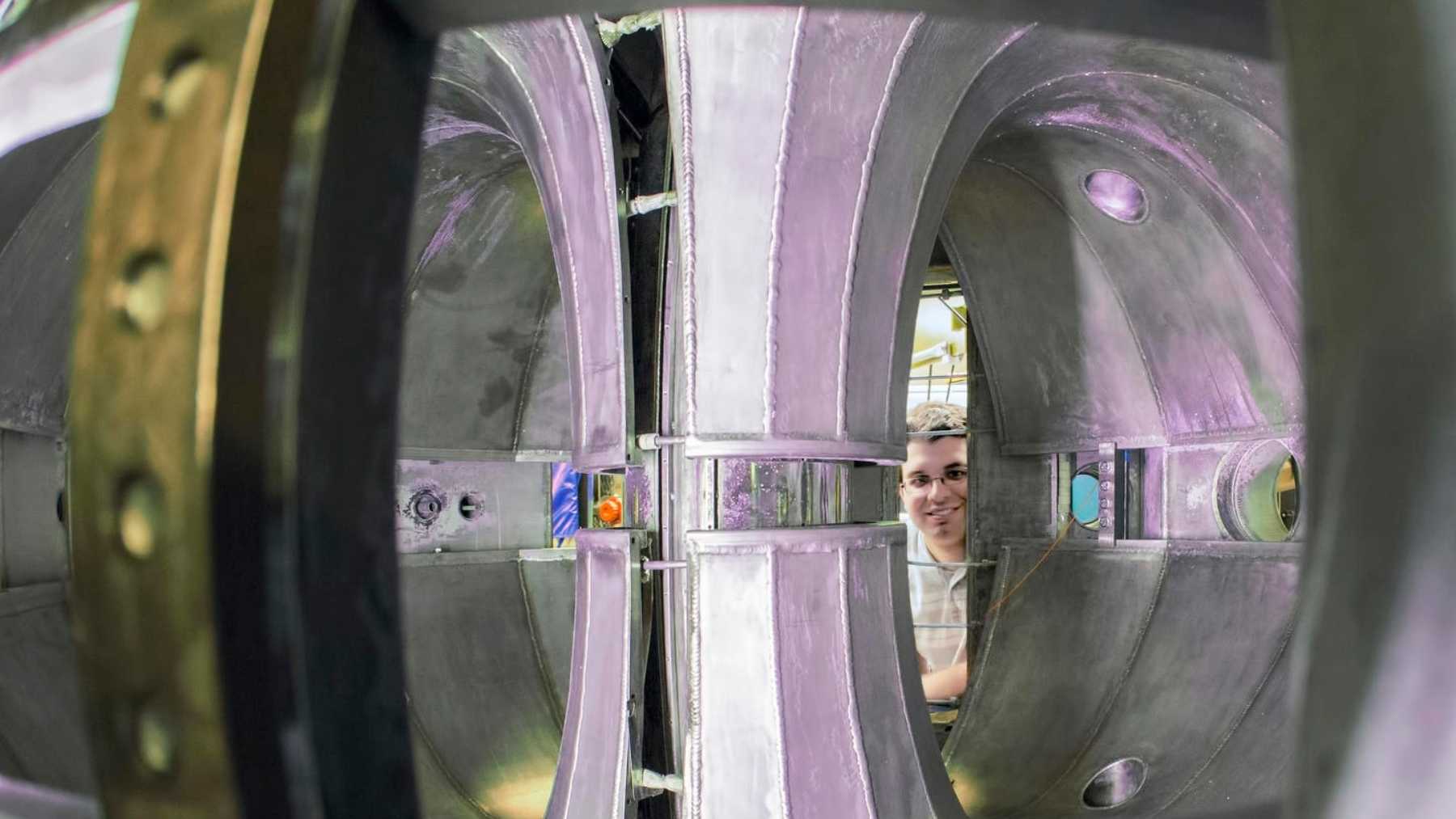
They ran the test in LTX-β, short for Lithium Tokamak Experiment-Beta, a small fusion device in New Jersey that PPPL bills as the first plasma experiment anywhere whose plasma-facing parts are entirely liquid metal. Those are the surfaces closest to the plasma, so they take the brunt of the heat, and LTX-β exists to find out what happens when they’re liquid lithium instead of bare metal.
So why would a fusion wall need a sponge?
The plasma inside a tokamak (the doughnut-shaped kind of fusion machine) is rough on anything solid you put near it. Over time, solid metal walls can crack, melt at the surface and shed dust.
Liquid metal gets around a lot of that because there’s nothing permanent to wreck. You keep flowing fresh metal in, and according to the paper, it’s practically immune to the lasting damage that neutrons and plasma do to solid parts. Lithium’s the favorite for the job.
The catch is that a liquid has to be held in place somehow. One of the more promising ways to do it is a tile of porous tungsten that soaks up lithium the way a sponge holds water. PPPL uses that exact comparison, and frankly it’s a good one.
Penn State made the sponges for this test with a process called spark plasma sintering. Basically, you pack tungsten powder into a graphite mold, squeeze it, and run a big electric current through it until the grains fuse where they touch. Stop early and you get a solid full of tiny open channels instead of a solid block.
The problem is what comes along for the ride. Powder has a huge amount of surface area, and all of it picks up carbon and oxygen. When the researchers checked the sample that ended up in LTX-β, carbon made up 82% of the atoms up there, and none of the tungsten was in its plain metallic form.
Then liquid lithium shows up. Lithium melts at about 358°F, but when it reacts with that carbon and oxygen it forms solids like lithium carbonate, which doesn’t melt until roughly 1,333°F. Those solids can build up inside the pores, and once that happens the lithium won’t flow the way it’s supposed to, which kind of defeats the purpose of having a sponge.
Cleaning tiles at the factory doesn’t work
So why not just scrub the tiles before they go in?
According to PPPL, even a spotless tile picks up fresh contamination as soon as air gets to it while it’s being installed. So cleaning at the factory basically buys you a clean tile for the trip to the lab.
The team went with glow discharge cleaning instead, which fusion labs have used for decades. You bleed a little gas into the vacuum chamber and put a few hundred volts on an electrode, and the gas lights up as a faint, low-temperature plasma. Charged gas atoms slam into the surfaces in there and knock loose whatever’s stuck to them, a bit like sandblasting at the scale of atoms.
They didn’t use helium, the gas you’d find in a party balloon. They went with neon, because PPPL says neon ions weigh more and do a better job of blasting carbon and oxygen loose, and the paper says helium just isn’t efficient enough at that in a machine without carbon walls.
The sample got two rounds of neon
Only one sample went into LTX-β. Penn State made four, but two had their pores partly clogged when the leftover graphite was polished off, and a third formed tungsten carbide, which lithium has a much harder time wetting. So the fourth one got the job.
It sat on a probe poking into the outer side of the machine’s vacuum vessel and went through two rounds of neon plasma. The first ran for 85 minutes. The second lasted five hours with the machine’s walls heated, which warmed the sample to about 392°F.
After each round, the probe heated the sample quickly with an electron beam to measure the gas coming off it. Here’s where it gets a little messy. PPPL’s own write-up says the sample was heated to roughly 800°C, which is about 1,470°F. The paper says the heating topped out at 1,000 kelvin, or about 1,340°F, and that the setup couldn’t go any hotter than that. I’m going with the paper.
Then the sample had to reach the analysis equipment without seeing air. It came off the probe inside a glovebox full of argon and rode to Princeton’s Imaging and Analysis Center in what the paper calls a vacuum suitcase, which is a much cooler piece of luggage than anything I own.
How clean is 87 percent clean?
The figure PPPL put up front is 87%, the share of metallic tungsten at the sample’s surface after cleaning, up from zero. That number only describes the tungsten atoms up there: before the cleaning none of them were in plain metallic form, and afterward 87% were.
Carbon still accounted for 40% of all the atoms on that outer layer, down from 82%. So if you see this described as a surface that’s 87% clean, that’s a slightly generous way to put it. Oxygen at the very top barely moved, going from 17% to 20%.
Just below the surface, the results look a lot better.
You could see the change, too. Camila López Pérez, the Penn State researcher who led the work, said in PPPL’s write-up that the sample went from dull dark gray to silvery. Her first thought was that they’d been depositing material on it, which she said “would have been a terrible result.” That’s not what happened. The sample had just gotten very clean.
This is still a one-sample test
I think this is a pretty clever bit of problem-solving. Cleaning the tile somewhere air can’t get back to it is arguably obvious once somebody says it out loud. Still, PPPL says no one had documented using glow discharge to clean powder-made parts like these inside a fusion machine and then studying them without any air exposure.
The authors are upfront about a few limits, too. The paper says the clean result showed up after both the plasma and the heating, and they think both did part of the work. You can’t tell from these results how much credit goes to each. The sample also picked up a little iron from the machine’s stainless steel walls, plus some lithium left over from earlier experiments.
The bigger issue is strength. The grains in these sintered sponges didn’t bond to each other very well, which left the samples brittle, and the paper says that would need to improve before one could survive the stresses inside a fusion reactor.
We’re also a long way from a full wall of the stuff. LTX-β is a small machine, and PPPL says its results may lead to more liquid lithium inside NSTX-U, the lab’s much bigger experiment, which recently got a 23,000-pound magnet flown in from Spain. The authors expect the same cleaning approach to carry over to other powder-based parts, including 3D-printed ones, and that’s probably the most useful line in the whole paper in Nuclear Materials and Energy.
López Pérez also led the upgrade of the probe the sample rode in on. According to PPPL’s August 4 announcement, she’ll rejoin the lab this fall with the title of associate research physicist.