
Every time a dry summer wrecks a harvest somewhere in Europe, the aftermath follows a script: farm groups ask for relief money, and governments eventually cut checks. Austria just had that kind of summer. Parched soil and water shortages put its farms under heavy pressure in 2026, by pretty much everyone’s account, including the farmers themselves.
So an announcement that landed on September 24 caught my eye, mostly because of its title: “Sustainable solutions instead of short-term drought aid.” It’s from EWS, a renewables engineering firm out of Munderfing that’s been building wind and solar projects for more than 30 years, and the pitch boils down to shade. On the company’s test field outside Bruck an der Leitha, east of Vienna, the winter wheat growing in the widest lanes between its solar trackers yielded 14 percent more this year than the wheat on open ground beside it.
And yes, that’s the field with a power plant on it out-growing the field without one, in a drought year.
Before you file that under too good to be true: I had that reflex too. So let’s walk through what this field actually is, where the number comes from, and who’s checking it.
So how does a solar panel get out of a combine’s way?
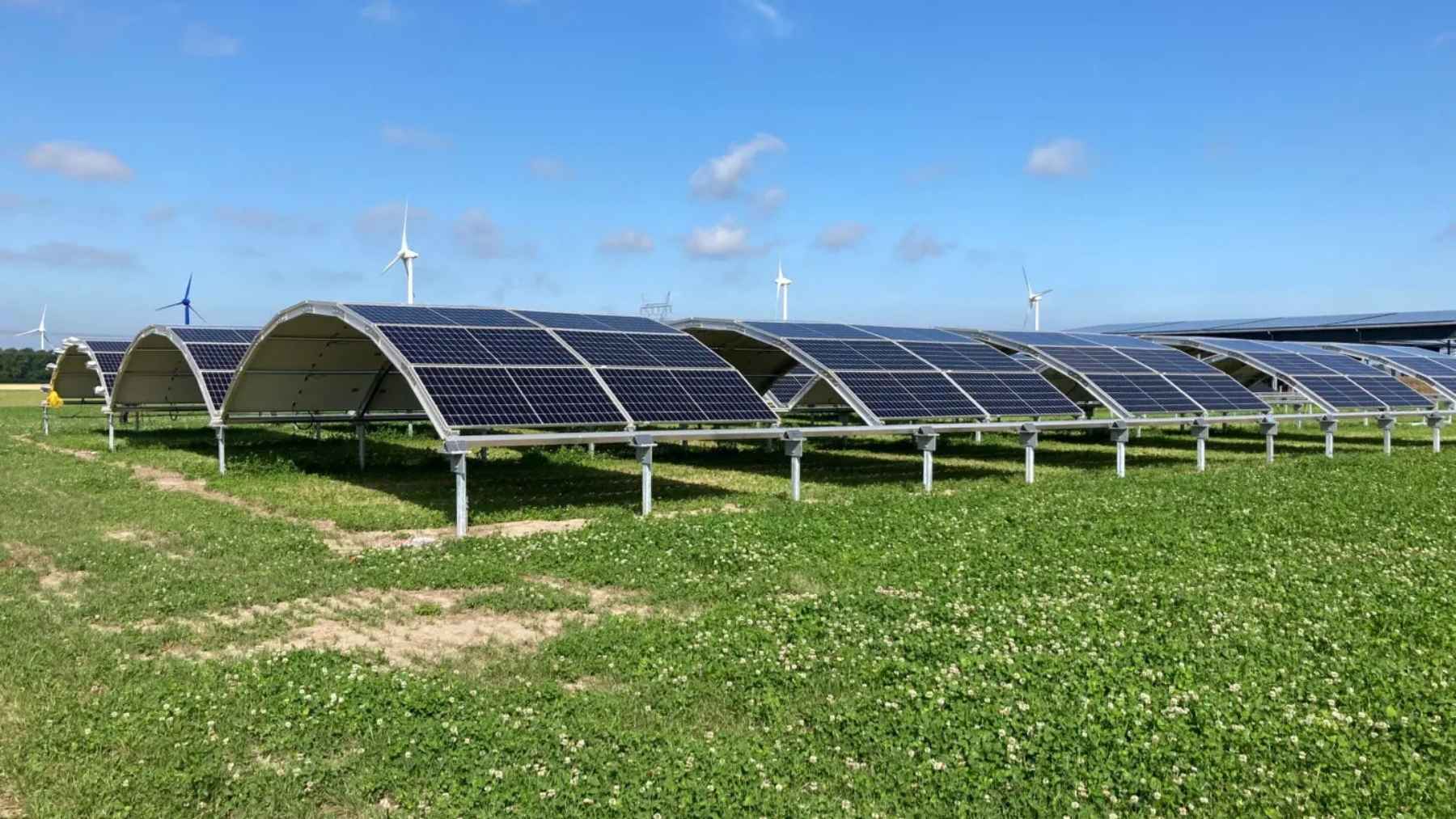
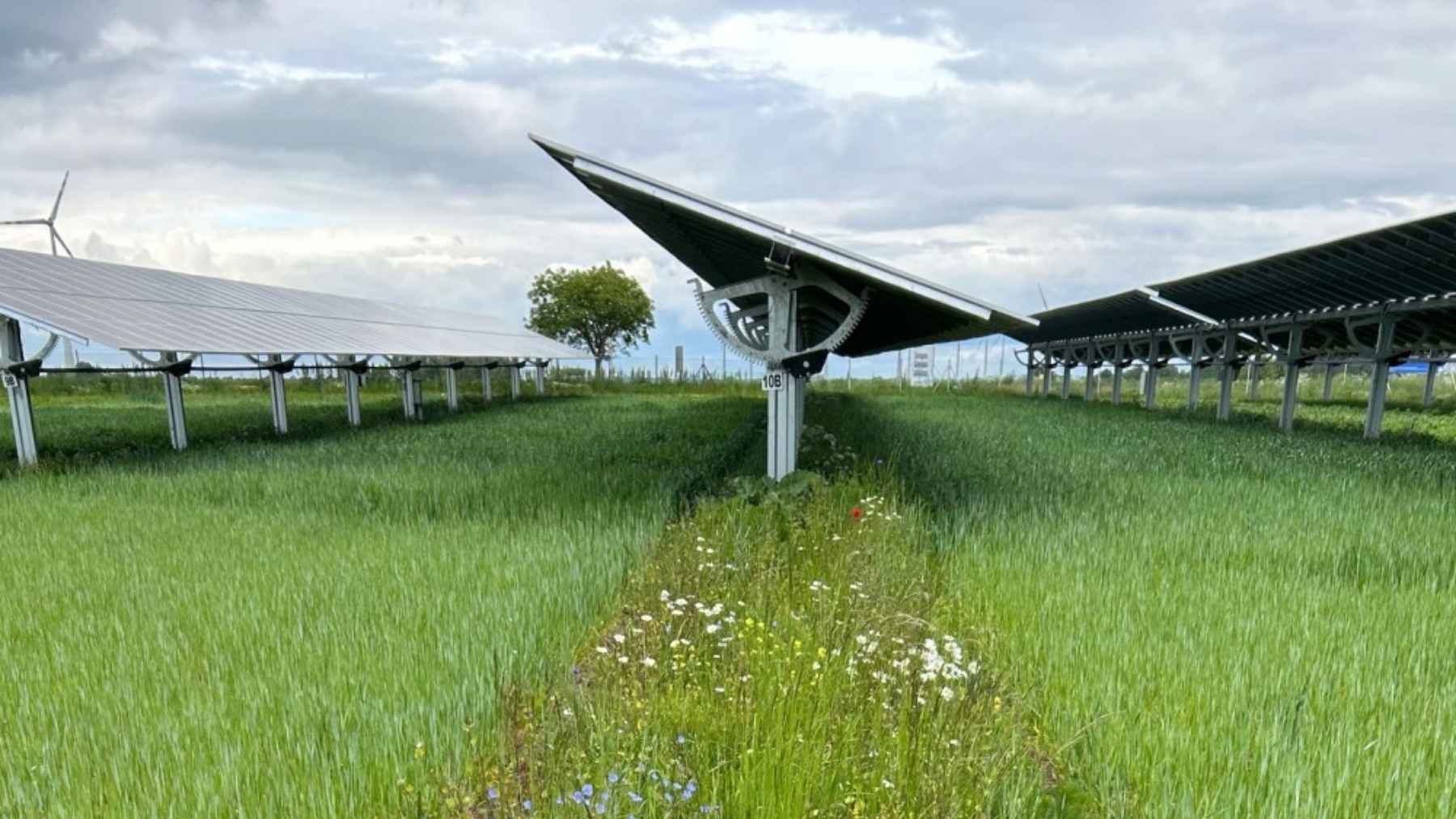
The Bruck an der Leitha site is built around tracker tables. They’re rows of panels on east-west axes that tilt toward the sun in the morning and follow it across the sky until evening, the way trackers do on any modern solar farm. The difference is what happens when the farming starts. The farmer can set every table flat, so seeders and sprayers pass through without clipping anything. At harvest time, neighboring rows fold away from each other by up to 70 degrees, opening a lane for the tractor and the combine to drive down. The rows don’t get tall, either, topping out around 9.2 feet (2.8 meters).
Machinery clearance is arguably the problem that decides whether agrivoltaics works at all. A modern combine is a tall, wide, expensive box, and glass is glass. Most projects solve the conflict with height, like the Spanish olive bottler raising its panels 13 feet over a grove because the harvester underneath stands 11.5 feet at full stretch. EWS went the other way. It left the hardware low and made the glass move out of the machine’s path instead, and that’s frankly a tidier answer than building a steel forest over a wheat field.
The widest lanes keep winning
This isn’t a commercial farm, it’s a research field, so the geometry varies on purpose. The tracker rows stand on three different spacings, leaving cropping strips about 20, 30 and 39 feet wide (6, 9 and 12 meters) between them, and the University of Natural Resources and Life Sciences Vienna, which everybody calls BOKU, has been following the harvests since the array went on the grid in 2022.
The pattern so far favors room. In 2024, wheat in the 20-foot and 30-foot strips came in close to the open-field control, while the 39-foot strips beat the control by about 10 percent. In 2026, those same 39-foot strips beat the control by 14 percent, and this time the comparison ran through a drought. EWS credits the partial shading: the panels throw a moving band of shade across each strip through the day, which the company says keeps soil moisture up and takes the edge off heat.
Here’s the plain-language version of why that can matter. When a wheat plant gets hot and short on water, it closes the pores in its leaves to stop losing moisture, and a plant with closed pores basically isn’t making grain anymore. A few hours of traveling shade each day keeps the ground damper and the plant cooler, so in a scorching summer it can keep filling kernels while the unshaded field next door quits early. That’s the mechanism EWS is pointing at, anyway.
Now for the hedges, because this is a company reporting its own result. The 14 percent is EWS’s figure. The harvest weights behind it haven’t been published, so there’s no bushels-per-acre number I can hand you, and BOKU is still working through this year’s wheat. They’re due to land in the research project’s final report by the end of 2026. EWS itself says yields hinge on weather, soil, crop type and even the compaction left in the ground by construction crews, which is more caution than you’ll usually get in a press release. I’d pencil the 14 percent in rather than carve it anywhere.
Would the widest lanes still win in a cool, wet year? Nobody can tell you yet, and EWS, to its credit, doesn’t try. A drought is the friendliest possible test for shade, since water stress is exactly what partial shading relieves. The 2024 result hints that the wide strips carry some advantage in an ordinary season too, at around 10 percent, but one field and a few harvests don’t settle anything. That’s what the long BOKU series is for.
The whole experiment fits on 13.6 acres
The field belongs to a landowner named Beppo Harrach, and the array runs as a joint project between EWS and the local Energiepark Bruck. The layout gives 80 percent of the roughly 13.6 acres to crops and 18 percent to flower strips and bee pasture, with about 2 percent lost to posts and hardware, and pv magazine put the array at roughly 3 megawatts when it came online. Austria’s climate and energy fund backed the build as a photovoltaics “lighthouse project,” and that’s the practical reason a field this size carries three row spacings and a control plot. The layout was drawn to produce comparisons as much as kilowatt-hours.
EWS is already running the same layout at scale. Its second site, a 4.58-megawatt field at Pischelsdorf am Engelbach in Upper Austria, keeps its cropping strips at the middle width of about 30 feet, and the company says its soybeans came through the dry summer in good shape. There’s no yield number out of Pischelsdorf yet, though, so the wheat result is the only one on the board with a control plot behind it.
That alone makes Bruck an der Leitha unusual. Most of the agrivoltaic hardware going up in Europe is still waiting on its first weighed harvest, including the French greenhouse over yellow kiwifruit we covered in September, while this field has put four years of harvests in front of BOKU.
EWS published its 14 percent figure on September 24, pv magazine picked it up the next day, and BOKU’s final report on the Bruck an der Leitha field, the one with the checked numbers in it, is due by the end of 2026.