
The cranberry business owns one of the best visuals in American farming, and you’ve seen it: a flooded bog, a couple of growers standing in it up to their waists, and a few million berries floating around them like a red ball pit. Ocean Spray has built decades of commercials on that picture. Last fall in Plympton, Massachusetts, part of that flood happened somewhere the commercials haven’t caught up with yet, under 8,060 solar panels tracking the sun 10 feet overhead.
And because the farm behind it files paperwork with the state, we now have the thing that’s been missing from pretty much every agrivoltaic project we’ve covered this year: a real harvest number. The annual report filed with the Massachusetts Department of Energy Resources logs the first crop under the panels at 325 barrels, against the 400 barrels the same bogs were expected to produce without them.
A barrel, if you don’t speak cranberry, is the industry’s unit for 100 pounds of fruit. That’s 32,571 pounds of berries. They came off the vines between late October and early November, and it’s about a fifth short of the open-field benchmark.
Hard harvest numbers are the scarce commodity on this beat. A sweet corn field in Hadley gave us one of the few others, at about 80 percent of its open rows, and most projects never publish one at all. This one comes with a winter attached, and it turns out the glass wasn’t the biggest problem.
So what’s standing over these bogs?
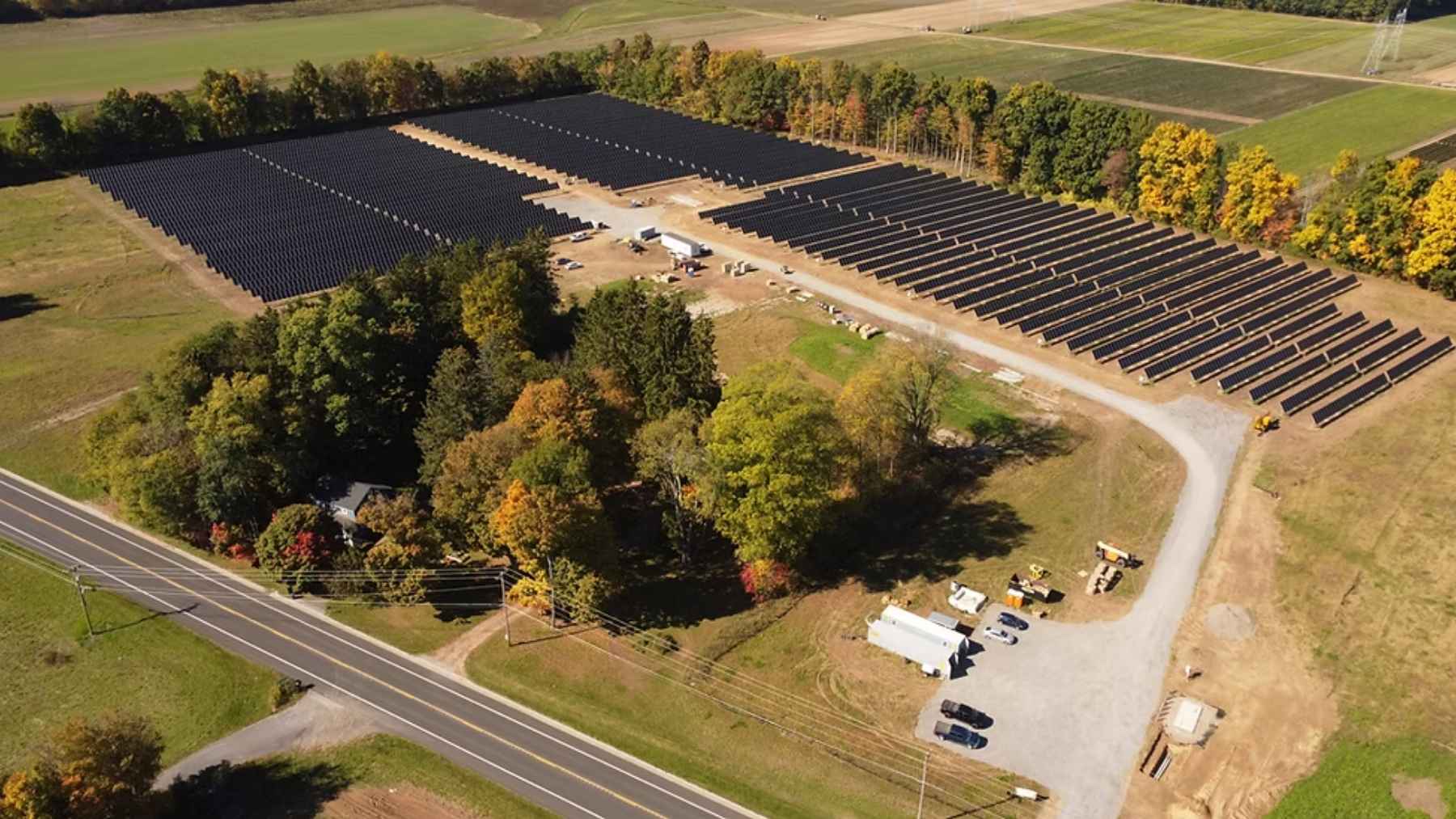
The project is called Ring Road Solar: a 2-megawatt array spread over 45 acres of farmland, with 30.4 acres of working cranberry bog in production underneath. Distributed Energy Infrastructure built it, Greenbacker Renewable Energy owns it, and the vines belong to Soland, LLC, the farm run by grower Iain Ward.
The build itself is my favorite section of the filing. You can’t just drive heavy machinery onto a cranberry bog, because a bog’s basically soft, wet ground, and compacting it stresses the vines for years afterward. So crews pre-drilled every pile hole 4 feet down so lighter pile drivers could finish the job, laid plastic matting under anything that had to cross the vines, and installed the torque tubes and all 8,060 panels by hand, off ladders. Machinery tends to drive the design in this niche, the way a straddle harvester set the panel height over a Spanish olive grove. Here the machines had to tiptoe instead.
The panels are 550-watt units on single-axis trackers, split 5,746 and 2,314 between the two bogs, and the rows sit 23 feet apart. Two sections got experimental spacings of 19, 22 and 25 feet instead, because the UMass Cranberry Station put sensors in these bogs and tracked vine health under each gap through 2024 and 2025. Row spacing’s arguably the live question over any crop, and a Bavarian hop farm already learned the expensive version of that lesson.
I can’t tell you which cranberry variety is under all that steel, because the filing doesn’t name it. UMass’s own shading pilot ran on ‘Stevens’, a common commercial variety, but that experiment used plywood sheets standing in for panels.
Is 325 barrels any good?
The February before that harvest dropped to 2°F, and a UMass Cranberry Station alert that spring described winterkill showing up on bogs across southeastern Massachusetts, with some growers estimating their crops down by as much as 30 percent. Stressed vines take cold the worst, the report notes, and these vines had just been through a construction season.
The damage split the site in two. The southerly bogs produced no harvestable fruit, only about 40 percent of the northerly bogs could be picked, and every one of the 325 barrels came off that 40 percent.
Construction didn’t help either. The original application anticipated no cranberry crop at all in year one if the build ran into the growing season, and it did, all the way through. These bogs had also sat uncultivated until work started in 2023, according to a February announcement from the builder. Read against all of that, 325 barrels off a freeze-burned site in its first season looks pretty respectable to me.
The fruit graded out decently too, from the looks of things: about 25 percent of the harvest sold as premium fresh fruit, and the other 75 percent went to processing.
This year’s crop gets picked dry
So why flood a bog at all?
Cranberries have small air pockets inside, and that’s why they float. Knock them off the vine in a flooded bog and you can herd the whole crop across the water with a boom instead of gathering it off the ground. More than 90 percent of the crop gets harvested that way, according to the Cape Cod Cranberry Growers’ Association, and wet berries go to juice, sauce and dried fruit. Only dry-picked berries get sold fresh.
Ring Road’s first harvest used both methods, and the filing doesn’t break down how the 325 barrels split between them, in case you’re wondering. This year’s harvest goes entirely dry, with the same equipment. Given that only dry-picked fruit sells fresh, you can see where they’re aiming. The crews also pruned the vine canopy during last fall’s dry pass, which the filing expects to raise fruit quality this season.
Two more changes are already in. About 10 acres, roughly a third of the bog, gets mowed this year instead of harvested, to push the vines into denser regrowth, and the farm automated its two irrigation pumps so the water goes on in the early morning, when less of it evaporates before the plants get to it.
The filing also puts a number on what the panels alone are expected to cost in a normal year: a projected 750 barrels with the array against 1,000 without it. Both figures are estimates on a form, not measurements, and the 10 mowed acres won’t add a berry to either one.
The Massachusetts picking window runs from mid-September into early November, so the second harvest under these panels is getting started right about now. Ring Road goes into it picking dry and chasing 750 barrels.