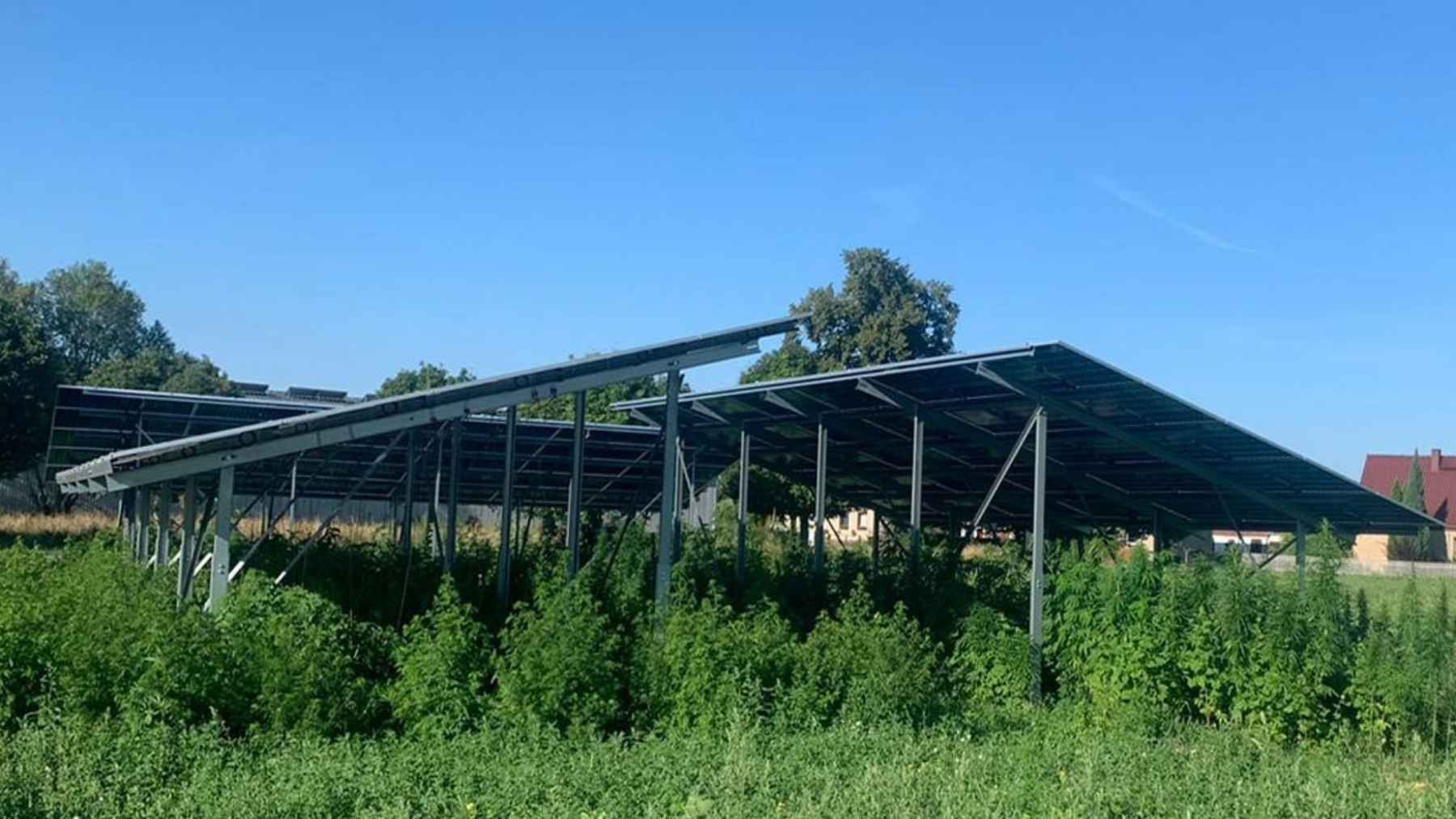

Agrivoltaics has settled into a fairly boring formula. Lift the panels high enough to drive a tractor under them, plant something that tolerates shade, then collect money twice off the same acre. Germany has been doing this long enough to have written a technical standard for it.
What SUNfarming wants to test in North Rhine-Westphalia breaks the formula in one specific way. There is no soil.
The company said on August 15 that it is developing and testing hydroponic growing systems under Agri-PV arrays, working with TH Köln and NourTec GmbH. Lettuce roots sitting in nutrient water, under glass-glass modules, on land that German law still has to classify as a farm.
That last part is where this gets interesting, and nobody in the announcement wanted to talk about it.
This is month 18 of a three-year project, not a launch
SUNfarming’s post reads like news. It is closer to a progress update.
TH Köln’s official project page lists CircularFarming.IN.NRW as running from March 2025 to February 2028, with SUNfarming and NourTec as the two industrial partners. The work is split across two faculties and two institutes, led by Prof. Mohieddine Jelali at the Cologne Lab for Artificial Intelligence and Smart Automation and Prof. Miriam Sartor at the Circular Transformation Lab in Gummersbach.
The project sits under NRW’s GreenEconomy.IN.NRW competition and draws on the state’s ERDF and Just Transition Fund programme, which carries roughly 1.9 billion euros of EU money inside a total investment volume of about 4.2 billion once state co-financing and project owner contributions are stacked on top.
None of that is a research grant for one lettuce shed. It is a regional industrial policy budget, and CircularFarming is a small line item inside it.
Hydroponics is water-smart and electricity-stupid
The obvious objection to putting hydroponics under panels is that hydroponics is already a controlled environment. Why bother shading it?
Because the power bill is brutal. Pumps run continuously, nutrient dosers run continuously, climate control runs continuously, and any supplemental lighting runs on top of all of it. A Chinese-Qatari team that modeled solar-assisted hydroponic farms told pv magazine back in 2021 that these systems are water-efficient but “not an energy-efficient solution.”
More recent work put actual numbers on the gap. A 2025 study in Scientific Reports compared a grid-powered hydroponic lettuce system against one running on PV and treated greywater. The solar version needed 6.14 megajoules per kilogram of lettuce. The grid version needed 14.89, and the solar setup cut carbon dioxide emissions per square meter by more than 94%.
Wire the crop straight to the array above it and a chunk of that energy problem goes away, along with the transmission losses you eat pulling the same electricity across a substation.
Lettuce actually wants the shade
The second half of the pitch is agronomic rather than financial. Leafy greens hate full July sun, and a partial canopy of modules delivers a cooler, more diffuse light environment than an open field does.
That effect is well documented at this point. Raised arrays over Arizona vegetable beds measurably drop temperatures underneath, and the relationship runs both ways, since panels lose efficiency as they heat up.
Hydroponics adds a control layer on top. A nutrient bed already carries sensors reading temperature, humidity, pH, conductivity and light. Tie those readings to the array overhead and the crop can drive its own environment, calling for supplemental LEDs when the modules shade too hard and pumps when the root zone dries out.
Japanese operators have been working the same loop from the other direction, rotating panels edge-on over rice so the crop gets its light back during the growing season. Nobody has published equivalent numbers for a soil-less bed under a German array, which is roughly the point of the exercise.
Who owns SUNfarming matters here
The company gets described as a German family firm, which was accurate until it wasn’t.
SUNfarming was founded in 2004 in Erkner, Brandenburg by Peter Schrum and Martin Tauschke, and says it has delivered more than 700 MW across over 1,300 sites. In November 2024, I Squared Capital’s renewables platform Cube Green Energy agreed to acquire control, with the founders keeping a minority holding and staying in post. I Squared said it was targeting more than 500 million euros of deployment by 2028 against an Agri-PV pipeline approaching 2 GW.
So the entity researching lettuce beds in Cologne is majority-owned by a Miami-headquartered infrastructure investor. That is not a criticism, it is context for how fast this research is likely to turn into hardware if the numbers land.
The scale on the other side of the business makes the point. SUNfarming began construction this spring on the Steinhöfel Klimapark in Brandenburg, a 753 MWp agrivoltaic park spread across roughly 1,236 acres and eight districts, with permits in hand for the first 550 MWp and an EEG auction award covering the opening 106 MWp phase.
German law has no clean box for this
Here is the part the press release skips.
Germany does not let you call something a farm because you parked a goat under a solar panel. DIN SPEC 91434 sets the standard the EEG references, and it requires that agricultural production stay the primary use of the land, delivering at least 66% of a reference yield. Separately, the CAP direct payments rules say at least 85% of the area has to remain agriculturally usable for the subsidy and the tax status to survive, a threshold the federal agriculture ministry states plainly.
Those rules were written for plants in dirt. A hydroponic bed is a structure sitting on the ground, fed by pumps, growing a crop that never touches the soil beneath it.
Whether German and EU authorities treat that as agricultural use of the land, as an installation occupying the land, or as something in between is an open question, and it is the single largest variable in whether any of this pencils out. We reported how hard that 66% threshold bites when a developer has to prove it at commercial scale. Neither SUNfarming nor TH Köln has published a position on how soil-less systems are meant to clear it.
The physical constraints are not trivial either. SUNfarming builds to DIN SPEC with bifacial glass-glass modules at a minimum clearance of about 6 feet 11 inches, and its structures are specified for small tractors with a 10-foot working width. Fitting growing tanks, plumbing and a nutrient loop into that envelope without blocking the machinery is a real design problem, and steel is what kills most agrivoltaic budgets before anything else does.
The deliverable is software, not salad
The end product here is not a farm. It is a planning tool.
TH Köln is building a model-based planning, simulation and training toolbox that treats vertical indoor farm design as a multi-criteria bioeconomic optimization problem, so a developer can specify a site, a crop and an array layout and get back a system sized to match. Aquaponics is in scope alongside hydroponics. Demonstration and education sites are part of the remit, which is why the project keeps showing up at public workshops in Cologne rather than in yield reports.
That is a slower and less quotable outcome than a working lettuce farm, and it is probably the more useful one. Anybody can build a demonstrator. Handing a farmer in Brandenburg a tool that tells them whether the numbers work on their specific parcel is the thing that turns a research project into an industry.
SUNfarming has until February 2028 to produce it, a 753-megawatt construction site to keep fed, and an American infrastructure fund watching the returns. If the soil-less version clears the regulatory bar, the same company already has the land, the steel and the permits to scale it. If it doesn’t, the panels will keep making money and somebody will plant grass underneath, which is what happens on most of these sites anyway.