
- 3 MONTHS AGO · ENERGYA steel tube of 855 servers came off the North Sea floor wearing barnacles and anemones the size of cantaloupes, with six machines dead against eight of the 135 kept on land, and Microsoft shut the programme down while China put 2,000 of them on the seabed off Shanghai
- 3 MONTHS AGO · ENERGYA 6,560-foot hole in Cornish granite came up with 158-degree water carrying 100 parts per million of lithium, and a well in the same rock pulls 340. So a small British company hired a Texas oilfield crew to sink two more holes and pump for three months
- 2 MONTHS AGO · ENERGYA solar cell built to see only the blue and green light left 33 feet underwater turned 34.7% of it into electricity in the lab, against 17% in full sun, and panels built the same way charged a drone’s batteries at that depth in open sea
- 2 MONTHS AGO · ENERGYA 12-foot bundle of 216 fuel rods tilted over inside the first American reactor being pulled back from decommissioning, after the loading machine had set it in the core and let go, and engineers are now designing tools just to lift that one bundle back out
- TODAY · THIS ARTICLEA 12-foot British drone submarine was put in the water from a quay in Shetland, swam 81 miles out to a dead North Sea oil field by itself, photographed the seabed from 16 feet up while sniffing for leaking oil, and came back to the same harbor to recharge for the next field
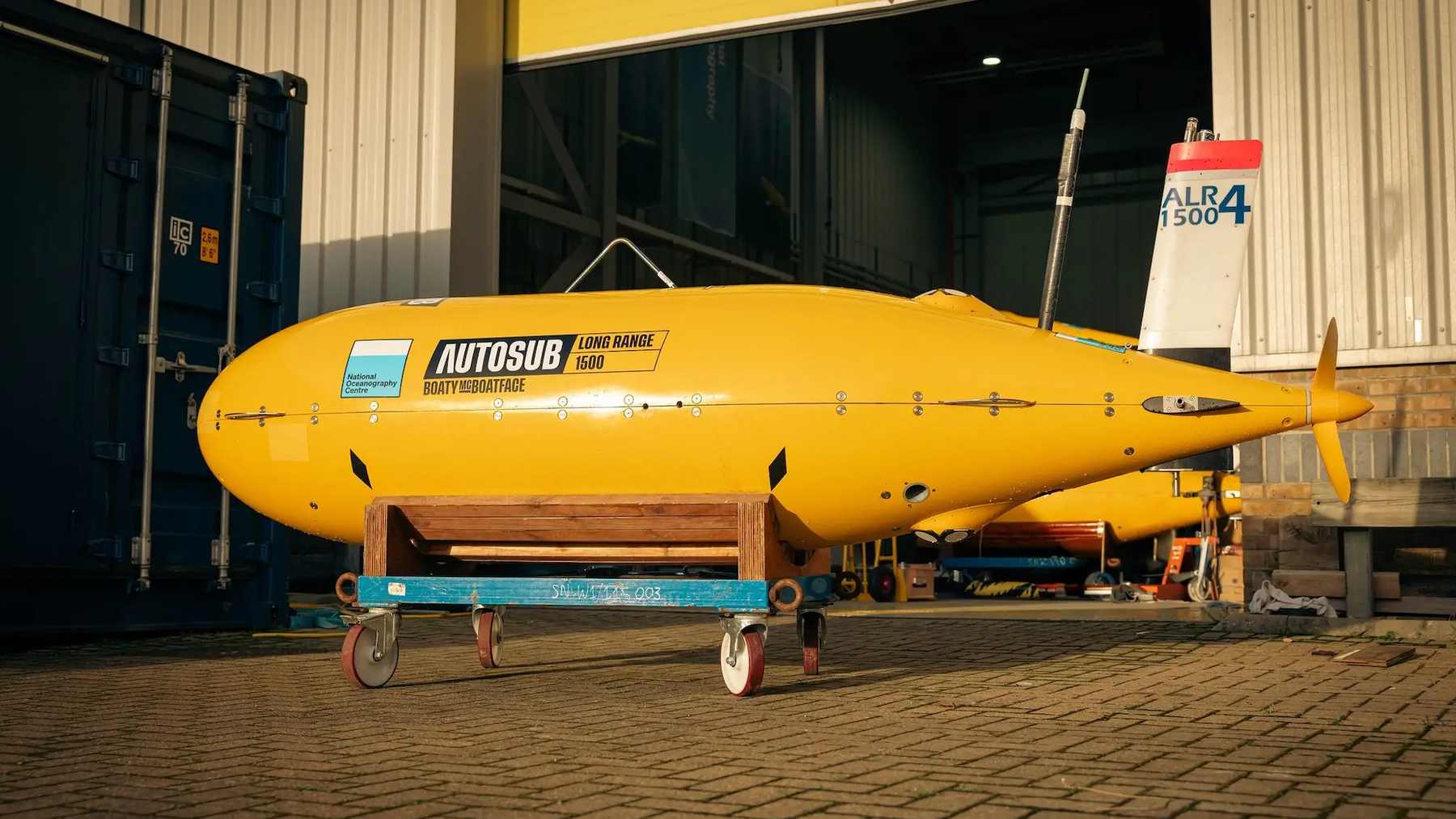
When Britain asked the public to name its new polar research ship, the internet did exactly what you’d expect and voted for Boaty McBoatface. The ship ended up as the RRS Sir David Attenborough, which is a perfectly respectable name for a perfectly respectable ship. But the people’s choice didn’t die. It got handed down to a yellow drone submarine instead.
Most people stopped following the story right there. That’s a shame, because Boaty has done some pretty serious work since. One trip in particular, a few years back, is the kind of thing I’d expect the offshore oil business to care about a lot more than it cares about the name.
So what did a drone with a joke name actually do?
Meet the yellow sub
Boaty’s real name is Autosub Long Range, or ALR, and it’s built and run by Britain’s National Oceanography Centre (NOC). It’s about 12 feet long and weighs roughly 1,500 pounds, according to Energy Voice. The NOC says it can cover around 1,240 miles on a charge, over missions that run for weeks. There are six of them in the fleet, and they all answer to Boaty, which seems fair.
For this job, the sub carried BioCam, a mapping rig from the University of Southampton that uses cameras, lasers and strobes to build 3D pictures of the seafloor. It also had sensors for currents, salinity, temperature and hydrocarbons. Hydrocarbons are basically oil and gas. So in plain English, Boaty was photographing the bottom and sniffing the water for leaks at the same time.
We’ve written about other North Sea survey drones before, like the 132-pound one two people can lift off a tailgate and the 49-foot one that flew over 74.6 miles of pipeline in a single pass. Boaty’s trick is different. It didn’t need anybody to drive it out to the job.
So why would a drone sub need a ship anyway?
Heavy-lift ships get most of the headlines in this business (one 1,253-foot ship lifted a 19,000-ton platform deck in seconds), but when an old field shuts down, the job doesn’t end when the steel’s gone. Decommissioning has to be backed up by an environmental assessment and follow-up monitoring. If some of the structure stays on the seabed, that monitoring can drag on for years.
Usually that means a survey ship, a crew and a lot of diesel. And underwater drones haven’t really fixed that. A University of Southampton project note says these vehicles are normally launched from ships for missions that last less than 24 hours. Which means you’re still paying for the ship. You’ve just added a robot to the bill.
According to the NOC, there are nearly 500 oil and gas structures in UK waters that are close to retirement. If each one needs a ship parked over it every so often, you can see why the industry might want to skip that step.
The trip out to Northwest Hutton
Boaty went into the water in Lerwick, Shetland’s main town, on a Monday morning in the fall of 2022. That was a day later than planned, because a heavy northerly swell pushed the launch back. It was then towed a short way to the north end of Bressay, the island across the harbor, and set off on its own.
Its first stop was Northwest Hutton, a decommissioned field about 81 miles east of Shetland. Once there, the plan was to switch every sensor on and photograph the bottom from about 16 feet up, which the team expected to take several days. Every 24 hours or so, it came up to check its GPS position and check in with the team over satellite.
After that, Boaty was supposed to swim back to Lerwick, get plugged in, have its data pulled off and head out again to Miller, another decommissioned field southeast of Shetland. It also swung by the Braemar Pockmarks, a marine protected area where gas already seeps out of the seafloor naturally. That stop was essentially a test. The team wanted to see whether the sub could reliably pick up gas escaping on its own. If it can, it should be able to flag a leak from old oil gear down the line. Frankly, if you want to calibrate a leak sniffer, that’s a pretty smart way to do it without waiting for something to break.
Dr. Daniel Jones, the project’s science lead, explained the appeal to Shetland News. Launching from shore stretches the sub’s range and lets it hit several sites in one mission, and, in his words, “we don’t need the ship.”
Did it actually work?
Pretty much, yes. The original plan called for about 12 days at sea. According to the University of Southampton, Boaty ended up running two missions across September and October, covering 629 miles over 21 days. It started and finished on the shore in Shetland, with no support ship. If you’re wondering how anyone kept an eye on it, the team tracked it by satellite the whole time.
And here’s where it gets clever. The people running it weren’t in Shetland. BioCam processed its images onboard and sent quality reports up whenever the sub surfaced. So researchers at their desks in Southampton, at the other end of the country, could see if the pictures were any good and change the mission while Boaty was still out at the sites. The photos were sharp enough to pick out single fish and starfish on a seafloor more than 330 feet down.
Then there’s the fuel bill. Boaty runs on rechargeable batteries, but the NOC says the energy it used on those missions was equivalent to two liters of fuel. That’s roughly half a gallon. The NOC works it out to about 1,120 miles per gallon of diesel, and I’d love to see your pickup try that.
The University of Southampton estimates a ship doing the same job would go through anywhere from tens of thousands of liters up to about 100,000, which tops out around 26,000 gallons. Admittedly, that’s the team’s own ballpark. Boaty’s real test was always comparing its data with a standard ship survey of the same sites, and I haven’t been able to find that side-by-side published anywhere.
Jones also told Shetland News he doesn’t think subs like this will ever completely replace ships and people, which is probably the honest take. The weather still gets a vote, as that one-day delay at the start showed.
Has anyone done it again?
Yes, sort of. The NOC ran another fully autonomous, shore-launched survey with an ALR carrying BioCam at Central Fladen, a marine protected area about 87 miles south-southeast of Lerwick, working with Defra, the UK government’s environment department. That one wasn’t an oil field, though. As far as I can tell, the NOC hasn’t published a second decommissioning run like the Northwest Hutton trip.
Still, a name that started as an internet prank now has a day job. NOC Innovations, the center’s commercial arm, announced the Central Fladen survey on December 19, 2023, and it now lists shore-launched seabed surveys of marine protected areas among the services it sells.
 A 1,207-megawatt reactor in Washington state was shut down by hand at 2:49 in the morning after both pumps pushing water through its core tripped five minutes apart, all because one blown fuse knocked out the chillers cooling their drives, and it stayed off the grid for over five daysEnergy · 2 days ago
 Six floating tidal turbines built on a 750-ton Scottish design just got the federal fish permit that sank an earlier company in the Bay of Fundy, where a five-story turbine has sat dead on the seabed since its owner went under and four rail cars full of concrete still mark where another developer mooredEnergy · 1 hour ago
 A 908-megawatt Ohio reactor once ran with a football-sized hole eaten through more than 6 inches of its steel lid by leaking boric acid, leaving a stainless liner three-eighths of an inch thick to hold back 2,155 psi, and its replacement lid came from a plant that never openedEnergy · 3 hours ago