
Compressed-air energy storage is not a new idea, and that is part of what makes the next few months worth watching. The first plant big enough to matter opened in Huntorf, Germany, back in 1978. A second went up in McIntosh, Alabama, in 1991. Then the whole concept more or less sat on a shelf for the better part of 40 years.
The catch was always the same: to turn the stored air back into electricity, both of those plants burn natural gas. A Toronto company called Hydrostor says it has finally engineered that gas burner out of the design, and it is about to test the claim at scale by carving a 500-megawatt battery into the rock under eastern Kern County, California.
No fuel, no lithium, just compressed air and water 2,000 feet down. The project is called the Willow Rock Energy Storage Center, it is permitted by the California Energy Commission, and Hydrostor has said it expects to break ground in 2026.
It is also not a one-off. In May, Hydrostor announced a second 500-megawatt project on the other side of the continent, in Greater Napanee, Ontario. Between the two, the company is betting that a technology almost everybody had written off can do something lithium still struggles with: store eight hours of power in one shot and hand it back, night after night, for half a century.
Willow Rock alone is rated at 500 MW and 4,000 megawatt-hours, enough to keep more than 400,000 California homes running for over eight hours on a single charge. Whether that bet pays off is a question about geology, money, and timing, and lately all three have gotten complicated.
The battery is a hole in the ground
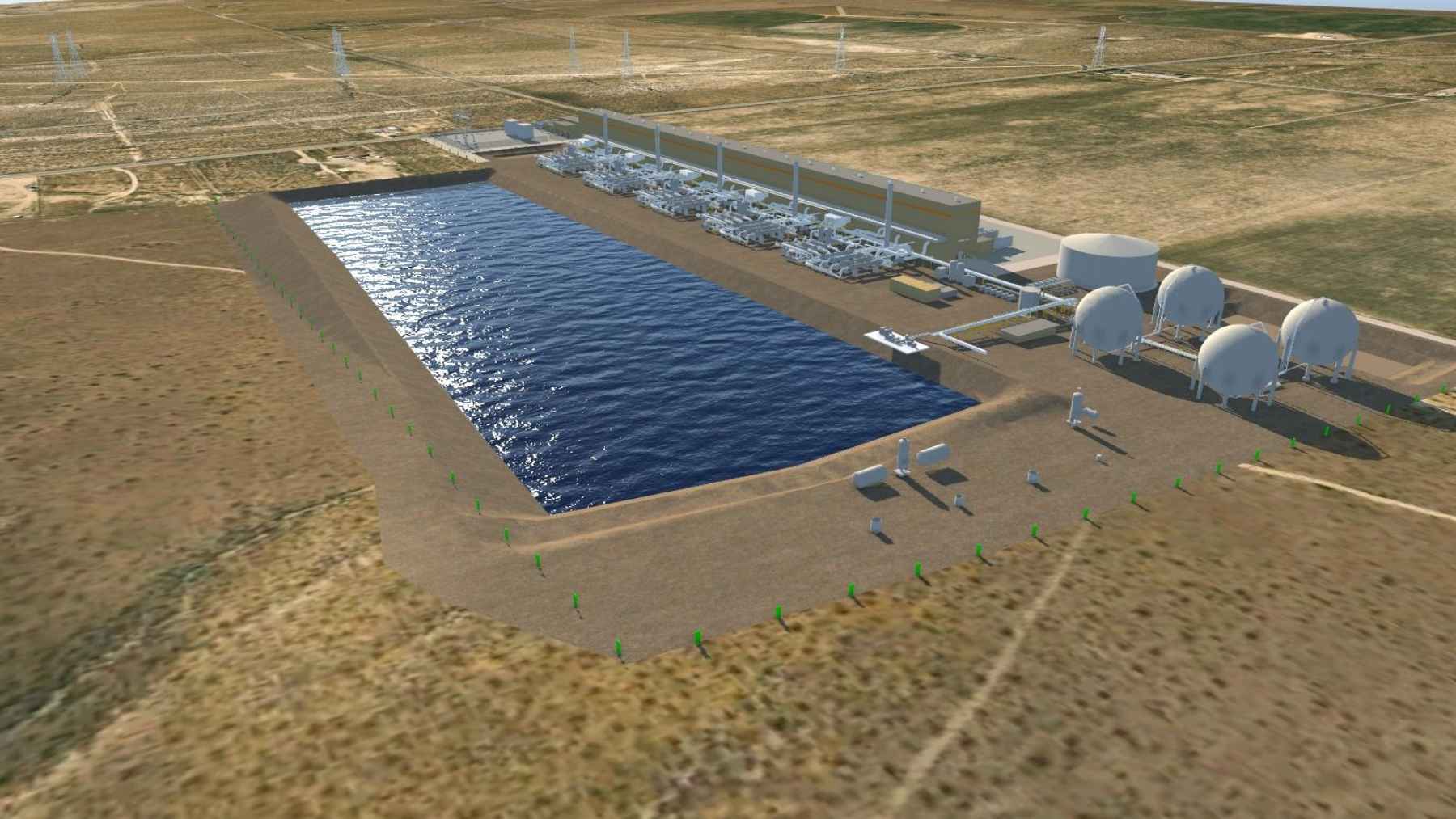
Strip away the jargon and Hydrostor’s system, which it calls advanced compressed-air energy storage, or A-CAES, runs on a principle a kid with a bike pump understands. When there is cheap, surplus power on the grid, usually midday solar that would otherwise be thrown away, the plant runs it through a compressor that squeezes air to high pressure and pumps it into a purpose-built cavern hollowed out of bedrock about 2,000 feet (roughly 600 meters) down.
Later, when the grid is short and prices spike, the air is let back out, expands through a turbine, and spins a generator to put electricity back on the wire. Charge with cheap power, discharge with expensive power. That part is genuinely old.
Two things separate Hydrostor’s version from the gas-burning plants in Germany and Alabama. The first is heat. Squeezing air makes it hot, and traditional compressed-air plants simply let that heat escape, then burn natural gas later to warm the air back up before it hits the turbine. That is why their round-trip efficiency lands somewhere around 40 to 54 percent, and why they are not exactly clean.
Hydrostor captures the heat of compression in an insulated thermal store and reuses it on the way back out, so there is no gas flame anywhere in the cycle.
The second trick is water, and it is the clever bit. A column of water runs from a reservoir on the surface down into the bottom of the cavern. As air gets pumped in, it shoves water up and out. As air gets drawn back out to make power, water flows back down to fill the space. The weight of that water column keeps the air inside the cavern at a constant pressure no matter how full it is, which is what lets the turbines run at a steady output instead of trailing off as the cavern empties.
One Hydrostor executive has described the whole arrangement as an underground water piston, which is about as good a two-word summary as you will get. It is closer in spirit to a pumped-hydro plant, the kind China is currently building up a Tibetan mountain, than to anything with a chemical cell inside it.
Eight hours is the whole point
The reason a Canadian company is digging holes in the Mojave comes down to a mismatch California created for itself. The state has so much solar that wholesale power prices sometimes go negative around noon, then the sun drops right as people get home, switch on the air conditioning, and plug in their cars.
Lithium batteries have gotten very good at covering that evening ramp. Earlier this year, California’s grid batteries pushed more than 12,000 megawatts onto the system at once and covered close to half the state’s demand at the 7 p.m. peak. But most of those installations are built for about four hours of output. After that, they tap out.
Willow Rock is built to run for eight, and that is the gap the state is trying to fill. The California Energy Commission has said California needs as much as 37 gigawatts of long-duration storage to fully retire its gas fleet by 2045, the deadline written into state law. Four-hour lithium does not get there on its own.
Neither does any single project, but an eight-hour, 500-megawatt block that uses no lithium, no cobalt, and no rare earths, just air, water, off-the-shelf turbomachinery, and a hole in the ground rated to last 50 years, is exactly the kind of resource the grid planners keep asking for. It is also the pitch that a wall of Tesla Megapacks in the Australian outback cannot quite make. The lithium does the fast work, but it fades after a few hours and the cells lose a sliver of capacity every cycle.
The money got political
The biggest number attached to Willow Rock is not its capacity. It is the $1.76 billion conditional loan guarantee the U.S. Department of Energy offered the project in January 2025, in the final weeks of the Biden administration. That figure, around $1.5 billion in principal plus capitalized interest, is the largest the federal government has ever put behind a long-duration storage technology, more than three times the previous record, a $504 million guarantee for a hydrogen project in Utah’s salt caverns.
It is worth being precise about what that money is, though, because it is easy to misread. It is not a grant and not a check. It is a guarantee that backs up to 80 percent of the project’s construction cost, and it only pays out once Hydrostor clears a stack of environmental, technical, and financial conditions. None of that has closed yet.
Then the politics arrived. Less than two weeks after the DOE announced the commitment, the incoming Trump administration put it under review along with a batch of other clean-energy loans, and for most of 2025 the Loan Programs Office was tearing up conditional commitments it had inherited. Hydrostor’s survived the cull. It was not on the list of guarantees the DOE moved to cancel, and the budget reconciliation bill signed in July 2025, which gutted the office’s future lending authority, specifically left already-committed deals intact. So the federal backing is still on the table, even if it is not yet in the bank.
In the meantime, Hydrostor has lined up the kind of unglamorous commitments that make a project bankable: a 25-year, $775 million contract with Central Coast Community Energy for 200 megawatts of Willow Rock’s output, a separate 50-megawatt deal signed in February with a group of California community-power agencies, and equity-and-equipment partnerships with the engineering firm Hatch and the energy-technology supplier Baker Hughes.
Ontario is getting one too
The Willow Rock blueprint is now being copied north of the border. On May 13, Hydrostor announced the Quinte Energy Storage Centre near Greater Napanee, Ontario: another 500-megawatt, 4-gigawatt-hour A-CAES project, with later phases on the drawing board that could push it to 8 or even 16 gigawatt-hours.
Ontario is staring at a 12-to-15-gigawatt capacity shortfall by 2035 as old nuclear units come offline, and Hydrostor is pitching Quinte as a way to soak up surplus nuclear power overnight and release it when demand climbs. The project is being developed with the Mohawks of the Bay of Quinte as an equity partner, and the company plans to bid it into a new Ontario procurement, launched in May, that is shopping for up to 800 megawatts of long-duration storage on 40-year contracts.
Add it all up and Hydrostor’s pipeline reads like a company that thinks its moment has arrived: the two 500-megawatt flagships in California and Ontario, a 200-megawatt project under development in New South Wales, Australia, and a global portfolio the company now pegs at more than 7 gigawatts. The one thing the pipeline is short on is operating hardware.
What still has to go right
For all the permits and partnerships and billion-dollar headlines, Hydrostor has exactly one A-CAES plant actually running, and it is tiny: a roughly 2-megawatt demonstration facility in Goderich, Ontario, that has been operating since 2019. Willow Rock is 250 times that size, and it does not exist yet. The company expects to break ground in 2026 and bring it online in 2030, and Quinte’s own timeline points to operation in the early-to-mid 2030s. These are not switches anyone is flipping this year.
The engineering is a real undertaking too, not a press-release rendering. To store four gigawatt-hours, Willow Rock needs a cavern on the order of 650,000 cubic meters carved out of solid rock, roughly a cube the length of a football field on every side, plus shafts, water systems, and pressure testing before a single kilowatt-hour moves.
Critics have pointed out that deep underground civil works of this kind tend to run long and over budget, and that the thing A-CAES has to beat is not standing still. Eight-hour lithium batteries are now a real procurement option, and they keep getting cheaper.
Hydrostor’s counter is that its caverns can be dug across an estimated 80 percent of the country’s geology, that the hardware is mostly standard turbomachinery rather than scarce battery chemistry, and that a 50-year asset wins on lifetime cost even if it costs more up front. Both of those arguments can be true at the same time.
Compressed air has spent nearly 50 years as the storage technology that always seemed about to happen and never quite did. What is different this time is that Hydrostor has the permits in hand, a federal loan that somehow survived a hostile administration, and two 500-megawatt projects on the board instead of a slideshow.
What it does not have yet is a single full-scale plant turning air back into electricity. The first hole still has to be dug in the Mojave, and the lithium box it is trying to outlast keeps getting cheaper while it digs. That is the whole contest, and it gets decided in the rock, not in the renderings.