
Perth has been short on water for a while now. Rainfall in that corner of Western Australia has been dropping, the population keeps climbing, and Water Corporation, the state-owned utility that keeps the city’s water flowing, has been pretty blunt about needing sources that don’t depend on the weather.
So it’s been turning to the ocean. Perth already drinks from two seawater desalination plants, and the newer one, the Southern Seawater Desalination Plant, produces about 30% of the city’s supply on average, according to the utility. A third plant is going up at Alkimos, on the coast north of Perth, and it’s just gotten through one of the trickiest jobs in the whole build.
In its October project update, Water Corporation says crews have connected the first offshore intake riser to the tunnel under the seabed. The center of that riser ended up about 4 inches from the spot engineers had planned for it, roughly 36 feet below the sea floor.
So why does 4 inches matter?
What’s a riser, and why does it have to line up?
A desalination plant needs a steady flow of seawater coming in and a way to send the leftover brine back out. At Alkimos, both jobs run through tunnels bored under the seabed. The intake end works basically like a giant drain. Seawater enters a structure sitting on the sea floor about a mile offshore. It drops down a vertical pipe called a riser and then flows along the tunnel to the plant on shore.
Here’s the catch. The risers and the tunnel were built from opposite directions.
Crews working from a jack-up barge called Beverley set the intake risers into the sea floor, and Water Corporation’s March update says both had been installed and grouted while the tunnel boring machine was still only about halfway along its route. Then the machine had to show up from below and drive through the bottom of those risers.
Basically, you’ve got a pipe planted in the seabed from above and a 577-foot machine grinding toward it through ground nobody can see, steering by laser guidance, sensors and live position readings. Water Corporation credits the accuracy of the tunneling for how close it came. I’d call that a pretty tidy piece of navigation. I’ve missed a wall stud by more than 4 inches with a stud finder and a pencil.
The risers aren’t small, either. RPC Technologies, which built them, says each one is roughly 39 to 46 feet long with an inside diameter of about 6 feet. They’re made from GRP, which stands for glass-reinforced plastic and is basically fiberglass.
Mary and Karli did the digging
Two tunnel boring machines handled the tunnels, and they had names, because tunnel boring machines pretty much always get one. Mary and Karli were each 577 feet long and about 13 feet in diameter, which Water Corporation says is about the length of 15 buses. That’s a unit of measurement I’d never seen before, but I’ll take it.
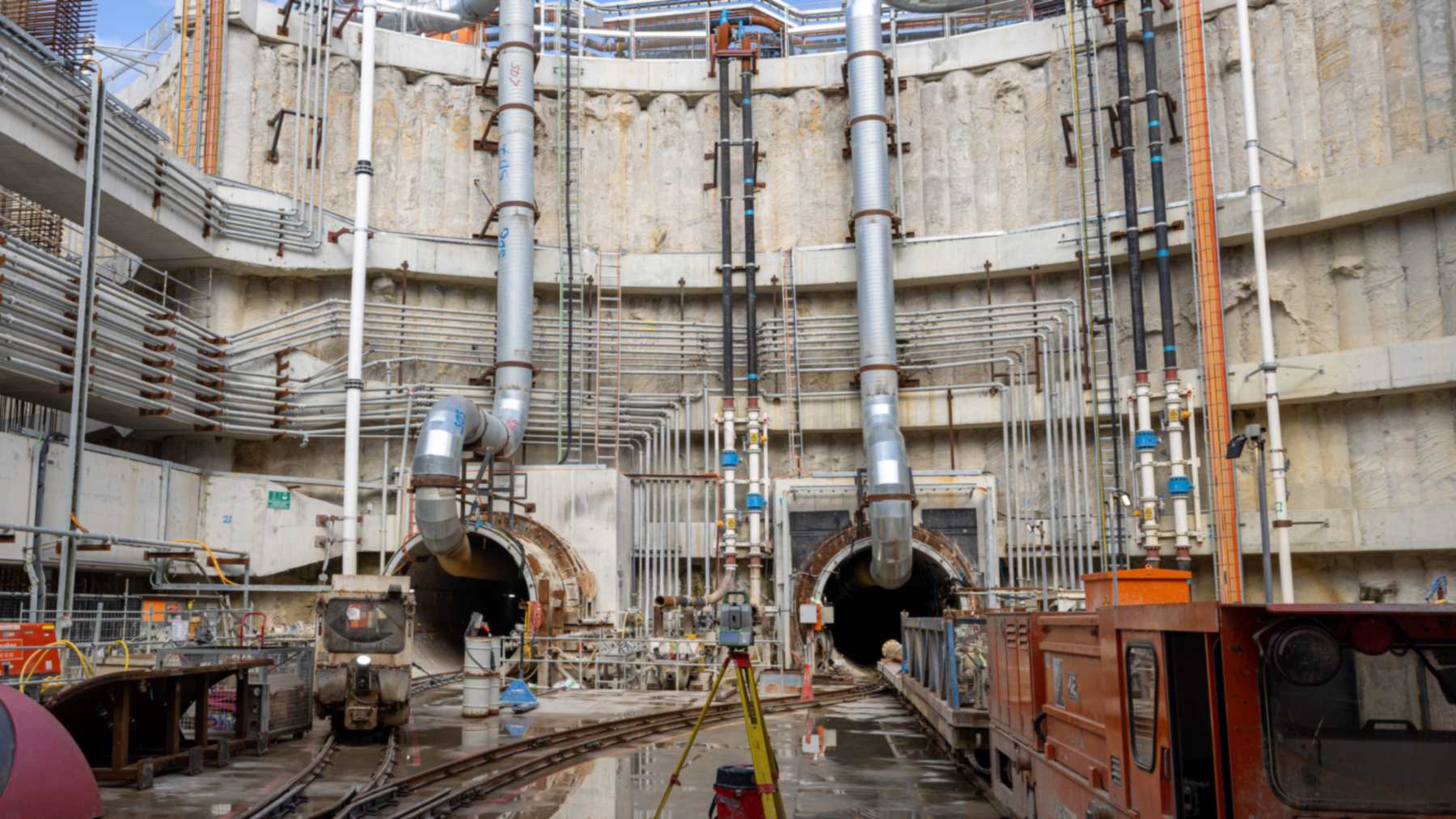
If you’ve never seen one, a tunnel boring machine is essentially a giant rotating cutter head on the front of a very long train of equipment. As it grinds forward, it lines the hole behind it with curved concrete pieces called segments, which lock together into rings. Mary’s intake tunnel took 1,937 of those rings, built from 11,622 segments and about 15,800 tons of concrete.
Each machine carried a crew of 10, with its own workspaces, a meal area and toilets, and small internal trains hauled people, equipment and materials in and out. The machines ran around the clock while crews rotated through 12-hour shifts. That’s a long shift in a steel tube under the Indian Ocean.
Mary took the intake. She started last November, covered about 1.6 miles in 196 days and reached the intake structure at the end of May, running about 39 feet beneath the seabed at her deepest point. Karli got the longer outfall tunnel, about 2.5 miles, and finished it in late August.
Back in May, Water Corporation said the machines were averaging about 59 feet per shift. They’d also set a project record of more than 144 feet in a single day.
The names are arguably the best part. Mary is named after Mary the Prophetess, an alchemist from antiquity whose name is tied to distilling and purifying liquids, which is a pretty fitting pick for a machine that dug a desalination tunnel. Karli is the Whadjuk Noongar word for boomerang, a nod to the Aboriginal people who are the traditional owners of the land around Alkimos.
What I can’t find is a weight for either machine, or the name of whoever built them. As far as I can tell, Water Corporation hasn’t published either detail, which is a little frustrating when you’re writing about a 577-foot machine.
Western Australia Premier Roger Cook called the finished tunnels “an amazing feat of engineering” when the state announced the end of tunneling in September, and the government says no other desalination plant in Australia has longer intake and outfall tunnels.
Why not just run a pipe along the sea floor?
You might be wondering why anyone would go to all this trouble when you could, in theory, lay a pipe across the seabed and call it a day. Water Corporation says it tunneled the pipelines deep under the seabed to keep them away from the dunes, the reef and marine life. So the only hardware you’ll see on the sea floor sits at the ends.
Those ends are two intake structures, each about 39 feet wide and roughly a mile offshore, plus a 427-foot outfall diffuser about 1.9 miles out that spreads the brine back into the ocean. Jack-up barges put them in, and the bigger one, Beverley, is what the state government calls Australia’s largest registered jack-up barge. It weighs about 4,200 tons, stands on 256-foot legs and carries a crane rated at roughly 440 tons.
A jack-up barge is basically a floating platform that lowers its legs to the sea floor and lifts its hull out of the water, so it can work like a temporary island. Beverley left Alkimos on July 28, once the marine work was done.
If you’ve been following our coverage, you’ll remember Las Vegas pulled off a similar trick when it bored a third intake under Lake Mead. That one’s job was chasing a shrinking lake rather than protecting a reef, but the tunneling problem looks pretty similar from where I’m sitting.
There’s still a second intake riser to reach
Mary and Karli aren’t there anymore. Water Corporation says both machines have been dismantled and hauled off site, along with the slurry treatment plant and the water treatment plant that supported the digging. That’s a gentler retirement than the one Snowy 2.0’s Lady Eileen Hudson is getting, since she’s being cut apart half a mile underground.
The connections aren’t finished, though. Crews are now digging toward the next intake riser, according to the October update. Water Corporation hasn’t said exactly when the first connection was made or when it expects to reach the second one. The outfall riser on Karli’s tunnel was also on the list in the utility’s September update, and the October update doesn’t say where that one stands.
On land, Water Corporation expects the walls and roof of the reverse osmosis building to be done by late November. After that, crews can start installing the racks for the membranes that strip the salt out of the seawater.
The Alkimos plant is costing the state 2.8 billion Australian dollars, and Water Corporation says it’s still on track to start producing drinking water in 2028, at about 13.2 billion gallons a year in its first stage.